project: nondominium type: architecture status: active created: 2026-03-25 version: v1.0 design
Nondominium v1.0 — Architecture & Data Model Design
Design session: 2026-03-25 Basis: ValueFlows 1.0 ontology + NDO Prima Materia Scope: Three-zome Holochain DNA — data model, VF compliance, zome boundaries, coordinator signatures
1. Design Principles
1.0 Dual-DNA Architecture (Ground Rule)
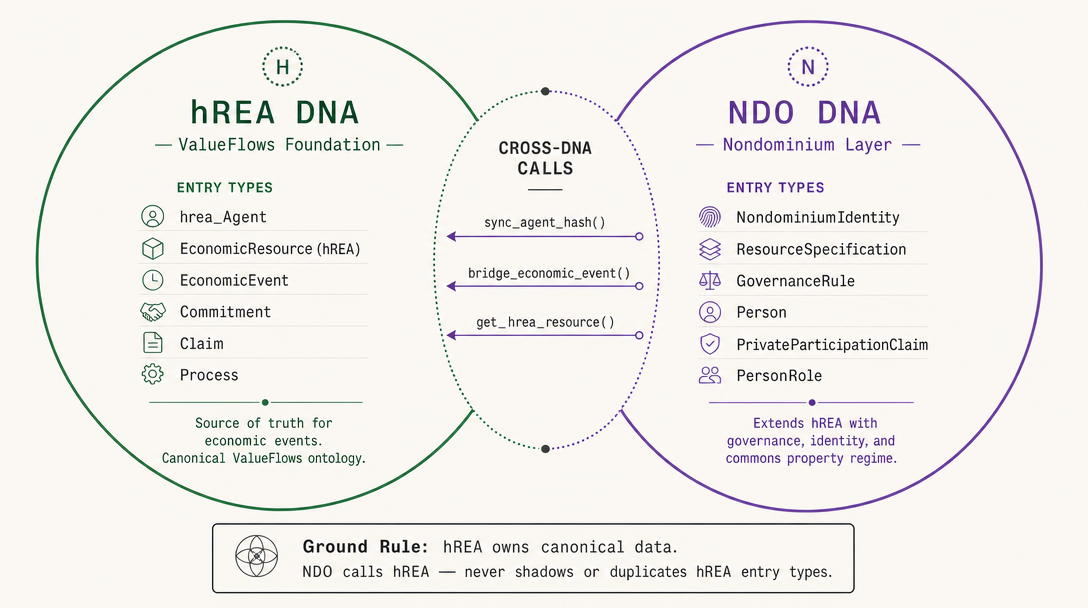
hREA DNA owns all canonical ValueFlows entry types (EconomicResource, EconomicEvent, Commitment). NDO DNA calls hREA via cross-DNA calls — never duplicates VF types. The bridge (sync_agent_hash, bridge_economic_event, get_hrea_resource) is the only coupling point.
Nondominium runs as a dual-DNA hApp — hrea DNA + ndo DNA, both registered as roles in happ.yaml. NDO does not re-implement VF entry types. All VF core types are owned by the hrea DNA. NDO coordinates governance, identity, and accountability on top of hREA via cross-DNA calls (CallTargetCell::OtherRole("hrea")).
| Lives in hREA DNA | Lives in NDO DNA |
|---|---|
| EconomicResource, EconomicEvent | NondominiumIdentity (Layer 0) |
| Commitment, Agreement, Plan | GovernanceRule, CapabilitySlot |
| ResourceSpecification (VF core) | PrivateParticipationClaim (PPR) |
| Process, Intent (post-v1.0) | ValidationReceipt, ResourceValidation |
| ReaAgent, ReaUnit | PrivatePersonData, Person |
| All VF 1.0 types | All NDO governance/identity extensions |
NDO zomes interact with hREA via:
call(CallTargetCell::OtherRole("hrea"), "hrea", fn_name, input)— from coordinator- Storing returned
ActionHashvalues in NDO-side link structures for traversal
hREA dependency: NDO v1.0 depends on hREA reaching a target compliance state. See documentation/hREA/strategic-roadmap.md (Phase 1 gap closure) and documentation/hREA/valueflows-1.0-compliance.md for the full audit. P0 gaps (effortQuantity, vf:Claim) must land in hREA before NDO's full work-event and reciprocity workflows are available.
1.1 VF 1.0 as the Floor, NDO Innovations as the Extension
ValueFlows 1.0 defines the economic ontology. VF core classes are provided by the hREA DNA. Every VF class either:
- Delegated to hREA — NDO calls hREA coordinator functions and stores returned hashes
- Extended by NDO — NDO adds a companion entry type with NDO-specific fields linked to the hREA hash
- Is deferred from v1.0 scope (Intent, vf:Claim as reciprocity — handled by hREA post-Phase 1)
NDO adds above the VF floor:
| NDO Extension | Relationship to VF |
|---|---|
NondominiumIdentity (Layer 0) | Not in VF — resource identity anchor |
LifecycleStage | Not in VF — resource maturity stages |
OperationalState | Replaces VF's string state with typed enum |
PropertyRegime | Not in VF — governance classification |
ResourceNature | Not in VF — Digital/Physical/Hybrid |
GovernanceRule | Not in VF — embedded Ostromian governance |
CapabilitySlot surface | Not in VF — stigmergic attachment |
PrivateParticipationClaim (PPR) | Extends vf:Claim with bilateral signatures |
1.2 Governance-as-Operator (preserve)
zome_resource = pure data model. No business logic.
zome_gouvernance = state transition operator. Reads resource state, evaluates rules, approves or rejects transitions, generates EconomicEvents.
This boundary is non-negotiable. It enables swappable governance without touching the data model.
1.3 Three-Layer NDO (new in v1.0)
Every resource begins as a Layer 0 identity anchor and grows in structural complexity as its social complexity demands:
Layer 2 — PROCESS (EconomicEvents, Commitments, PPRs)
     ↑ activated by NDOToProcess link
Layer 1 — SPECIFICATION (ResourceSpecification, GovernanceRules)
     ↑ activated by NDOToSpecification link
Layer 0 — IDENTITY (NondominiumIdentity — permanent, immutable name+regime+nature+lifecycle)
2. VF 1.0 Class Mapping
Legend: hREA = provided by hREA DNA (cross-DNA call from NDO) · NDO = native NDO entry type · NDO+hREA = NDO extends hREA with a companion entry
| VF Class | DNA | Entry / Mechanism | NDO Zome | v1.0 Status | Notes |
|---|---|---|---|---|---|
vf:Agent | hREA | ReaAgent via cross-DNA call | zome_person | Partial — individual only | NDO also stores AgentPubKey + Person |
vf:EconomicResource | hREA | ReaEconomicResource via cross-DNA | zome_resource | Full (via hREA) | NDO stores returned hash; links to NondominiumIdentity |
vf:ResourceSpecification | NDO+hREA | ReaResourceSpecification (hREA) + ResourceSpecification extension (NDO) | zome_resource | Full | NDO extension holds: category, tags, is_active, image |
vf:EconomicEvent | hREA | ReaEconomicEvent via cross-DNA | zome_gouvernance | Full (via hREA) | NDO calls hREA; stores hash for PPR linkage |
vf:Commitment | hREA | ReaCommitment via cross-DNA | zome_gouvernance | Full (via hREA) | NDO calls hREA; links PPR to hREA Commitment hash |
vf:Agreement | hREA | ReaAgreement via cross-DNA | zome_gouvernance | Full (via hREA) | NDO calls hREA post-Phase 1a (reciprocal fields) |
vf:Claim | NDO | Fulfillment (Rust: Claim — ADR-004) | zome_gouvernance | Partial | NDO fulfillment bridge; hREA vf:Claim = post-Phase 1c |
vf:Process | hREA | ReaProcess via cross-DNA | zome_gouvernance | Basic (via hREA) | NDO Layer 2 activation links to hREA Process hash |
vf:Unit | NDO | Unit | zome_resource | Full | NDO-local for now; may delegate to hREA post-v1.0 |
vf:Intent | — | — | — | Post-v1.0 | Valid VF 1.0 class — deferred; CapabilitySlot path |
NDO: NondominiumIdentity | NDO | NondominiumIdentity | zome_resource | New | Layer 0 permanent identity anchor |
NDO: GovernanceRule | NDO | GovernanceRule | zome_resource | Enhanced | GovernanceRuleType enum (was String) |
| NDO: PPR | NDO | PrivateParticipationClaim | zome_gouvernance | Unchanged | Bilateral cryptographic accountability |
3. Complete Entry Type Specifications
3.1 zome_resource Integrity
Supporting Types (shared)
#![allow(unused)]
fn main() {
#[derive(Clone, PartialEq, Debug, Serialize, Deserialize)]
pub struct QuantityValue {
    pub has_numerical_value: f64,
    pub has_unit: ActionHash, // → Unit entry
}

#[derive(Clone, PartialEq, Debug, Serialize, Deserialize)]
pub enum PropertyRegime {
    Private,       // Full rights bundle; individual ownership
    Commons,       // Non-rivalrous; governance via licensing/attribution
    Collective,    // Cooperative/collective ownership
    Pool,          // Rivalrous shared; custody/scheduling/maintenance
    CommonPool,    // Rivalrous consumable; quota/depletion rules
    Public,        // Public/governmental stewardship; open-access; non-alienable by public body
    Nondominium,   // Uncapturable; contribution-based access; no alienation
}

#[derive(Clone, PartialEq, Debug, Serialize, Deserialize)]
pub enum ResourceNature {
    Digital,   // Software, data, design files, documents
    Physical,  // Material objects, equipment, spaces
    Hybrid,    // Digital twin of a physical resource
}

#[derive(Clone, PartialEq, Debug, Serialize, Deserialize, Default)]
pub enum LifecycleStage {
    #[default]
    Ideation,       // Idea registered, no form yet
    Specification,  // Form defined; design or spec exists
    Development,    // Active work; not yet distributable
    Prototype,      // Working prototype; validation in progress
    Stable,         // Peer-validated; ready for active use
    Distributed,    // Actively used across multiple agents/locations
    Active,         // In active operational use
    Hibernating,    // Temporarily inactive; may be reactivated
    Deprecated,     // Superseded; has declared successor NDO
    EndOfLife,      // Permanently concluded; tombstone only
}

#[derive(Clone, PartialEq, Debug, Serialize, Deserialize, Default)]
pub enum OperationalState {
    #[default]
    Available,         // No active process; ready for use
    PendingValidation, // Initial state; awaiting peer validation
    Reserved,          // Commitment accepted; process not yet started
    InTransit,         // Transport process active (Move/TransferCustody event open)
    InStorage,         // Storage service commitment active
    InMaintenance,     // Repair/modify process active
    InUse,             // Use event open; actively being used
}

#[derive(Clone, PartialEq, Debug, Serialize, Deserialize)]
pub enum GovernanceRuleType {
    AccessRequirement,    // Role/affiliation/capability required for access
    MaintenanceSchedule,  // Maintenance obligations and intervals
    RoleRequirement,      // Specific role required for a given VfAction
    UsageLimit,           // Quantity/time/frequency limits
    TransferCondition,    // Conditions for custody/ownership transfer
    IdentityVerification, // Requires Flowsta cross-app identity (Tier 2)
    EconomicAgreement,    // Unyt Smart Agreement binding (stub; Phase 3)
}

#[derive(Clone, Debug, Serialize, Deserialize)]
pub struct CapabilitySlotTag {
    pub slot_type: SlotType,
    pub attached_at: Timestamp,
    pub label: Option<String>,
}

#[derive(Clone, Debug, Serialize, Deserialize)]
pub enum SlotType {
    Documentation,
    IssueTracker,
    FabricationQueue,
    GovernanceDAO,
    VersionGraph,
    DigitalAsset,
    WeaveWAL,
    FlowstaIdentity,        // IsSamePersonEntry action hash (Flowsta cross-app identity)
    UnytAgreement(String),  // Unyt Alliance network seed
    CustomApp(String),      // Extensible
}
}
Entry Types
#![allow(unused)]
fn main() {
// vf:Unit — first-class unit of measure
#[hdk_entry_helper]
pub struct Unit {
    pub label: String,          // "kilogram", "hour", "each", "piece"
    pub symbol: Option<String>, // "kg", "h", "ea"
}

// NDO Layer 0 — permanent identity anchor for every Nondominium Object
#[hdk_entry_helper]
pub struct NondominiumIdentity {
    pub name: String,
    pub description: Option<String>,
    pub initiator: AgentPubKey,        // Post-v1.0: AgentContext — supports Bot agents and composed collective agents (dual-face model: agent face references this NDO as resource face)
    pub property_regime: PropertyRegime,
    pub resource_nature: ResourceNature,
    pub lifecycle_stage: LifecycleStage, // Only field mutable after creation
    pub created_at: Timestamp,
}
// Immutability rules: initiator, property_regime, resource_nature, name, description = immutable.
// lifecycle_stage = only mutable field. Every update must reference a triggering EconomicEvent hash.
// Deletion: ALWAYS INVALID. NondominiumIdentity entries are permanent DHT records.

// vf:ResourceSpecification — Layer 1 form definition
#[hdk_entry_helper]
pub struct ResourceSpecification {
    pub name: String,
    pub description: String,
    pub category: String,
    pub image_url: Option<String>,
    pub tags: Vec<String>,
    pub is_active: bool,
    // VF 1.0 additions:
    pub default_unit_of_resource: Option<ActionHash>, // → Unit
    pub default_unit_of_effort: Option<ActionHash>,   // → Unit
    pub medium_of_exchange: bool,  // Is this a currency-like resource?
    pub substitutable: bool,       // Can instances be freely swapped?
}

// vf:EconomicResource — Layer 2 physical/digital instance
#[hdk_entry_helper]
pub struct EconomicResource {
    // VF 1.0 compliant fields:
    pub accounting_quantity: QuantityValue, // Committed/on-books quantity
    pub onhand_quantity: QuantityValue,     // Physically available quantity
    pub primary_accountable: AgentPubKey,  // Accountable agent (was: custodian)
    pub custodian: Option<AgentPubKey>,    // Physical custody (may differ from accountable)
    pub conforms_to: ActionHash,           // → ResourceSpecification (required, embedded)
    pub current_location: Option<String>,
    // NDO-specific:
    pub operational_state: OperationalState, // Process condition on instance (REQ-NDO-OS-01)
    pub tracking_identifier: Option<String>, // Serial number, QR code, etc.
}

// Typed governance rule — replaces untyped String rule_type
#[hdk_entry_helper]
pub struct GovernanceRule {
    pub rule_type: GovernanceRuleType,  // Was: String — now typed enum
    pub rule_data: String,              // JSON-encoded parameters (typed per rule_type in Phase 2)
    pub enforced_by: Option<String>,    // Role name string (post-v1.0: GovernanceRoleRef)
}
}
Link Types (zome_resource)
#![allow(unused)]
fn main() {
#[hdk_link_types]
pub enum LinkTypes {
    // Existing discovery anchors (preserved):
    AllResourceSpecifications,
    AllEconomicResources,
    AllGovernanceRules,
    SpecificationToResource,
    CustodianToResource,           // → renamed to AccountableToResource in Phase 2
    SpecificationToGovernanceRule,
    AgentToOwnedSpecs,
    AgentToManagedResources,
    AgentToOwnedRules,
    SpecsByCategory,
    ResourcesByLocation,
    ResourcesByState,              // DEPRECATED → split below
    RulesByType,
    ResourceToValidation,
    ResourceSpecificationUpdates,
    EconomicResourceUpdates,
    GovernanceRuleUpdates,

    // NEW — NDO Three-Layer Links:
    AllNDOs,                   // Anchor → NondominiumIdentity
    NDOsByLifecycleStage,      // LifecyclePath → NondominiumIdentity
    NDOsByNature,              // NaturePath → NondominiumIdentity
    NDOsByRegime,              // RegimePath → NondominiumIdentity
    NDOLifecycleHistory,       // NondominiumIdentity → LifecycleEvent (audit trail)
    NDOToSpecification,        // NondominiumIdentity → ResourceSpecification (Layer 1 activation)
    NDOToProcess,              // NondominiumIdentity → Process (Layer 2 activation)
    NDOToComponent,            // NondominiumIdentity → NondominiumIdentity (holonic composition)

    // NEW — Capability Surface:
    CapabilitySlot,            // NondominiumIdentity → capability target (tag carries SlotType)

    // NEW — VF ResourceState split:
    ResourcesByOperationalState, // OperationalState → EconomicResource (replaces ResourcesByState)

    // NEW — Unit discovery:
    AllUnits,                  // Anchor → Unit
}
}
3.2 zome_gouvernance Integrity
New Entry Types
#![allow(unused)]
fn main() {
// vf:Process — Layer 2 anchor; records the economic activity around an NDO
#[hdk_entry_helper]
pub struct Process {
    pub name: String,
    pub note: Option<String>,
    pub in_scope_of: Option<AgentPubKey>, // Post-v1.0: AgentContext — collective variants carry NDO hash as resource-face reference (dual-face model)
    pub created_at: Timestamp,
    pub finished: bool,
}

// vf:Agreement — set of reciprocal commitments among agents
#[hdk_entry_helper]
pub struct Agreement {
    pub name: String,
    pub description: Option<String>,
    pub parties: Vec<AgentPubKey>,   // Post-v1.0: Vec<AgentContext> — collective variants carry NDO hash as resource-face reference (dual-face model)
    pub created_at: Timestamp,
    pub note: Option<String>,
}
}
Updated Entry Types
#![allow(unused)]
fn main() {
// vf:EconomicEvent — observed economic flow (updated for VF 1.0)
#[hdk_entry_helper]
pub struct EconomicEvent {
    pub action: VfAction,
    pub provider: AgentPubKey,
    pub receiver: AgentPubKey,
    pub resource_inventoried_as: ActionHash,
    pub affects: ActionHash,
    pub resource_quantity: QuantityValue,  // Was: f64 — now VF-compliant QuantityValue
    pub effort_quantity: Option<QuantityValue>, // NEW: labor/effort measure
    pub event_time: Timestamp,
    pub note: Option<String>,
    pub at_location: Option<String>,            // NEW: event location
    pub to_location: Option<String>,            // NEW: destination (transport)
    // VF 1.0 relations:
    pub fulfills: Option<ActionHash>,           // NEW: → Commitment (direct VF link)
    pub realization_of: Option<ActionHash>,     // NEW: → Agreement
    pub triggered_claim: Option<ActionHash>,    // NEW: → Fulfillment (audit bridge)
}

// vf:Commitment — planned economic flow (updated for VF 1.0)
#[hdk_entry_helper]
pub struct Commitment {
    pub action: VfAction,
    pub provider: AgentPubKey,
    pub receiver: AgentPubKey,
    pub resource_inventoried_as: Option<ActionHash>,
    pub resource_conforms_to: Option<ActionHash>,
    pub input_of: Option<ActionHash>,         // → Process
    pub due_date: Timestamp,
    pub note: Option<String>,
    pub committed_at: Timestamp,
    // VF 1.0 addition:
    pub clause_of: Option<ActionHash>,        // NEW: → Agreement
}

// NDO Fulfillment — fulfillment bridge (renamed from Claim for semantic clarity)
// Note: Keeps "Claim" as the Rust type name for backwards compatibility in this zome,
// but semantically acts as a VF fulfillment record.
#[hdk_entry_helper]
pub struct Claim {
    pub fulfills: ActionHash,     // → Commitment
    pub fulfilled_by: ActionHash, // → EconomicEvent
    pub claimed_at: Timestamp,
    pub note: Option<String>,
}

// Existing entries preserved:
// ValidationReceipt, ResourceValidation, PrivateParticipationClaim (PPR — unchanged)
}
Updated Link Types (zome_gouvernance)
#![allow(unused)]
fn main() {
#[hdk_link_types]
pub enum LinkTypes {
    // Existing (preserved):
    ValidatedItemToReceipt,
    ResourceToValidation,
    CommitmentToClaim,
    ResourceToEvent,
    AllValidationReceipts,
    AllEconomicEvents,
    AllCommitments,
    AllClaims,
    AllResourceValidations,
    AgentToPrivateParticipationClaims,
    EventToPrivateParticipationClaims,
    CommitmentToPrivateParticipationClaims,
    ResourceToPrivateParticipationClaims,

    // NEW:
    AllProcesses,              // Anchor → Process
    AllAgreements,             // Anchor → Agreement
    AgreementToCommitment,     // Agreement → Commitment (stipulates)
    AgreementToEvent,          // Agreement → EconomicEvent (realizes)
    ProcessToEvent,            // Process → EconomicEvent
    ProcessToCommitment,       // Process → Commitment
}
}
4. Three-Layer Activation Model
flowchart TD
    subgraph L0["NDO Layer 0 — IDENTITY · NDO-specific (no VF equivalent)"]
        NDO["NondominiumIdentity\nname · regime · nature · lifecycle_stage"]
    end

    subgraph L1["NDO Layer 1 — SPECIFICATION · VF: Knowledge Layer"]
        SPEC["ResourceSpecification\nname · description · category\ndefault_unit · substitutable · medium_of_exchange"]
        GRULE["GovernanceRule\nrule_type(enum) · rule_data · enforced_by"]
    end

    subgraph L2["NDO Layer 2 — PROCESS · VF: Plan + Observation Layers"]
        subgraph VFP["VF Plan Layer"]
            PROC["Process\nname · in_scope_of · finished"]
            COMMIT["Commitment\naction · provider · receiver\ndue_date · clause_of"]
            AGREE["Agreement\nname · parties"]
        end
        subgraph VFO["VF Observation Layer"]
            ERES["EconomicResource\naccounting_qty · onhand_qty\nprimary_accountable · conforms_to"]
            EEVENT["EconomicEvent\naction · provider · receiver\nresource_quantity · fulfills"]
            PPR["PrivateParticipationClaim\n(NDO extension of vf:Claim)\nbilateral signature · 16 categories"]
        end
    end

    Agent(["Agent · VF Observation Layer\nAgentPubKey + Person entry"])

    Agent -->|"create_ndo()"| NDO
    NDO -->|"NDOToSpecification\nactivate_layer1()"| SPEC
    SPEC -->|"SpecificationToGovernanceRule"| GRULE
    NDO -->|"NDOToProcess\nactivate_layer2()"| PROC
    PROC -->|"ProcessToResource"| ERES
    ERES -->|"conforms_to"| SPEC
    PROC -->|"ProcessToEvent"| EEVENT
    PROC -->|"ProcessToCommitment"| COMMIT
    COMMIT -->|"clause_of"| AGREE
    EEVENT -->|"fulfills"| COMMIT
    EEVENT -->|"realization_of"| AGREE
    EEVENT -->|"triggers"| PPR

    NDO -->|"NDOToComponent\n(holonic composition)"| NDO
Activation rules:
- Layer 0 is created first; its
ActionHashis the stable NDO identifier forever - Layer 1 activates via
NDOToSpecificationlink — retroactive activation is supported - Layer 2 activates via
NDOToProcesslink — requires Layer 1 to be active first EconomicResourceinstances link through the Process, never directly to Layer 0- An NDO can contain other NDOs via
NDOToComponent(holonic composition)
Lifecycle Transition State Machine
stateDiagram-v2
    direction LR

    [*] --> Ideation : create_ndo()

    Ideation       --> Specification : Work\n(initiator)
    Specification  --> Development   : Work\n(initiator / AccountableAgent)
    Development    --> Prototype     : Modify\n(custodian + validation)
    Prototype      --> Stable        : Accept\n(N-of-M peer validation)
    Stable         --> Distributed   : Transfer\n(PrimaryAccountableAgent)
    Distributed    --> Active        : (operational use begins)

    Ideation      --> Hibernating : Lower
    Specification --> Hibernating : Lower
    Development   --> Hibernating : Lower
    Prototype     --> Hibernating : Lower
    Stable        --> Hibernating : Lower
    Distributed   --> Hibernating : Lower
    Active        --> Hibernating : Lower

    Hibernating --> Ideation      : Raise\n(return to prior stage)
    Hibernating --> Specification : Raise\n(return to prior stage)
    Hibernating --> Development   : Raise\n(return to prior stage)
    Hibernating --> Prototype     : Raise\n(return to prior stage)
    Hibernating --> Stable        : Raise\n(return to prior stage)
    Hibernating --> Distributed   : Raise\n(return to prior stage)
    Hibernating --> Active        : Raise\n(return to prior stage)
    Hibernating --> Active        : Raise\n(claim — any AccountableAgent\nif inactivity criteria met)

    Active      --> Deprecated : Cite\n(successor NDO required)
    Active      --> EndOfLife  : Consume\n(challenge period)
    Deprecated  --> EndOfLife  : Consume
    Hibernating --> EndOfLife  : Consume

    EndOfLife --> [*] : tombstone (permanent, never deleted)
Transition Authorization Table
| Transition | Authorized by | VfAction trigger |
|---|---|---|
| Ideation → Specification | Initiator | Work |
| Specification → Development | Initiator or any Accountable Agent | Work |
| Development → Prototype | Custodian + governance validation | Modify |
| Prototype → Stable | N-of-M peer validation | Accept |
| Stable / Active → Distributed | Primary Accountable Agent | Transfer |
| Any → Hibernating | Current custodian(s) | Lower |
| Hibernating → [prior stage] | Current custodian(s) | Raise |
| Hibernating → Active (custodian claim) | Any AccountableAgent — inactivity criteria met (governance-configured threshold) | Raise |
| Any → Deprecated | Custodian + successor NDO declared | Cite |
| Any → EndOfLife | Custodian + challenge period elapsed | Consume |
5. Zome Responsibility Boundaries
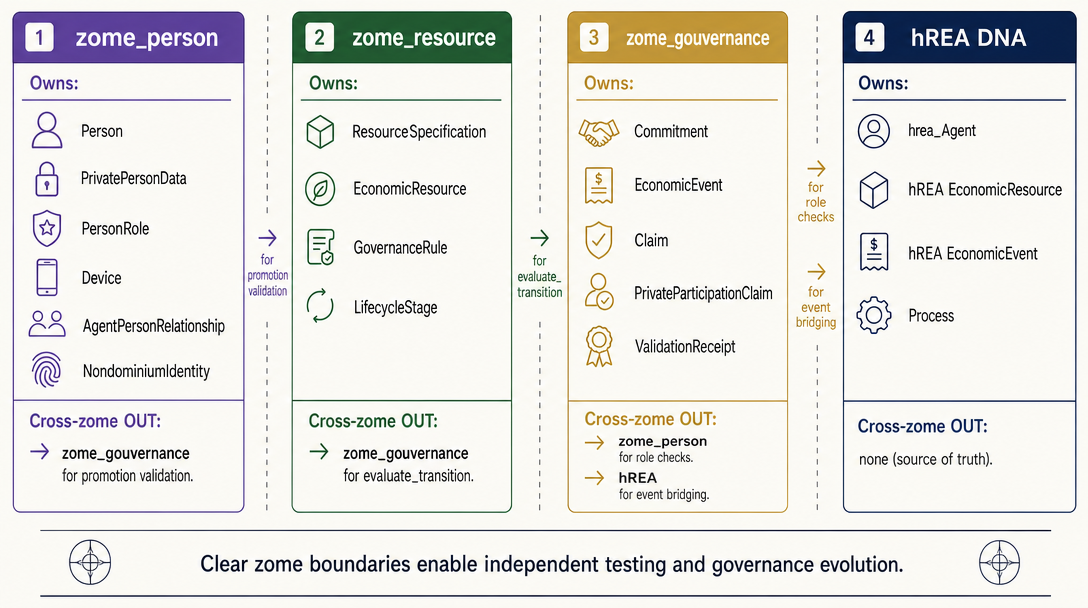
zome_person owns identity and roles. zome_resource owns NDO entry types. zome_gouvernance owns the accountability cycle (Commitment/Event/Claim/PPR). hREA DNA is the source of truth for ValueFlows. Arrows show authorized cross-zome call directions.
hREA DNA — VF Core Layer
Owns: All VF 1.0 core types. Accessed via CallTargetCell::OtherRole("hrea").
- Entry types:
ReaEconomicResource,ReaEconomicEvent,ReaCommitment,ReaAgreement,ReaProcess,ReaResourceSpecification,ReaAgent,ReaUnit, + all other VF types - NDO interacts with hREA only through its coordinator public functions — never reads hREA's source chain directly
- hREA Phase 1+2 roadmap:
documentation/hREA/strategic-roadmap.md
zome_resource — NDO Identity & Extension Layer
Owns: NDO-specific resource data. No business logic. Cross-DNA calls to hREA for VF operations.
- Entry types:
Unit,NondominiumIdentity,ResourceSpecification(NDO extension — category, tags, image, is_active),GovernanceRule - Responsibility: Layer 0 identity anchors, NDO resource spec extensions, governance rule storage, capability slots
- Cross-DNA calls:
create_rea_resource_specification,create_rea_economic_resource(stores returned hashes) - Does NOT: Own VF core types, evaluate governance rules, issue PPRs, approve state transitions
zome_gouvernance — Operator & Accountability
Owns: NDO governance logic. NDO-specific accountability types. Orchestrates hREA economic events.
- Entry types:
Fulfillment(Rust:Claim— ADR-004),ValidationReceipt,ResourceValidation,PrivateParticipationClaim - Responsibility: Receive transition requests. Evaluate GovernanceRules. Call hREA to create EconomicEvents, Commitments, Agreements. Issue PPRs after hREA call succeeds.
- Cross-DNA calls:
create_rea_economic_event,create_rea_commitment,create_rea_agreement,create_rea_process - Does NOT: Create hREA entries without governance evaluation; own VF core types
zome_person — Identity & Privacy
Owns: Agent identity, capability grants, roles, devices.
- No changes in v1.0.
- Post-v1.0: Add
AgentContextunion type,AffiliationRecord.
Cross-DNA + Cross-Zome Call Pattern (governance-as-operator)
sequenceDiagram
    actor Agent
    participant ZR as zome_resource<br/>(NDO — identity/extension)
    participant ZG as zome_gouvernance<br/>(NDO — operator)
    participant ZP as zome_person<br/>(NDO — identity)
    participant HR as hREA DNA<br/>(VF core types)

    Agent->>ZR: request_resource_transition(input)
    ZR->>ZG: cross_zome_call("evaluate_transition", request)

    ZG->>ZR: cross_zome_call("get_governance_rules", spec_hash)
    ZR-->>ZG: Vec<GovernanceRule>

    ZG->>ZP: cross_zome_call("get_agent_capability_level", agent_pub_key)
    ZP-->>ZG: CapabilityLevel

    ZG->>ZG: evaluate rules against request + capability

    alt approved
        ZG->>HR: cross_dna_call("create_rea_economic_event", event_input)
        HR-->>ZG: ActionHash (hREA event hash)
        ZG->>ZR: cross_zome_call("update_resource_operational_state", new_state)
        ZR-->>ZG: ActionHash
        ZG->>ZG: issue_ppr(hrea_event_hash, participants)
        ZG-->>ZR: Ok(hrea_event_hash)
        ZR-->>Agent: Ok(hrea_event_hash)
    else rejected
        ZG-->>ZR: Err(GovernanceViolation)
        ZR-->>Agent: Err(GovernanceViolation)
    end
6. Coordinator Function Signatures (New & Updated)
zome_resource — New Functions
#![allow(unused)]
fn main() {
// Unit management
fn create_unit(input: CreateUnitInput) -> ExternResult<ActionHash>
fn get_unit(unit_hash: ActionHash) -> ExternResult<Option<Record>>
fn get_all_units() -> ExternResult<Vec<UnitRecord>>

// NDO Layer 0 management
fn create_ndo(input: CreateNDOInput) -> ExternResult<ActionHash>
fn get_ndo(ndo_hash: ActionHash) -> ExternResult<Option<Record>>
fn get_all_ndos() -> ExternResult<Vec<NDORecord>>
fn get_ndos_by_lifecycle_stage(stage: LifecycleStage) -> ExternResult<Vec<ActionHash>>
fn get_ndos_by_nature(nature: ResourceNature) -> ExternResult<Vec<ActionHash>>
fn get_ndos_by_regime(regime: PropertyRegime) -> ExternResult<Vec<ActionHash>>
fn update_ndo_lifecycle(input: UpdateNDOLifecycleInput) -> ExternResult<ActionHash>
// UpdateNDOLifecycleInput { original_hash, previous_hash, new_stage, transition_event_hash }

// Layer activation
fn activate_layer1(ndo_hash: ActionHash, spec_hash: ActionHash) -> ExternResult<()>
fn activate_layer2(ndo_hash: ActionHash, process_hash: ActionHash) -> ExternResult<()>
fn get_ndo_layer1(ndo_hash: ActionHash) -> ExternResult<Option<Record>> // latest ResourceSpec
fn get_ndo_layer2(ndo_hash: ActionHash) -> ExternResult<Option<Record>> // active Process

// Capability slots
fn add_capability_slot(input: AddCapabilitySlotInput) -> ExternResult<()>
// AddCapabilitySlotInput { ndo_hash, target_hash, slot_type, label }
fn get_capability_slots(ndo_hash: ActionHash) -> ExternResult<Vec<CapabilitySlotRecord>>
fn get_slots_by_type(ndo_hash: ActionHash, slot_type: SlotType) -> ExternResult<Vec<ActionHash>>
}
zome_resource — Updated Signatures
#![allow(unused)]
fn main() {
// ResourceSpecification now includes VF fields
fn create_resource_specification(input: CreateResourceSpecInput) -> ExternResult<ActionHash>
// CreateResourceSpecInput adds: default_unit_of_resource, default_unit_of_effort,
//   medium_of_exchange, substitutable

// EconomicResource now uses QuantityValue, primary_accountable, conforms_to
fn create_economic_resource(input: CreateEconomicResourceInput) -> ExternResult<ActionHash>
// CreateEconomicResourceInput: accounting_quantity: QuantityValue, onhand_quantity: QuantityValue,
//   primary_accountable: AgentPubKey, custodian: Option<AgentPubKey>,
//   conforms_to: ActionHash, current_location: Option<String>

// State update now uses OperationalState
fn update_economic_resource_operational_state(
    input: UpdateOperationalStateInput
) -> ExternResult<ActionHash>
// UpdateOperationalStateInput { original_hash, previous_hash, new_state: OperationalState,
//   triggering_event_hash: ActionHash }
}
zome_gouvernance — New Functions
#![allow(unused)]
fn main() {
// Process management
fn create_process(input: CreateProcessInput) -> ExternResult<ActionHash>
fn get_process(process_hash: ActionHash) -> ExternResult<Option<Record>>
fn get_all_processes() -> ExternResult<Vec<ProcessRecord>>
fn conclude_process(process_hash: ActionHash, terminal_event_hash: ActionHash) -> ExternResult<()>

// Agreement management
fn create_agreement(input: CreateAgreementInput) -> ExternResult<ActionHash>
fn get_agreement(agreement_hash: ActionHash) -> ExternResult<Option<Record>>
fn get_all_agreements() -> ExternResult<Vec<AgreementRecord>>
fn get_agreement_commitments(agreement_hash: ActionHash) -> ExternResult<Vec<ActionHash>>
fn get_agreement_events(agreement_hash: ActionHash) -> ExternResult<Vec<ActionHash>>
}
7. VfAction — Preserved + Context
The VfAction enum is unchanged in v1.0. NDO-specific extensions (InitialTransfer, AccessForUse, TransferCustody) are preserved. The semantic methods (requires_existing_resource, creates_resource, modifies_quantity, changes_custody) are preserved.
Post-v1.0 addition: corrects → EconomicEvent (correction events) — not yet in scope.
8. PPR System — Preserved Unchanged
The PrivateParticipationClaim (16-category bilateral cryptographic participation receipts) is unchanged in v1.0. It is not a VF class — it is an NDO innovation that extends VF's Claim concept with bilateral accountability.
The PPR PerformanceMetrics struct (timeliness, quality, reliability, communication weights) is unchanged.
ReputationSummary computation is unchanged.
9. Explicit Out-of-Scope for v1.0
| Feature | Reason | Phase |
|---|---|---|
AgentContext union (collective, project, network, bot, external) | Requires governance refactoring across all 3 zomes; collective variants use dual-face model — agent face (AgentContext) + resource face (NondominiumIdentity) linked by ActionHash; multi-sig collective actions post-v1.0 | Post-v1.0 |
AffiliationRecord + AffiliationState derivation | Depends on AgentContext | Post-v1.0 |
| Flowsta Phase 2/3 (governance enforcement of identity verification) | Stub in GovernanceRuleType; UI/governance integration separate | Post-v1.0 |
| Unyt Smart Agreement full integration | Stub in GovernanceRuleType + SlotType; RAVE proof validation separate | Post-v1.0 |
vf:Intent | Valid VF 1.0 class — deferred post-v1.0; extension path via CapabilitySlot surface | Post-v1.0 |
vf:Claim (reciprocity, settlement) | NDO Fulfillment entry (Rust: Claim) has fulfillment semantics; VF reciprocity Claim = post-v1.0 | Post-v1.0 |
ProcessSpecification | Not yet needed | Post-v1.0 |
| Many-to-many flows (multi-custodian) | Architecture requires AgentContext | Post-v1.0 |
| Versioning DAG / digital resource integrity | Separate specification | Post-v1.0 |
| Network and federation governance layers | Requires holonic governance design | Post-v1.0 |
| Non-binary decision mechanisms (conviction voting, quadratic) | Governance extension | Post-v1.0 |
| ZKP proofs for affiliation privacy | Cryptographic infrastructure | Post-v1.0 |
| Dispute resolution mechanism | Beyond PPR category placeholder | Post-v1.0 |
| Frontend updates | Separate work | Separate |
| GovernanceRule typed rule_data schemas (per GovernanceRuleType) | Phase 2 governance work | Post-v1.0 |
10. Architecture Decision Records
ADR-001: QuantityValue as mandatory (not Option)
- Status: Accepted
- Decision:
accounting_quantityandonhand_quantityare required fields onEconomicResource, not Optional. Unit entry must exist before EconomicResource creation. - Rationale: VF compliance. Optional quantity is meaningless for resource tracking. If quantity is unknown, use 0.0 with an appropriate unit.
- Consequence: All EconomicResource creation call sites must be updated. Test fixtures need Unit entries created first.
ADR-002: conforms_to as embedded ActionHash (not link-only)
- Status: Accepted
- Decision:
EconomicResource.conforms_to: ActionHashis embedded in the entry, not expressed only viaSpecificationToResourcelink. - Rationale: VF compliance. Bi-directional: embed on resource (resource knows its spec) + keep link from spec (spec knows its instances). Discovery works both ways.
- Consequence:
conforms_tois required on creation. Cannot have an EconomicResource without a ResourceSpecification.
ADR-003: GovernanceRule.rule_data remains String in v1.0
- Status: Accepted
- Decision:
GovernanceRule.rule_typechanges toGovernanceRuleTypeenum, butrule_data: String(JSON) remains untyped in v1.0. - Rationale: Defining typed schemas for each
GovernanceRuleTypevariant (AccessRequirement params, MaintenanceSchedule params, etc.) is substantial design work beyond v1.0 scope. The enum gives us type-safety on the category without requiring complete schema for each. - Consequence: Runtime validation of rule_data remains the responsibility of the coordinator. Phase 2 will add typed rule_data per variant.
ADR-004: NDO's Claim entry retains name but repurposed as Fulfillment
- Status: Accepted
- Decision: The current
Claimentry (fulfills → Commitment, fulfilled_by → EconomicEvent) is semantically a VF "fulfillment bridge." It is NOT VF'svf:Claim(reciprocity). Rust struct keeps nameClaim; design docs call it "Fulfillment." - Rationale: Renaming the Rust type in v1.0 would be a larger refactor than the value it provides. VF compliance is achieved via
EconomicEvent.fulfills → Commitment(direct field); the bridge entry becomes redundant but is kept for audit trail. - Consequence: Post-v1.0, the Claim entry may be renamed to Fulfillment and VF's reciprocity Claim added as a new entry type.
ADR-005: Process entry type lives in zome_gouvernance
- Status: Accepted
- Decision:
Processentry type is defined inzome_gouvernanceintegrity, notzome_resource. - Rationale: Processes are governed economic activities. Layer 2 activation link (
NDOToProcess) inzome_resourceLinkTypes points to aProcessentry hash inzome_gouvernance— cross-zome ActionHash references are valid in Holochain. - Consequence: The NDO Layer 2 activation is a cross-zome link.
get_ndo_layer2(ndo_hash)in the resource coordinator must make a cross-zome call to retrieve the Process record.
ADR-006: VF core types delegated to hREA DNA, not reimplemented in NDO
- Status: Accepted
- Decision: NDO does not re-implement VF entry types (EconomicResource, EconomicEvent, Commitment, Agreement, Process, ResourceSpecification). All VF core types are owned by the
hreaDNA (registered asOtherRole("hrea")inhapp.yaml). NDO coordinator zomes call hREA functions and store returnedActionHashvalues. - Rationale: Avoids duplication and divergence. hREA is the canonical VF 1.0 implementation. NDO's value is in governance, identity, and accountability layers — not in reimplementing economic primitives. The
vendor/hreasubmodule is already a live runtime DNA in the bundle. - Consequence: NDO v1.0 capabilities are bounded by hREA's current compliance level (~65% VF 1.0). P0 gaps in hREA (
effortQuantity,vf:Claim) must be resolved before NDO's work-event recording and claim-based reciprocity workflows are available. Seedocumentation/hREA/strategic-roadmap.mdfor the Phase 1 gap closure plan.
11. Migration Notes (Current → v1.0)
| Current | v1.0 | Migration |
|---|---|---|
EconomicResource.quantity: f64 | accounting_quantity: QuantityValue + onhand_quantity: QuantityValue | All creation call sites; test fixtures need Unit entries |
EconomicResource.unit: String | Removed (unit is in QuantityValue) | See above |
EconomicResource.custodian: AgentPubKey | primary_accountable: AgentPubKey + custodian: Option<AgentPubKey> | Rename + add physical custody field |
ResourceState enum | OperationalState enum (on EconomicResource) + LifecycleStage (on NondominiumIdentity) | State mapping: Active→Available, PendingValidation→PendingValidation, Maintenance→InMaintenance, Retired→EndOfLife, Reserved→Reserved |
GovernanceRule.rule_type: String | GovernanceRule.rule_type: GovernanceRuleType | All coordinator match arms |
EconomicEvent.resource_quantity: f64 | resource_quantity: QuantityValue | Same as EconomicResource quantity migration |
| No Agreement | Agreement entry in zome_gouvernance | New entry type, new coordinator functions |
| No NondominiumIdentity | NondominiumIdentity entry in zome_resource | New entry type; no existing entries to migrate |
| No Process entry | Process entry in zome_gouvernance | New entry type for Layer 2 activation |
| No Unit entry | Unit entry in zome_resource | New entry type; must be created before EconomicResource |