Nondominium Prima Materia
Status: Normative architecture document — Layer 0 implemented in MVP; Layers 1–2, capability slots, and full governance-as-operator lifecycle remain post-MVP targets
Created: 2026-03-10
Last updated: 2026-06-16
Authors: Nondominium project
Relates to: post-mvp/many-to-many-flows.md, post-mvp/ndo-versioning.md, post-mvp/digital-resource-integrity.md, post-mvp/unyt-integration.md, post-mvp/flowsta-integration.md, lobby-dna.md, post-mvp/project-type-ndo-specifications.md, post-mvp/source-ndo-requirements.md
Implementation reference: documentation/IMPLEMENTATION_STATUS.md (NDO Layer 0 ✅ PR #80; NDO DNA extensions ✅ PR #103; Layers 1 & 2 ❌)
Table of Contents
- What is the Prima Materia?
- Complexity Economics as Architectural Foundation
- Complexity Oriented Programming
- The Three-Layer Model: The Prima Materia
- Resource State Model — Lifecycle & Operational State
- The Surface of Attachment — Capability Slots
- Design Patterns
- DHT Data Structures
- Requirements (including §9.0 Implementation Status)
- Migration from Current Architecture
- Relationship to Other Post-MVP Work
1. What is the Prima Materia?
In medieval alchemy, the prima materia is the primordial, undifferentiated substance that underlies all matter — the formless potential from which everything is made. Before a substance becomes gold, lead, or salt, it passes through the prima materia: an essential, minimal state that carries the capacity to become anything. The alchemists were not simply mystifying chemistry. They were describing a pattern: complex things begin as nearly nothing, and their nature reveals itself progressively through process.
This document borrows that metaphor deliberately. A Nondominium Object (NDO) is the prima materia of the Nondominium system: a minimal DHT structure that carries the potential to become any kind of resource — digital or physical, simple or composite, idea or fabricated artifact — and that grows in structure and function as the resource it represents grows in complexity and social embeddedness.
1.1 The Gap in the Legacy Model — and What Remains
The original flat resource model consisted of two primary entry types:
ResourceSpecification— the type or template of a resource: name, description, category, governance rulesEconomicResource— an instance of a resource: quantity, unit, custodian, location, state
That model is well-grounded in the ValueFlows standard and works well for resources that already exist in a stable, operational form. Its fundamental limitation was that it represented being, not becoming: there was no first-class object for a resource from ideation through archival memory — no placeholder for an idea not yet designed, a project in active development, a design under peer review before any physical instance exists, an artifact in hibernation (distinct from end-of-life), or a record that persists as institutional memory after activity has ceased.
Partially addressed — Layer 0 (MVP, implemented PR #80): NondominiumIdentity is the permanent Layer 0 anchor. It carries LifecycleStage (Ideation through EndOfLife, including Hibernating and Deprecated), PropertyRegime, and ResourceNature. An NDO can be created at Ideation with name and intent only; lifecycle transitions are integrity-validated and discoverable by stage, nature, and regime. The UI implements Lobby → Group → NDO creation and lifecycle transition against this entry type. See documentation/IMPLEMENTATION_STATUS.md §NDO Layer 0.
Still outstanding (this document remains the normative target for these gaps):
- Layer 2 not activated: process entries are not yet linked to Layer 0 via
NDOToProcess. Layer 1 is activated (#132):create_resource_specificationwrites anNdoToSpecificationlink and the spec carries its Layer 0 pointers, so a spec can no longer be created without an NDO parent. Specification assets are still not attached viaDigitalAssetcapability slots (REQ-NDO-L1-06). - Specification richness: Structured project-type know-how bundles (
post-mvp/project-type-ndo-specifications.md) are post-MVP requirements only — the MVPResourceSpecificationentry remains a thin summary (name, description, category, tags). ResourceStateconflation:OnResolved (data layer):EconomicResourceEconomicResource.operational_stateusesOperationalState; lifecycle maturity lives onNondominiumIdentity.lifecycle_stage. Governance-zome transition ownership (REQ-NDO-OS-02/03) remains deferred.- Governance-as-operator for lifecycle: MVP allows only the NDO
initiatorto callupdate_lifecycle_stage. Governance-validated transitions, role authorization per Section 5.3, and automaticEconomicEventgeneration on each transition (REQ-NDO-LC-02, REQ-NDO-LC-03) remain deferred.
The three-layer prima materia model closes the original gap progressively: Layer 0 addresses identity and lifecycle becoming; Layers 1 (form) and 2 (process) will complete the model when linked and enriched as specified in Sections 4 and 9.
1.2 The Intent of the Prima Materia
The prima materia defines a minimal DHT object that:
- Exists as a placeholder from the moment of conception — before the lifecycle phases of design, specification, as well as before any physical instantiation
- Grows in structure progressively — gaining specification, governance rules, assets, and process infrastructure as the resource matures
- Carries a permanent, stable identity — a content-addressed anchor that persists through all transformations, including end-of-life
- Provides a surface of attachment for capabilities that cannot be anticipated in advance — external hApps, governance tools, fabrication queues, issue trackers
- Represents the full lifecycle — from the first spark of an idea to archival tombstone
1.3 The Key Example: Nondominium Itself
The Nondominium hApp is itself an NDO, of a digital type (a computer program). It began as an idea (Ideation), passed through design (Specification), prototype implementation (Development → Prototype), and is now moving toward its first stable release. Its assets are code on GitHub (the location). Its process is the collaborative work of contributors. Its governance rules will be embedded in the code. Its identity is stable across all versions.
When someone starts a hardware design project for a shared CNC machine, they create an NDO (the identity first). When they publish design files and documentation for distributed fabrication (3D models, bill of materials, manuals, etc.), Layer 1 (Specification) is activated. When contributors begin working, Layer 2 (Process) is activated. When the design is mature and being fabricated by many, all three layers are fully active. When the design becomes obsolete, Layers 1 and 2 are archived, but the NDO identity remains — a permanent record that the thing existed, who created it, and what happened to it.
MVP today: Group-scoped
create_ndocreates Layer 0 only. Layer 1 and Layer 2 activation links are not yet in the codebase; lifecycle stage on Layer 0 can still advance independently (see §5.3). Know-how bundle requirements for project-type NDOs are specified inpost-mvp/project-type-ndo-specifications.md.
2. Complexity Economics as Architectural Foundation
The three-layer design of the NDO is not an arbitrary architectural preference. It is a direct consequence of applying complexity economics to the problem of representing resources in a decentralized peer-to-peer system. Three theoretical pillars justify the design.
2.1 Bar-Yam: Complexity Matching
Yaneer Bar-Yam's central thesis in Complexity Rising is that a system's behavioral complexity must match the complexity of the challenges it faces. When the environment's complexity exceeds a system's adaptive capacity, the system fails. Hierarchical command-and-control structures have cognitive ceilings — there is only so much complexity a centralized decision-maker can handle. As the environment grows more complex, decentralized, networked systems with distributed decision-making become necessary.
Applied to DHT data design, this principle has a direct corollary: do not pre-classify a resource at creation time. At the moment a resource is conceived, its full lifecycle complexity is unknowable. A project started as a personal experiment may become a global standard. A community tool may be adopted and fabricated by thousands of people, communities and networks. A hardware design may spawn dozens of forks and regional variants. Committing to a fixed classification at t=0 is the data equivalent of hierarchical overreach — assuming a knowledge of the future that no agent possesses.
The OVN computational model (ovn.world) demonstrates this formally: Finite State Machines, the computational model underlying most fixed-classification systems, require a number of states that grows exponentially with social complexity — quickly reaching numbers exceeding the atoms in the observable universe for even modestly complex communities. FSMs are not inadequate; they are categorically incompatible with governing complex human systems. A resource data model built on fixed state at creation is an FSM in disguise.
The solution is the adjacent possible (Kauffman): at any moment, only the next step is visible. The NDO model respects this by making layer activation a response to rising environmental complexity, not a commitment made at genesis.
2.2 Benkler: Information Opportunity Costs
Yochai Benkler's analysis of commons-based peer production (Coase's Penguin, 2002; The Wealth of Networks, 2006) identifies the primary economic advantage of P2P coordination as lower information opportunity costs. Markets and managerial hierarchies are informationally lossy — they filter, aggregate, and approximate the rich information available in a distributed network. P2P systems process this information with lower loss because agents at the edges of the network can sense and act on local information directly, without routing it through central aggregators.
In the NDO context, this principle justifies the pay-as-you-grow structure of layer activation. Each layer carries a coordination overhead:
- Layer 0 (Identity) has near-zero coordination cost: one agent creates one entry.
- Layer 1 (Specification) has moderate cost: governance rules must be written, assets attached, peer review coordinated.
- Layer 2 (Process) has the highest cost: economic events must be recorded, commitments tracked, PPRs issued, multi-agent consent coordinated.
In a hierarchical system, all resources would bear the full overhead of the richest representation, regardless of their current needs. Benkler's insight says this is wasteful — it imposes coordination costs that exceed the information value returned. The NDO model matches coordination cost to actual coordination demand: a tool lent between neighbors needs no Process layer; a shared fabrication standard being actively developed by a distributed network needs all three.
2.3 Morin: The Seven Principles of Complexity
Edgar Morin's seven principles of complex thought, applied in the Sensorica complexity economics framework, provide a philosophical grounding for the NDO's structure. Each principle finds direct expression in the design:
| Morin's Principle | Expression in the NDO |
|---|---|
| Systemic (interdependence) | Every NDO exists in relation to agents, processes, and other NDOs; its identity is defined by its links, not its content alone |
| Holographic (part reflects whole) | Every NDO carries the full three-layer potential, regardless of its current activation state |
| Retroactive (feedback loops) | Lifecycle stage changes are triggered by economic events (outputs of the system feeding back as inputs) |
| Recursive (products as producers) | A project-type NDO (representing a resource in development, going through life stages from idea to design, to prototype, to stable) produces NDOs representing its outputs; Nondominium-the-hApp produces Nondominium-as-resource |
| Dialogical (antagonisms coexist) | The NDO holds the tension between resource and agent, between digital and physical, between stability (identity) and change (process), between public (spec) and private (governance) |
| Reintroduction of the subject | Agent motivation and contribution are first-class: PPRs, custody, and contribution tracking are built into the NDO's process layer |
| Ecology of action | No action guarantees its outcome; the NDO's stigmergic capability surface allows unforeseen capabilities to attach — the system is never fully knowable from the source code alone |
2.4 Holonic Structure
The NDO is a holon in the sense used by the OVN model: an entity that is simultaneously a whole in itself and a part of a larger whole. Arthur Koestler coined the term holon to describe systems where every level of organization is both complete and a component. Holonic systems are characteristic of living organisms, ecosystems, and complex economies.
An NDO is:
- A whole: it has its own identity, specification, and process — it is a complete self-describing object
- A part: it is embedded in networks of other NDOs. for example, a project-type NDO contains Resource NDOs, which contain Design NDOs, which reference Component NDOs
This recursive self-similarity is what makes the NDO fractal. Each NDO carries the same structural potential; the difference between a sub-component and a top-level project is only one of social context and activation state, not of structural type.
See fractal composablity and fractal-composable-resource-architecture.md
3. Complexity Oriented Programming
The NDO's design embodies a programming paradigm that does not yet have a formal name but is emerging in practice. We call it Complexity Oriented Programming (COP).
3.1 The Reductive Paradigm and Its Limits
All dominant programming paradigms share a common epistemological assumption: complexity is a problem to be eliminated through abstraction.
- Object-Oriented Programming (OOP) encapsulates complexity behind interfaces, hiding internal state
- Functional Programming (FP) eliminates side effects, reducing programs to pure transformations
- Procedural programming linearizes execution, replacing concurrency with sequence
These strategies are powerful for building closed, bounded systems where the programmer can anticipate all relevant states in advance. But they break down when applied to open, complex, emergent systems — precisely the kind of systems that P2P infrastructure must support.
The failure mode is always the same: the abstraction boundary becomes a wall that the system's actual complexity cannot respect. Side effects leak through interfaces. State escapes encapsulation. The linear pipeline encounters a feedback loop it was not designed to handle. The FSM reaches a state it was not designed to represent.
3.2 Complexity Oriented Programming: The Inversion
COP inverts the reductive assumption. Instead of hiding complexity through abstraction, COP models complexity faithfully and works with it as the primary material. The vocabulary shifts:
| Reductive Paradigm | Complexity Oriented Programming |
|---|---|
| Single source of truth | Distributed state with coherence protocols |
| Deterministic pipelines | Adaptive feedback architectures |
| Contained side effects | Typed relational events flowing through a graph |
| Static type at creation | Dynamic layer activation in response to context |
| Closed system design | Conditions designed for emergence |
The epistemological shift is from programmer as god (designs a closed, fully known system) to programmer as ecologist (designs conditions, observes what arises). The system is never fully knowable from the source code alone.
3.3 Where COP Already Exists
COP is not invented here — it is being discovered simultaneously in several places:
- Holochain's agent-centric model: there is no global state machine. Each agent runs local validation rules, and global coherence emerges from the aggregate of local actions. The DHT is not designed; it arises.
- ValueFlows/REA: the economic model is not a state machine but a flow of events. Resources do not "have states" in the FSM sense — they accumulate economic events that describe what has happened to them. The past is permanent; the present is an interpretation of the past.
- Actor model concurrency: concurrent entities with private state communicating through asynchronous messages — the distributed system coordinates without shared mutable state.
- Reactive/dataflow systems (FRP, signals): time and context are primary, not afterthoughts. Computation is driven by the flow of values through a graph, not by sequential instruction execution.
- Cellular automata: global patterns emerge from purely local rules. Complexity at the macro level is not programmed; it is grown.
3.4 The NDO as a COP Primitive
The NDO is the fundamental COP primitive in the Nondominium system. Its design embodies COP in every structural choice:
- Layer activation is not a state machine transition — it is a response to rising environmental complexity, designed to allow emergence rather than constrain it
- Capability slots are not predefined interfaces — they are typed relational events that flow through the DHT link graph, allowing unforeseen tools to attach without modifying the NDO entry
- Lifecycle transitions are not deterministic state machine edges — they are feedback arcs driven by economic events (agents' actions feeding back into the resource's representation of itself)
- The tombstone at end of life is not a deletion — it is the permanent memory that the system was alive, respecting the append-only nature of the DHT as a feature, not a constraint
The honest challenge of COP, noted in the complexity_oriented_programming archive: tooling. Debuggers, type systems, and unit tests all assume reducibility. COP requires new verification paradigms — closer to simulation and formal methods than conventional testing. The Nondominium testing strategy relies on Sweettest (Rust, multi-agent) for backend validation; legacy Tryorama tests in tests/ are deprecated.
4. The Three-Layer Model: The Prima Materia
The prima materia is realized in the NDO as a three-layer structure, where each layer corresponds to a different register of complexity and is activated independently in response to the resource's current context.
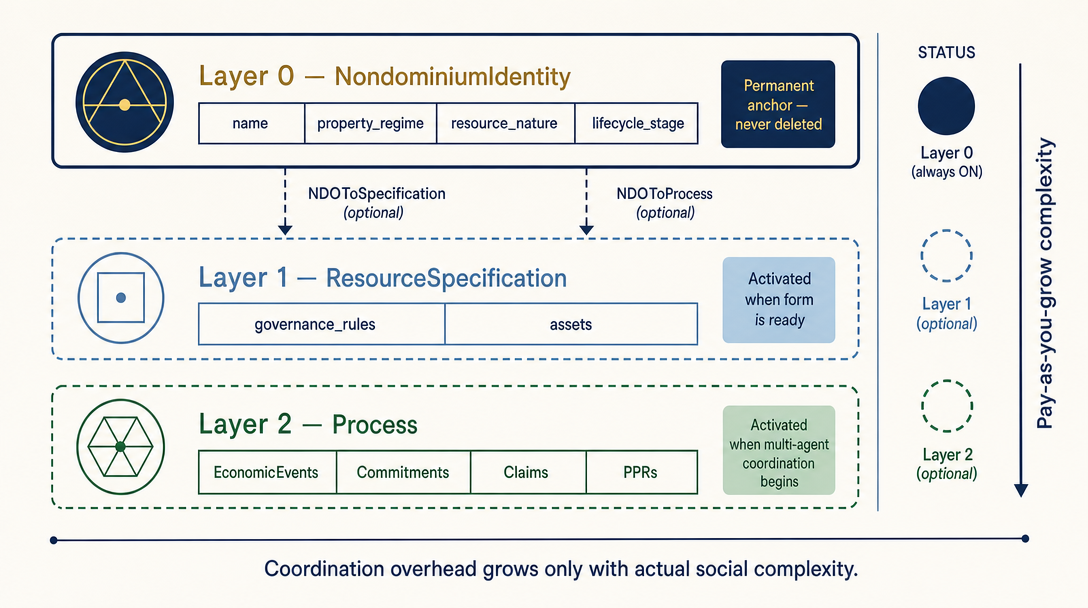
Layer 0 (NondominiumIdentity) is always present — implemented in MVP. Layer 1 (ResourceSpecification via NDOToSpecification) and Layer 2 (Process via NDOToProcess) are normative targets not yet wired in code; each layer adds overhead only when the environment demands it.
4.1 The Brain Architecture Analogy
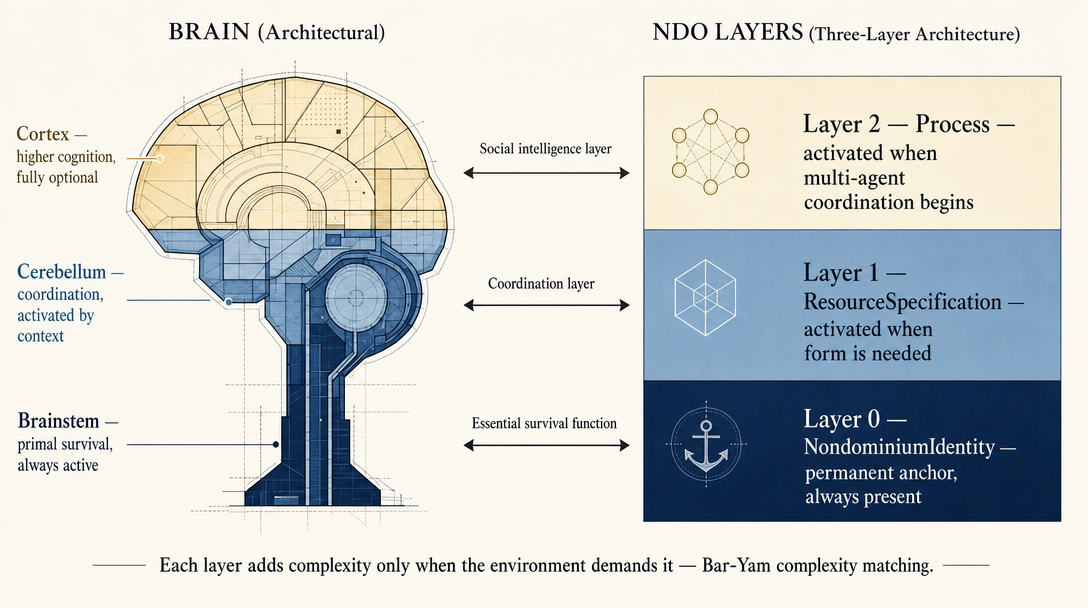
The triune brain evolved in layers: brainstem (always active) → cerebellum (coordination) → cortex (higher cognition, optional). The NDO mirrors this: Layer 0 (permanent anchor) → Layer 1 (specification) → Layer 2 (process). Each layer adds complexity only when the environment demands it.
The human brain provides the most vivid structural analogy. It did not evolve as a single organ — it evolved in layers, each built on and coupled to the previous:
- The brainstem handles vital functions: breathing, heartbeat, arousal. It is always active. The organism cannot survive without it. It is the oldest evolutionary layer.
- The cerebellum handles coordination, posture, and procedural memory — the form of the body's activity. It evolved on top of the brainstem and is coupled to it, but can be understood as a distinct functional layer.
- The cortex handles higher cognition, agency, and deliberate action. It evolved on top of the cerebellum and is the most recently evolved layer. It is situational — not all cognitive tasks require cortical engagement.
This is also a manifestation of path dependency in evolution.
These layers do not replace each other. They are coupled and co-active. The cortex does not work without the brainstem. But the brainstem can sustain basic life without the cortex (as in the case of brain death with brainstem function preserved). And at death, the cortex goes first.
The NDO mirrors this exactly:
┌─────────────────────────────────────────────────────────────────┐
│ Layer 2 — PROCESS                                               │
│ (cortex: agency, higher cognition, multi-agent economic work)   │
│ Activated situationally. Deactivated at hibernation / EOL.      │
├─────────────────────────────────────────────────────────────────┤
│ Layer 1 — SPECIFICATION                                         │
│ (cerebellum: coordination, form, replication)                   │
│ Activated when form needs to be shared. Archived at EOL.        │
├─────────────────────────────────────────────────────────────────┤
│ Layer 0 — IDENTITY                                              │
│ (brainstem: vital functions, always on, the tombstone)          │
│ Always active. The last thing standing. Never voided.           │
└─────────────────────────────────────────────────────────────────┘
4.2 Layer 0: Identity — The Permanent Anchor
Layer 0 is the prima materia in its most essential form. It is the minimum viable NDO — the smallest structure that gives a resource a stable, cryptographically-anchored identity in the DHT.
Status: ✅ Implemented in MVP (zome_resource integrity + coordinator ndo_identity.rs; UI via Group-scoped NDO creation and lifecycle transition modals). Layers 1 and 2 remain post-MVP (see §1.1).
Structure (as implemented in dnas/nondominium/zomes/integrity/zome_resource/src/lib.rs):
#![allow(unused)]
fn main() {
pub struct NondominiumIdentity {
    pub name: String,
    pub initiator: AgentPubKey,
    pub property_regime: PropertyRegime,
    pub resource_nature: ResourceNature,
    pub lifecycle_stage: LifecycleStage,
    pub created_at: Timestamp,
    pub description: Option<String>,
    /// Set once when entering `Deprecated` (REQ-NDO-LC-06); also linked via `NdoToSuccessor`.
    pub successor_ndo_hash: Option<ActionHash>,
    /// Set on → `Hibernating` (records pre-pause stage); cleared on resume from hibernation.
    pub hibernation_origin: Option<LifecycleStage>,
}
}
Shared enums live in crates/shared/src/types.rs. PropertyRegime has seven variants (Private, Commons, Collective, Pool, CommonPool, Public, Nondominium); ResourceNature includes Physical, Digital, Service, Hybrid, and Information. The UI (packages/shared-types and creation/filter controls) exposes all seven PropertyRegime options.
Key properties:
- The original
create_ndoaction hash is the permanent, stable Layer 0 identity — a namespace that future layers and capability slots link to (REQ-NDO-L0-02). - It is never deleted — integrity validation rejects all deletes (
validate_delete_nondominium_identity); Holochain's append-only model plus explicit validation ensures the identity remains readable as a tombstone atEndOfLife(REQ-NDO-L0-03, REQ-NDO-L0-06). - Immutable after creation:
name,initiator,property_regime,resource_nature,created_at, anddescriptioncannot change on update. This is stricter than a free-text “living description”; editorial history belongs in Layer 1 or process records post-MVP. - Mutable on lifecycle update only:
lifecycle_stage— integrity-validated state machine (§5.3); forward chain is monotonic (no skipping stages);Hibernatingand terminal transitions (Deprecated,EndOfLife) have special rules.successor_ndo_hash— set exactly once when enteringDeprecated; must reference an existing DHT record (REQ-NDO-LC-06).hibernation_origin— set when enteringHibernating, cleared when resuming to the recorded origin stage.
- Authorization (MVP): only the
initiatormay callupdate_lifecycle_stage. Full governance-as-operator role checks (REQ-NDO-LC-07) and automaticEconomicEventgeneration per transition (REQ-NDO-LC-03) are deferred;NdoToTransitionEventlinks exist for future wiring. - Discovery: global and faceted anchors —
AllNdos,AgentToNdo,NdoByLifecycleStage,NdoByNature,NdoByPropertyRegime(REQ-NDO-L0-07). The Lobby/Group UI browses and filters NDOs on these dimensions.
When Layer 0 exists alone (typical today — Layers 1 & 2 not yet linked):
- A stub registration at
Ideation: “this thing exists; I intend to develop it” (UI default initial stage). - An identity carrying full classification (
property_regime,resource_nature,lifecycle_stage) before any linkedResourceSpecificationor process entries. - A tombstone at
EndOfLife(or archived identity atDeprecatedwith successor): Layer 0 remains; upper layers are design targets, not yet activated in code. - The minimal representation of an idea that has not yet been designed — sufficient for discovery and lifecycle progression without Layer 1 assets.
4.3 Layer 1: Specification — The Form
Status: 🔄 Post-MVP (not activated in code). Legacy
ResourceSpecificationentries exist inzome_resourcebut are not linked to Layer 0 viaNDOToSpecification. Project-type know-how bundles are specified inpost-mvp/project-type-ndo-specifications.md.
Layer 1 is activated when a resource has a form that needs to be communicated to others — when the resource is ready to be described, shared, peer-reviewed, or replicated.
Activation mechanism: Creation of an NDOToSpecification link from the Layer 0 identity hash to a ResourceSpecification entry.
Layer 1 carries:
- Design intent and description (what the resource is)
- Governance rules (who can access it and how)
- Assets: files, 3D models, code references, digital integrity manifests, documentation links
- Tags and categories for discovery
When to activate Layer 1:
- The resource has a design worth sharing with others
- Distributed fabrication is intended (the spec is the product)
- Peer review or validation of the design is needed
- The resource needs to be discoverable by category or tag
When Layer 1 becomes dormant:
- The resource enters hibernation or end of life
- The specification is archived (
is_active: false) - The
NDOToSpecificationlink remains readable (DHT is append-only), but no new updates are made to the spec
The design file as the product: In the distributed fabrication context (cosmolocal production), the Layer 1 specification is the product in the most meaningful sense. When a hardware design reaches Stable lifecycle stage, anyone with a 3D printer and the fabrication spec can produce a local instance. The spec is not documentation for a product — it is the shareable, replicable artifact. This is the nondominium model's most radical departure from capitalist product logic.
4.4 Layer 2: Process — The Activity
Status: 🔄 Post-MVP (not activated in code).
EconomicEvent,Commitment, andClaimexist inzome_gouvernancebut are not linked to NDO identity viaNDOToProcess. Federation extensionsNdoHardLink,Contribution, andAgreement(#103) provide partial cross-NDO process semantics; see §11.7.
Layer 2 is activated when there is active multi-agent economic work around the resource — when contributions are being tracked, custody is being transferred, use events are being recorded, or commitments are being made.
Activation mechanism: Creation of an NDOToProcess link from the Layer 0 identity hash to a ValueFlows Process entry.
Layer 2 carries:
EconomicEventrecords of all actions taken on or with the resourceCommitmentrecords of agents' intentions to perform future actionsClaimrecords linking commitments to fulfilling eventsPrivateParticipationClaim(PPR) records issued to participants- Labor contribution tracking for OVN-compliant attribution
When to activate Layer 2:
- A second agent becomes involved (multi-agent coordination begins)
- Development work begins in earnest and contributions need to be tracked
- Custody transfers are required
- Use events or resource access need to be recorded
- PPRs need to be issued (any economically accountable interaction)
When Layer 2 becomes dormant:
- The process concludes: all commitments are fulfilled or cancelled, all events are finalized
- The resource enters hibernation (process paused, not terminated)
- End of life: process is formally concluded with terminal events
4.5 Layer Composition Across the Lifecycle
graph TD
    L0["Layer 0: Identity\n(always active)"]
    L1["Layer 1: Specification\n(activated when form exists)"]
    L2["Layer 2: Process\n(activated for active work)"]

    subgraph ideation ["Ideation"]
        L0_i[Layer 0 only]
    end

    subgraph design ["Specification / Design"]
        L0_d[Layer 0]
        L1_d[Layer 1 activated]
        L0_d --> L1_d
    end

    subgraph dev ["Development / Active"]
        L0_v[Layer 0]
        L1_v[Layer 1]
        L2_v[Layer 2 activated]
        L0_v --> L1_v --> L2_v
    end

    subgraph hib ["Hibernation"]
        L0_h[Layer 0]
        L1_h["Layer 1 (dormant)"]
        L2_h["Layer 2 (dormant)"]
        L0_h --> L1_h -.-> L2_h
    end

    subgraph eol ["End of Life"]
        L0_e["Layer 0 (tombstone)"]
        L1_e["Layer 1 (archived)"]
        L2_e["Layer 2 (concluded)"]
        L0_e --> L1_e -.-> L2_e
    end

    ideation --> design --> dev --> hib --> eol
5. Resource State Model: Two Orthogonal Dimensions
Implementation snapshot (MVP):
LifecycleStageis implemented onNondominiumIdentity(10 stages, integrity-validated transitions, initiator-only authorization in the coordinator).OperationalStateis implemented onEconomicResource(7 states, custodian-initiated updates viaupdate_operational_state, faceted discovery viaResourcesByOperationalState). Governance-zome ownership of operational transitions (REQ-NDO-OS-02/03) remains deferred.
The legacy ResourceState enum conflated two independent dimensions. The NDO requires their explicit separation:
LifecycleStage— the maturity or evolutionary phase of the resource as an artefact. Advances rarely and (mostly) irreversibly, driven by significant events (design completion, peer validation, fabrication, end-of-life declaration). Lives on theNondominiumIdentity(Layer 0).OperationalState— what process is currently acting on a specific resource instance. Cycles frequently as processes begin and end. Managed by the governance zome. Lives on theEconomicResourceinstance (Layer 2).
The key distinction: transport, storage, and maintenance are processes that can apply to a resource at any lifecycle stage. A Prototype can be InTransit (moved between R&D labs). An Active resource can be InStorage, InTransit, or InMaintenance simultaneously with its lifecycle stage. These are not lifecycle milestones — they are transient operational conditions.
5.1 LifecycleStage Enum
Lives on NondominiumIdentity. Describes what the resource has become, not what is happening to it right now.
#![allow(unused)]
fn main() {
pub enum LifecycleStage {
    // --- Emergence Phase ---
    Ideation,       // Placeholder: name and intent only. Layer 0 alone.
    Specification,  // Design/requirements being written. Layer 1 activating.
    Development,    // Active construction, prototyping. Layers 0+1+2 active.
    Prototype,      // PoC exists, not production-ready. Layers 0+1+2 active.

    // --- Maturity Phase ---
    Stable,         // Production-ready, design is replicable. All layers active.
    Distributed,    // Being actively fabricated/used across the network.

    // --- Operation Phase ---
    Active,         // In normal use. All layers active.

    // --- Suspension ---
    Hibernating,    // Not end-of-life — dormant. Layers 1+2 dormant, L0 active.

    // --- Terminal ---
    Deprecated,     // Superseded by a newer version. Links to successor.
    EndOfLife,      // Concluded. L0 tombstone, L1 archived, L2 concluded.
}
}
Note:
MaintenanceandReservedare not lifecycle stages — they describe transient operational conditions and belong inOperationalState(Section 5.4).
5.2 Lifecycle → Layer Activation Table
Normative target: Layer activation via
NDOToSpecification/NDOToProcesslinks is not yet enforced in code. Today, lifecycle stage advances on Layer 0 independently; the table below describes intended coupling once Layers 1 and 2 are wired.
| Lifecycle Stage | Layer 0 | Layer 1 | Layer 2 | Notes |
|---|---|---|---|---|
Ideation | Active | — | — | Pure stub: name + property regime |
Specification | Active | Activating | — | Spec being written, governance rules defined |
Development | Active | Active | Active | Multi-agent contributions begin |
Prototype | Active | Active | Active | PoC exists, process ongoing |
Stable | Active | Active | Active | Spec is production-ready |
Distributed | Active | Active | Active | Use events flowing |
Active | Active | Active | Active | Normal operation; OperationalState cycles independently |
Hibernating | Active | Dormant | Dormant | Identity preserved; no new events |
Deprecated | Active | Archived | Concluded | Successor NDO linked |
EndOfLife | Active (tombstone) | Archived | Concluded | Permanent record only |
At any stage from
Developmentonward, theOperationalState(Section 5.4) may be any value independently of the lifecycle stage.
5.3 Lifecycle Transitions and Governing Events
Each transition between lifecycle stages shall be driven by a VfAction economic event, validated by the governance zome acting as state transition operator (REQ-ARCH-07). MVP today: transitions are validated in the integrity zome (validate_update_nondominium_identity); the initiator may call update_lifecycle_stage without a cross-zome governance evaluation. Optional transition_event_hash creates an NdoToTransitionEvent link when provided, but the referenced EconomicEvent is not yet validated cross-zome. Role-based authorization in the table below is target behaviour (REQ-NDO-LC-07), not current enforcement.
stateDiagram-v2
    [*] --> Ideation : "NondominiumIdentity created"

    %% Forward maturity chain (monotonic, no skipping)
    Ideation --> Specification : "Produce (spec created)"
    Specification --> Development : "Work (contributions begin)"
    Development --> Prototype : "Produce (PoC delivered)"
    Prototype --> Stable : "Accept (peer validated)"
    Stable --> Distributed : "Transfer (first fabrication)"
    Distributed --> Active : "Use (operational)"

    %% Suspend — any non-terminal stage may enter Hibernating
    Ideation --> Hibernating : "Lower"
    Specification --> Hibernating : "Lower"
    Development --> Hibernating : "Lower"
    Prototype --> Hibernating : "Lower"
    Stable --> Hibernating : "Lower"
    Distributed --> Hibernating : "Lower"
    Active --> Hibernating : "Lower (activity paused)"

    %% Resume — always returns to the stage that was paused (hibernation_origin)
    Hibernating --> Ideation : "Raise (to origin)"
    Hibernating --> Specification : "Raise (to origin)"
    Hibernating --> Development : "Raise (to origin)"
    Hibernating --> Prototype : "Raise (to origin)"
    Hibernating --> Stable : "Raise (to origin)"
    Hibernating --> Distributed : "Raise (to origin)"
    Hibernating --> Active : "Raise (to origin)"

    %% Terminal — any non-terminal stage may deprecate or end
    Hibernating --> Deprecated : "Cite (successor declared)"
    Active --> Deprecated : "Cite (superseded)"
    Deprecated --> EndOfLife : "Consume (formally concluded)"
    Active --> EndOfLife : "Consume (formally concluded)"
Hibernating is a memory-preserving pause. The
hibernation_originfield records the stage that was active before enteringHibernating. On resume ("Raise"), the resource returns to exactly that stage — not necessarilyActive. This means a resource paused atSpecificationresumes atSpecification, preserving the integrity of the maturity chain.The Mermaid above shows representative "Raise" arrows; in practice, the valid resume target is always
hibernation_origin, enforced by the integrity zome.
Transition authorization by role (target — REQ-NDO-LC-07; MVP: initiator only):
| Transition | Authorized by |
|---|---|
| Ideation → Specification | Initiator (Layer 0 creator) |
| Specification → Development | Initiator or any Accountable Agent with contribution |
| Development → Prototype | Custodian + governance validation |
| Prototype → Stable | Multi-agent peer validation (configurable N-of-M) |
| Stable → Distributed | Custodian |
| Distributed → Active | Custodian |
| Any → Hibernating | Current custodian(s) |
| Hibernating → {origin stage} | Current custodian(s) |
| Any → Deprecated | Custodian + declaration of successor NDO |
| Any → EndOfLife | Custodian + challenge period (see REQ-GOV-11 to REQ-GOV-13) |
5.4 OperationalState Enum
Status: ✅ Implemented (data layer).
EconomicResource.operational_stateusesOperationalState.ResourcesByOperationalStatereplaces legacyResourcesByState. Lifecycle faceting remains onNdoByLifecycleStage(Layer 0). Governance-zome transition rules (REQ-NDO-OS-02/03) remain deferred.
Lives on EconomicResource (Layer 2). Describes what process is currently acting on a specific resource instance. Set and cleared by the governance zome when processes begin and end.
#![allow(unused)]
fn main() {
pub enum OperationalState {
    // Default — no active process.
    Available,

    // A Commitment exists for a future process; no active Event yet.
    // Cleared when the Event is created or the Commitment is cancelled.
    Reserved,

    // A transport process is active (a TransferCustody or Move Event is open).
    // Valid at any LifecycleStage (a Prototype may be InTransit between labs).
    InTransit,

    // A storage service commitment is active.
    // Valid at any LifecycleStage.
    InStorage,

    // A repair or maintenance process is active (a Modify Event is open).
    // Valid at any LifecycleStage; does NOT advance the lifecycle.
    InMaintenance,

    // Actively being used (a Use Event is open).
    InUse,

    // Awaiting peer validation before becoming Available.
    // Initial state for newly created EconomicResource instances.
    PendingValidation,
}
}
OperationalState transitions (governed by the governance zome, triggered by EconomicEvents):
| Trigger | From | To |
|---|---|---|
EconomicResource created | — | PendingValidation |
| Peer validation approved | PendingValidation | Available |
| Commitment accepted | Available | Reserved |
| Commitment cancelled | Reserved | Available |
Transport process begins (Move / TransferCustody event) | Available or Reserved | InTransit |
Transport process completes (Accept event) | InTransit | Available |
| Storage process begins | Available or Reserved | InStorage |
| Storage process completes | InStorage | Available |
Maintenance process begins (Modify event) | Available | InMaintenance |
Maintenance process completes (Accept event) | InMaintenance | Available |
Use begins (Use event opened) | Available | InUse |
| Use ends | InUse | Available |
OperationalStatetransitions do not advanceLifecycleStage. A resource that completes a repair cycle returns toOperationalState::Availableat the sameLifecycleStageit had before.
6. The Surface of Attachment — Capability Slots
Implementation snapshot:
CapabilitySlotlinks and theSlotTypeenum are not yet inzome_resource. Federation extensionsNdoHardLink,Contribution, andAgreement(#103) inzome_gouvernanceprovide a partial cross-NDO attachment and process record — related in purpose but structurally distinct from the stigmergicCapabilitySlotpattern defined here. Unyt and Flowsta integrations (§6.6–6.7) remain post-MVP.
A central requirement of the NDO is that it must not need to anticipate all future capabilities at design time. Like Discord channels to which anyone can add integrations, or like the MOSS Weave Interaction Pattern where hApps can link to any Weave Asset, the NDO must provide a surface of attachment for capabilities that do not yet exist.
6.1 The COP Principle of the Attachment Surface
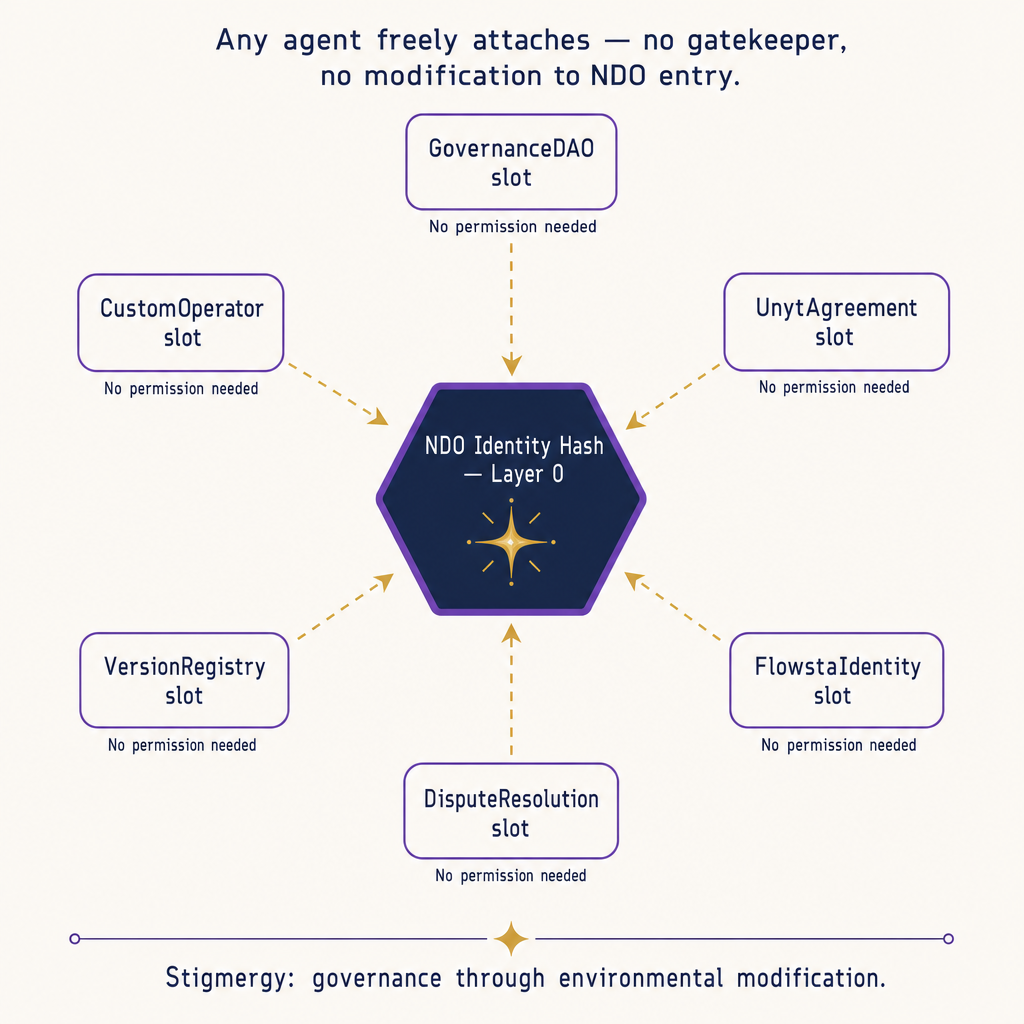
Any agent freely attaches capability slots (GovernanceDAO, UnytAgreement, FlowstaIdentity, custom operators) to the NDO's Layer 0 identity hash without modifying the NDO entry itself — pure stigmergy: coordination through environmental modification, not central authority.
In COP terms: you cannot design the attachment surface in advance. The DHT link space is the surface. Any agent, any hApp, any future tool that knows the Layer 0 identity hash can create a link from that hash to whatever it needs to attach. The NDO entry itself does not change.
This is stigmergy in the complexity economics sense: indirect coordination through the environment. Ants coordinate the construction of a nest not by communicating plans but by leaving pheromone trails (environmental modifications) that other ants respond to. The NDO's Layer 0 hash is the pheromone trail — any agent can respond to it by attaching capabilities.
6.2 Stigmergic Link Channels
The attachment mechanism uses typed DHT links with structured link tags:
NDO_identity_hash →[LinkType: CapabilitySlot, tag: { slot_type, author, attached_at }]→ capability_target_hash
Predefined slot type vocabulary (extensible):
| Slot Type | Description | Typical target |
|---|---|---|
Documentation | Human-readable docs, wiki, manuals | Wiki entry hash or external URI |
IssueTracker | Bug reports, feature requests | Issue tracker hApp cell hash |
FabricationQueue | Distributed manufacturing requests | Fabrication process hash |
GovernanceDAO | Governance proposals and voting | DAO hApp cell hash |
VersionGraph | Version history and forks | Versioned entity hash (see post-mvp/ndo-versioning.md) |
DigitalAsset | Files, 3D models, code, manifests | Asset manifest hash |
WeaveWAL | Moss/Weave Asset Link | WAL (Weave Asset Locator) |
FlowstaIdentity | Cross-app identity attestation | IsSamePersonEntry action hash |
UnytAgreement | Programmable economic terms governing value flows triggered by resource interactions | Unyt Smart Agreement entry hash (cross-cell reference) |
CustomApp | Any other hApp integration | Any hash, labelled by consumer |
6.3 MOSS / Weave Integration
The Weave Interaction Pattern defines an open standard for creating, searching, linking, and organizing "social space units" — precisely what an NDO is. MOSS integration works as follows:
- The NDO is declared as a Weave Asset by creating a
WeaveWALcapability slot pointing to the asset's WAL - Other MOSS tools (issue trackers, document editors, governance DAOs, fabrication queues) can attach to the NDO's Layer 0 hash via the Weave protocol without modifying the NDO entry
- As the NDO gains lifecycle stages, MOSS tools can respond to those transitions — a fabrication queue tool might automatically activate when the NDO reaches
Stable
6.4 Governance of the Attachment Surface
Status: ❌ Not implemented for
CapabilitySlottrust filtering. The rules below describe target governance behaviour once capability slots land inzome_resource.
The stigmergic surface is permissionless at the DHT level — any agent can create a capability link. But the governance layer determines which links are trusted and surfaced to other agents, versus which are ignored or filtered:
- Links created by the initiator or custodians are trusted by default
- Links created by Accountable Agents are conditionally trusted
- Links created by unknown agents are filtered until governance validation
- The governance zome can validate capability attachments using the same
validate_new_resourcepattern already in place
This mirrors the approach taken in the wider complex systems literature: edge-based sensing and attachment is permissionless (lower information opportunity costs), while trust propagation and filtering happens through distributed consensus rather than centralized gatekeeping.
6.5 CapabilitySlot on Agent Identity (Post-MVP)
TODO (G15 — Agent CapabilitySlot): The stigmergic attachment pattern described in this section applies equally to agent identities. The
Personentry hash is itself a stable, permanent identity anchor — analogous to theNondominiumIdentityLayer 0 hash — and should serve as a surface of attachment for external capabilities:
- DID documents (W3C Decentralised Identifiers)
- Verifiable Credential wallets
- Reputation oracles from other networks
- Professional credential registries
- Social graph exports
An agent's
Personentry hash →CapabilitySlot→ external capability target, using the sameCapabilitySlotTag/SlotTypepattern defined in Section 8.3. This enables credential portability and DID interoperability without modifying the corePersonentry schema.See
documentation/archives/agent.md§3.2 andREQ-AGENT-11.Flowsta Auth (Section 6.7) provides the first concrete implementation of this pattern: a
FlowstaIdentitycapability slot linking thePersonhash to anIsSamePersonEntry— a dual-signed cryptographic attestation that the agent's NDO key and their Flowsta Vault key belong to the same person. This gives every agent a W3C DID (did:flowsta:uhCAk...) without modifying thePersonentry schema.
6.6 Economic Agreement Slots — Unyt Integration
A detailed analysis of the UnytAgreement slot type, its relationship to the governance layer, and the three-phase integration path.
Why Unyt Is a Capability, Not a Layer
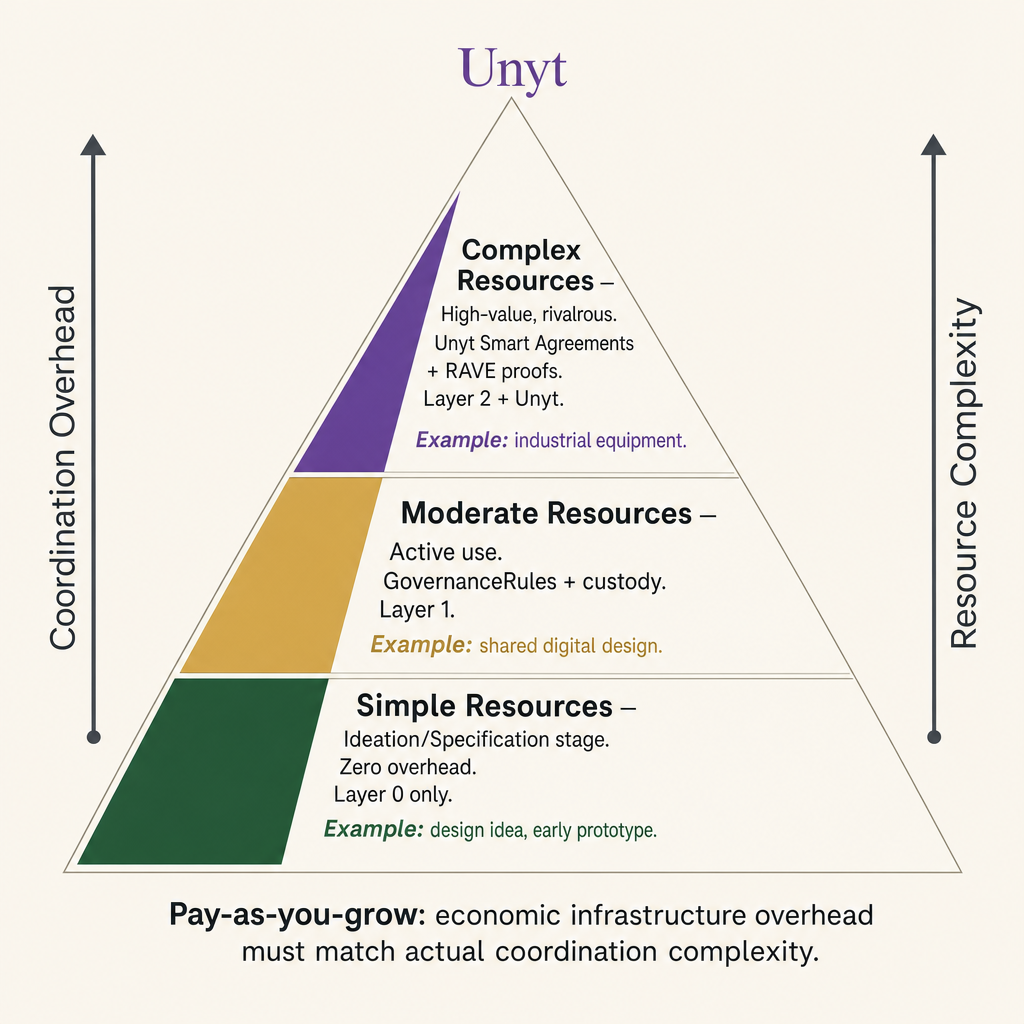
Simple resources (Ideation/Specification) need zero economic overhead. Moderate resources (Active, distributed) benefit from GovernanceRules and custody tracking. Complex, high-value rivalrous resources justify Unyt Smart Agreements and RAVE proofs. Pay-as-you-grow.
The prima materia model has three structural layers. It might seem natural to propose a fourth — an "Economic Layer" — for payment and value-flow infrastructure. This would be the wrong architecture.
The COP principle of pay-as-you-grow is explicit: impose only the coordination overhead that the resource's current social complexity demands. Not all resources need payment infrastructure. A bicycle lent between neighbours does not need a Unyt Smart Agreement. A shared CNC machine used by fifty contributors under a usage-fee model does. Imposing economic infrastructure at NDO creation — making it structural — would repeat the reductive paradigm mistake that the three-layer model was designed to avoid. It would be a fixed classification at t=0 of a future that no agent can know.
Unyt belongs in the capability surface for the same reason that governance DAOs, fabrication queues, and issue trackers do: it is an economic operator that some resources need and others do not, and its attachment should emerge from the network's actual practice rather than be prescribed by the programmer.
The UnytAgreement slot type has one property that other slot types do not: it is governance-enforceable. A Documentation link is informational — the governance zome does not condition state transitions on it. A UnytAgreement link, when endorsed through a GovernanceRule of type EconomicAgreement, becomes a precondition for transition approval. This makes it a hybrid: permissionless at the attachment surface, authoritative at the governance layer.
Two-Tier Economic Authority
The UnytAgreement capability slot operates at two tiers.
Tier 1 — Permissionless Proposal (CapabilitySlot)
Any Accountable Agent can attach a Unyt Smart Agreement to any NDO by creating a CapabilitySlot link of type UnytAgreement. This is an assertion: "I believe this agreement should govern interactions with this resource." The governance zome does not enforce it. Other agents can read it as a proposal, a community suggestion, or a pricing signal. Multiple competing proposals may coexist.
This tier respects the stigmergic principle: lower information opportunity costs, permissionless economic expression, no gatekeeping on proposals.
Tier 2 — Governance Endorsement (GovernanceRule)
When the NDO's custodian — or a community governance process — formally endorses a Unyt Smart Agreement by creating a GovernanceRule entry of type EconomicAgreement, the agreement becomes enforceable. State transitions that trigger it (Access, CustodyTransfer, service processes) require the requesting agent to provide a valid Unyt RAVE as proof of economic settlement before the governance zome approves the transition.
The capability slot (Tier 1) and the governance rule (Tier 2) are independent but complementary: the slot makes the agreement discoverable; the rule makes it mandatory.
graph TD
    Agent["Any Accountable Agent"]
    Custodian["Custodian / Governance Process"]
    NDO["NDO Identity Hash (Layer 0)"]
    Unyt["Unyt Smart Agreement\n(on Unyt DHT)"]
    GovRule["GovernanceRule\n(EconomicAgreement type)\n— Layer 1 asset —"]
    Transition["State Transition Request\n(AccessForUse, CustodyTransfer, etc.)"]
    GovZome["Governance Zome\n(state transition operator)"]
    RAVE["Unyt RAVE\n(proof of settlement)"]
    PPR["PrivateParticipationClaim (PPR)\n+ settlement_rave_hash"]

    Agent -->|"CapabilitySlot link\n(Tier 1: permissionless proposal)"| NDO
    NDO -.->|"links to"| Unyt
    Custodian -->|"GovernanceRule\n(Tier 2: endorsed terms)"| GovRule
    GovRule -->|"linked from ResourceSpecification\n(Layer 1)"| NDO

    Transition -->|"includes rave_hash"| GovZome
    GovZome -->|"validates EconomicAgreement rule"| GovRule
    GovZome -->|"validates RAVE against Unyt DHT"| RAVE
    GovZome -->|"on approval, issues"| PPR
    PPR -->|"settlement_rave_hash"| RAVE
Unyt Smart Agreement as Economic GovernanceRule
The current GovernanceRule entry in zome_resource carries rule_type, rule_data (JSON-encoded), and an optional enforced_by role requirement. The Unyt integration adds a new rule_type variant and a corresponding structured rule_data schema:
#![allow(unused)]
fn main() {
// New variant in GovernanceRuleType enum (zome_resource integrity)
pub enum GovernanceRuleType {
    // ... existing rule types ...
    EconomicAgreement, // rule_data: JSON-serialized EconomicAgreementRuleData
}

// rule_data schema for EconomicAgreement rules
#[derive(Serialize, Deserialize)]
pub struct EconomicAgreementRuleData {
    pub unyt_alliance_id: String,          // Network seed of the Unyt Alliance
    pub smart_agreement_hash: String,       // Entry hash of the Unyt Smart Agreement
    pub trigger_actions: Vec<VfAction>,     // Which VfActions trigger this agreement
    pub settlement_window_secs: u64,        // Max time between RAVE execution and transition request
    pub note: Option<String>,               // Human-readable description of the economic terms
}
}
When the governance zome encounters an EconomicAgreement rule during a state transition evaluation, it executes the following validation sequence:
- Confirms that the transition's
VfActionis in the rule'strigger_actionslist - Requires a
rave_hashfield in the transition request payload - Queries the Unyt DHT (via cross-DNA
call()) to retrieve and validate the RAVE - Confirms the RAVE was executed within the declared
settlement_window_secs - Confirms the RAVE's inputs match the transition context (resource identity, provider, receiver, quantity or duration)
- Only then approves the state transition and issues the PPR
This makes the governance zome's approval conditional on cryptographic proof of economic settlement — the resource does not move (physically, digitally, or in custody) until the agreed value has flowed.
Value Flow Patterns
Four standard patterns map the most common resource-interaction economics onto Unyt's Smart Agreement library:
| Pattern | Trigger VfAction | Unyt Agreement Template | Economic logic |
|---|---|---|---|
| Access Fee | AccessForUse | Conditional Forward | User pre-pays; access granted on RAVE |
| Service Billing | Work (fulfilled Claim) | Proof-of-Service | Provider paid on validated Claim |
| Revenue Sharing | Transfer | Aggregate Payment | Proceeds split: custodian / protocol / creator |
| Custody Bond | TransferCustody | Conditional Forward (escrowed) | Bond held; returned on clean handoff with PPR |
These map directly to the Smart Agreement templates in the Unyt Smart Agreement Library. The Conditional Forward template is the workhorse for access and custody patterns; Aggregate Payment and Proof of Service serve billing and revenue distribution.
The templates use RHAI scripting — the same logic that currently drives Unyt's DePIN billing (Log → Invoice → Agreement → Settlement). For Nondominium, the "log" is the Nondominium Commitment + Claim + ValidationReceipt chain; the invoice is implicit in the EconomicAgreementRuleData; the settlement is the RAVE.
PPR and RAVE: A Complete Provenance Chain
When a state transition is approved with a valid RAVE, the PrivateParticipationClaim generated for the interaction carries the RAVE hash as an optional field:
#![allow(unused)]
fn main() {
pub struct PrivateParticipationClaim {
    // ... existing fields ...
    pub settlement_rave_hash: Option<String>, // Unyt RAVE hash, if economic settlement occurred
}
}
This creates a complete, cross-verifiable provenance chain:
Commitment
  └─ (fulfilled by) EconomicEvent
       └─ (generates) PrivateParticipationClaim (PPR)
            └─ settlement_rave_hash → Unyt RAVE
                 └─ (verifiable on Unyt DHT: inputs, outputs, agreement, executor)
The PPR is the participation proof: who did what, at what quality, in which role. The RAVE is the economic proof: what value flowed, to whom, under what rules, verified by Unyt peers. Together, they constitute a full, mutually-reinforcing record of a resource interaction that neither system alone can provide.
This linkage also feeds back into the credit system: agents whose PPRs consistently carry RAVEs (meaning they reliably execute their economic obligations) earn higher reputation scores, which in turn increases their Unyt credit limits (see post-mvp/unyt-integration.md). Reputation and credit become two readings of the same underlying participation data.
The Resource as Economic Actor
When an NDO has an endorsed EconomicAgreement governance rule, it becomes a self-pricing, self-settling economic actor. No platform intermediary determines what the resource costs, no rent is extracted by infrastructure owners, and no contract enforcement requires a legal system. The community that embedded the rule in the resource's Layer 1 specification determines the economic terms, and Unyt enforces them cryptographically among peers.
This is the nondominium model's deepest departure from platform economics. Platform platforms capture value by positioning themselves between resource and user — Airbnb between host and guest, Uber between driver and passenger. In the NDO model, the "platform" is the DHT itself: owned by no one, accessible to everyone, governed by the rules the community wrote into the resource. The resource is simultaneously a physical or digital artifact, a governance system, and an economic agent.
In complexity economics terms: the resource has become a holon with economic agency. Not only does it exist within the economic web (participating in ValueFlows events), it actively shapes the economic flows that run through it — enforcing its own terms, rewarding its stewards, and settling its debts, all without human intermediation.
Integration Path
The Unyt integration is structured as three independent phases, each delivering immediate value and requiring no rollback of prior work.
Phase 1 — Capability Surface Extension (no zome structural changes required)
Add UnytAgreement(String) to the SlotType enum. Any Accountable Agent can now attach a proposed Unyt Smart Agreement to any NDO. The governance zome does not enforce these links — they are informational, discoverable proposals. This phase delivers: economic expression in the network (market pricing signals without enforcement), tooling foundations (UIs can surface proposed payment terms), and community standard-setting (the network can develop shared pricing conventions before enforcement is added).
Phase 2 — Governance Rule Extension (zome_resource changes only)
Add EconomicAgreement to the GovernanceRuleType enum and define the EconomicAgreementRuleData schema. Custodians can now formally endorse a Unyt Smart Agreement by creating a GovernanceRule entry. The governance zome reads these rules but does not yet enforce them at transition time — Phase 2 makes the endorsement discoverable and legible to the network without yet conditioning transitions on RAVEs. This phase delivers: governance-layer economic declarations, tooling for custodians to set and communicate official payment terms, and the data structure foundation for Phase 3.
Phase 3 — Governance Zome Integration (zome_gouvernance changes)
The governance zome's evaluate_transition_request function is extended to: (a) check for EconomicAgreement governance rules when processing relevant VfAction events; (b) require a rave_hash in transition requests when such a rule exists; (c) validate the RAVE via cross-DNA call to the Unyt cell; (d) link the RAVE hash into the generated PPR via settlement_rave_hash. This phase delivers: full enforcement, automatic settlement, and the complete PPR↔RAVE provenance chain. The NDO becomes a fully self-pricing economic actor.
6.7 Identity and Authentication Slots — Flowsta Integration
A detailed analysis of the FlowstaIdentity slot type, its relationship to the agent identity surface (Section 6.5), and the three-phase integration path.
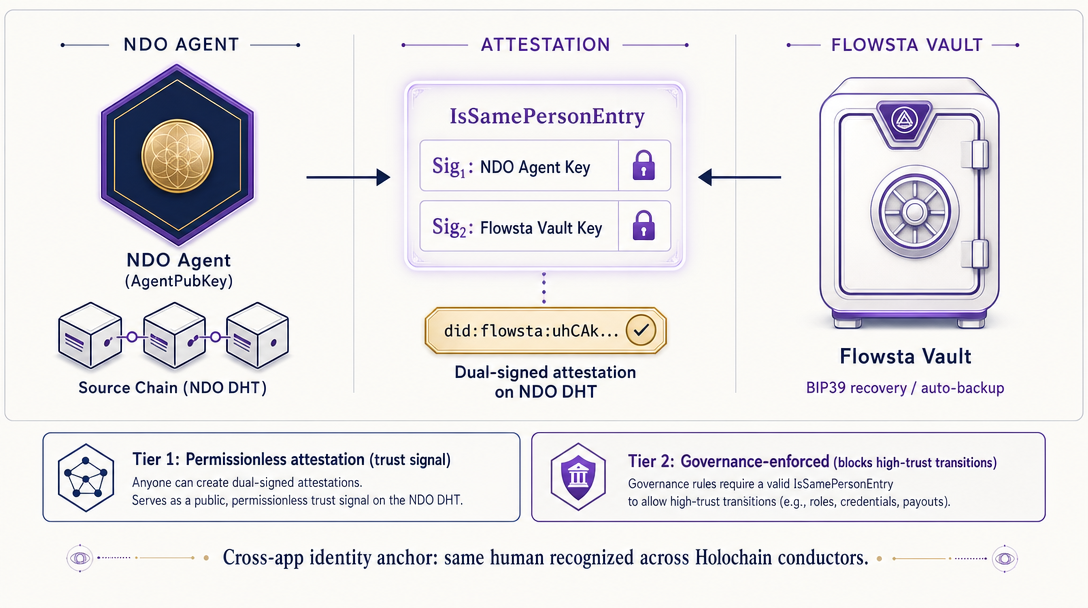
Tier 1: any agent voluntarily attaches a FlowstaIdentity slot (permissionless trust signal). Tier 2: governance rules can require a valid Flowsta link for high-trust transitions (e.g. PrimaryAccountableAgent promotion). The dual-signed IsSamePersonEntry on the NDO DHT yields a W3C DID without modifying the Person entry schema.
Why Flowsta Is a Capability, Not a Layer
The prima materia model has three structural layers. It might seem natural to propose cross-app identity as a mandatory component of Layer 0 — to require every agent to complete Flowsta Vault linking before they can participate. This would be the wrong architecture.
The COP principle of pay-as-you-grow is explicit: impose only the coordination overhead that the resource's current social complexity demands. Not all communities need cross-app identity. A neighbourhood tool-sharing network may operate perfectly well with Holochain-native AgentPubKey identifiers and locally-earned PPR reputation. A multi-network fabrication coalition spanning multiple Holochain apps — where contributors participate in design, fabrication, logistics, and economic settlement across separate DHTs — needs verifiable cross-app identity to prevent sybil fragmentation and enable reputation portability.
Imposing Flowsta at agent registration — making it structural — would repeat the reductive paradigm mistake that the three-layer model was designed to avoid. It would be a fixed classification at t=0 of a future that no agent can know: whether this particular agent will ever need cross-app identity, whether this particular community will ever span multiple networks.
Flowsta belongs in the capability surface for the same reason that Unyt does: it is an identity operator that some communities need and others do not, and its attachment should emerge from the network's actual practice rather than be prescribed by the programmer.
IsSamePersonEntry: The Cross-App Attestation
Flowsta's agent linking mechanism creates a cryptographic attestation — IsSamePersonEntry — on the NDO's DHT that proves two Holochain agent keys belong to the same person. The attestation is committed via the flowsta-agent-linking zomes (flowsta-agent-linking-integrity and flowsta-agent-linking-coordinator), which are added to the NDO's DNA manifest.
The 78-byte signing payload:
- Bytes 0–38: First agent public key (39 bytes: 3-byte prefix + 32-byte Ed25519 key + 4-byte checksum)
- Bytes 39–77: Second agent public key (same format)
- Both keys are sorted lexicographically for canonical ordering
- Both agents sign this payload: the NDO agent key signs via the local conductor, and the Flowsta Vault agent key signs via the Vault's lair keystore
Verification properties:
- Purely cryptographic: Ed25519 signature verification on the dual-signed payload — no shared DNA, no API dependency, no central authority needed for verification
- Any agent on the NDO DHT can verify the attestation by checking both signatures against the embedded public keys
- Purpose-specific: Flowsta Vault computes the signing payload itself and displays it to the user for approval — apps cannot trick the Vault into signing arbitrary data
- Revocable: either party can revoke the link via the
revoke_linkzome function - Each Flowsta user carries a W3C DID:
did:flowsta:uhCAk...(ordid:key:z6Mk...), providing a standards-compliant cross-app identifier
Two-Tier Identity Authority
The FlowstaIdentity capability slot operates at two tiers, paralleling the Unyt two-tier model (Section 6.6).
Tier 1 — Permissionless Attestation (CapabilitySlot)
Any agent can link a Flowsta identity to their Person entry by creating a CapabilitySlot link of type FlowstaIdentity, pointing to the IsSamePersonEntry action hash. This is an assertion: "I have completed Vault agent linking (dual-signed attestation)." The governance zome does not enforce it at Tier 1. Other agents can read it as a trust signal — a voluntarily disclosed cross-app identity. Multiple agents may have Flowsta links; some may not.
This tier respects the stigmergic principle: lower information opportunity costs, permissionless identity expression, no gatekeeping on attestation.
Tier 2 — Governance Requirement (GovernanceRule / Role Promotion)
When a community's governance rules require verified cross-app identity — for example, as a precondition for PrimaryAccountableAgent role promotion, or for custody transfer of high-value resources — the governance zome can condition role transitions on the presence of a verified FlowstaIdentity capability slot on the agent's Person hash. The verification checks:
- A
FlowstaIdentityCapabilitySlot link exists from the agent'sPersonhash - The target
IsSamePersonEntrycontains the agent'sAgentPubKeyas one of the two signing parties - The attestation has not been revoked
The capability slot (Tier 1) makes the identity discoverable; the governance rule (Tier 2) makes it mandatory for specific actions.
graph TD
    Agent["Agent on NDO DHT"]
    Vault["Flowsta Vault\n(local Holochain conductor + lair)"]
    PersonHash["Person Entry Hash\n(agent identity anchor)"]
    FlowstaSlot["FlowstaIdentity\nCapabilitySlot link"]
    ISP["IsSamePersonEntry\n(dual-signed 78-byte attestation)\non NDO DHT"]
    DID["W3C DID\ndid:flowsta:uhCAk..."]
    OtherApp["Other Flowsta-Linked\nHolochain App"]
    PPR["PrivateParticipationClaim"]
    RepSummary["ReputationSummary\n(cross-app attributable)"]
    GovRule["GovernanceRule\n(IdentityVerification type)"]
    RolePromotion["Role Promotion\n(PrimaryAccountableAgent)"]

    Agent -->|"has"| PersonHash
    Agent -->|"runs"| Vault
    PersonHash -->|"CapabilitySlot link\n(Tier 1: permissionless)"| FlowstaSlot
    FlowstaSlot -->|"points to"| ISP
    ISP -->|"dual-signed by"| Vault
    ISP -->|"carries"| DID
    DID -.->|"verifiable by"| OtherApp
    PPR -->|"attributed to"| DID
    PPR -->|"aggregated into"| RepSummary
    RepSummary -.->|"portable via DID"| OtherApp
    GovRule -->|"Tier 2: requires\nFlowstaIdentity slot"| RolePromotion
    RolePromotion -->|"checks"| FlowstaSlot
PPR Cross-App Attribution
When an agent has linked a Tier 1 FlowstaIdentity slot to a valid, non-revoked IsSamePersonEntry, their PPR ReputationSummary becomes attributable to a cross-app DID. (This is cryptographic attestation via Vault dual-signing — not the same as Tier 2 governance enforcement in Phase 3.) This creates the foundation for portable reputation without requiring full Verifiable Credential infrastructure:
- Other Flowsta-integrated apps can query whether an agent has a linked NDO identity by checking their own DHT for an
IsSamePersonEntrycontaining the same Flowsta Vault key - The DID serves as the stable key for reputation aggregation across apps — a single DID may accumulate PPR histories from multiple independent Holochain networks
- Agents control disclosure: the
FlowstaIdentityslot is voluntary (Tier 1), and PPR summaries are already selectively shared via existing capability grants - This is the practical path toward
REQ-NDO-AGENT-08(Portable Credentials): the DID provides the identity anchor; the PPR provides the participation record; selective disclosure provides the privacy control
The cross-app attribution chain is:
Person entry (NDO DHT)
  └─ FlowstaIdentity CapabilitySlot → IsSamePersonEntry
       └─ carries DID: did:flowsta:uhCAk...
            └─ same DID resolvable on other Flowsta-linked apps
                 └─ PPR ReputationSummary attributable to DID across apps
Recovery and Backup via Vault
Flowsta Vault provides recovery infrastructure that the NDO currently lacks:
- BIP39 recovery phrases: Deterministic Ed25519 keypair regeneration from a 24-word mnemonic. If an agent loses their device, they can regenerate the same key pair on a new device using their recovery phrase.
- Auto-backups: Encrypted snapshots every 60 minutes (up to 10 timestamped snapshots per app), working while the Vault is locked (after first unlock in a session). Oldest snapshots are auto-rotated.
- Full data export: Decrypted private entries and cryptographic keys can be exported, compliant with the Cryptographic Autonomy License (CAL).
This aligns with the NDO's design principle that identity must persist through all transformations. The non-deletable, append-only nature of Person entries and PPRs assumes the agent retains access to their signing key — a guarantee the current NDO architecture cannot make. Vault's deterministic key regeneration ensures that the permanent records the NDO creates remain accessible to their authors across device loss and hardware failure.
CAL alignment: The Cryptographic Autonomy License requires that users can always get a copy of their own data plus the cryptographic keys needed for independence from any particular service provider. Vault's full data export — including decrypted private entries and cryptographic keys — satisfies this requirement directly, and positions NDO communities for CAL-compliant distribution.
Flowsta and Unyt: Complementary Capabilities
Flowsta and Unyt are the two external capability integrations defined for the NDO. They are complementary and independent:
- Flowsta answers who is who — cross-app identity, DID, recovery, authentication
- Unyt answers who owes what to whom — credits, debits, settlement, economic closure
An NDO community may adopt one, both, or neither. When both are active, they reinforce each other: an agent's Flowsta DID provides the stable identity across Unyt Alliances, and their Unyt credit limit (derived from PPR reputation) is attributable to that DID (via Tier 1 link / IsSamePersonEntry, and optionally Tier 2–gated processes). The agent is simultaneously identifiable, accountable, and economically active — without any platform intermediary.
Integration Path
The Flowsta integration is structured as three independent phases, each delivering immediate value and requiring no rollback of prior work.
Phase 1 — Capability Surface Extension (no core zome structural changes required)
Add FlowstaIdentity to the SlotType enum. Add flowsta-agent-linking-integrity and flowsta-agent-linking-coordinator zomes to the DNA manifest (dna.yaml). Install @flowsta/holochain SDK in the frontend. Any agent can now link their Flowsta identity to their Person entry via a FlowstaIdentity capability slot. This phase delivers: cross-app identity expression in the network (trust signals without enforcement), DID attachment to agent profiles, and the foundation for Vault-backed key recovery.
Phase 2 — Frontend and UX Integration (UI changes only)
Add a "Link Flowsta Identity" flow in the person/profile management UI. Display linked Flowsta DIDs on agent profiles. Show Flowsta verification badges on agents in search results and governance views. Integrate Vault backup API for agent data resilience (@flowsta/holochain backup functions: startAutoBackup, backupToVault, retrieveFromVault, listVaultBackups). This phase delivers: user-facing identity management, visible trust indicators, and data resilience.
Phase 3 — Governance-Enforced Identity Verification (zome_gouvernance changes)
Add IdentityVerification variant to GovernanceRuleType (or use existing rule mechanisms). Governance rules can now require a FlowstaIdentity slot as a precondition for role promotions (e.g., PrimaryAccountableAgent) or for high-value custody transfers. The governance zome validates the IsSamePersonEntry signature chain — checking that the FlowstaIdentity slot exists, that the target IsSamePersonEntry contains the agent's AgentPubKey, and that the attestation has not been revoked — before approving the conditioned transition. This phase delivers: governance-enforced identity verification, sybil resistance for high-trust roles, and the bridge between permissionless participation and accountable governance.
7. Design Patterns
The NDO embodies six named design patterns. These patterns are architectural idioms that recur throughout the system and should guide implementation decisions.
Implementation snapshot: Pattern 1 (Identity Anchor) and Pattern 5 (Tombstone, Layer 0 only) are reflected in MVP code. Pattern 4 is partially reflected in the UI (default
Ideationcreation, lifecycle progression). Patterns 2, 3, and 6 depend on link types not yet inzome_resource. FederationNdoHardLink(#103) is a related cross-NDO attachment mechanism inzome_gouvernance, distinct from Pattern 6'sCapabilitySlotsurface.
Pattern 1: Identity Anchor
Status: ✅ Implemented (MVP) —
create_ndo, discovery anchors, immutable delete rejection.
Intent: Give every resource a stable, cryptographically-secure identity anchor that persists through all transformations, including end of life.
Structure: The NondominiumIdentity genesis entry. Its action hash is the stable namespace for all other entries and links. Nothing else in the system references a resource by any other handle.
Rationale: In complex adaptive systems, identity must be decoupled from form. A person's identity persists even as their body, beliefs, and relationships change. A corporation's identity persists through restructuring. The NDO's identity must persist through design changes, custody transfers, version forks, and end of life. Content-addressing in Holochain makes this natural: the action hash of the genesis entry never changes.
Holochain idiom:
#![allow(unused)]
fn main() {
// Layer 0 creation — returns the stable identity hash
let ndo_hash = create_entry(&EntryTypes::NondominiumIdentity(identity))?;
// Everything else links to ndo_hash
}
Pattern 2: Complexity-Matched Layer Activation
Status: 🔄 Partial —
NdoToSpecification(Layer 1) is in code as of #132;NDOToProcess(Layer 2) is not.
Intent: Activate only the structural complexity that the current coordination environment demands. Do not pay coordination costs in advance of need.
Structure: Layer activation via link creation. Layer 1 activates when the NdoToSpecification link is created. Layer 2 activates when the NDOToProcess link is created. Both can be created retroactively, at any lifecycle stage the target layer's gate permits: Layer 1 accepts Specification through Active (Section 5.2), and the Layer 2 gate is not yet enforced.
Rationale: Benkler's information opportunity cost analysis: overhead that exceeds the value of the coordination it enables is pure waste. A tool being lent between friends does not need a full ValueFlows process. A community hardware standard being developed across fifty fabrication networks does. The NDO model allows the system's complexity to grow with the resource's social complexity, not ahead of it.
Holochain idiom:
#![allow(unused)]
fn main() {
// Activate Layer 1 — link identity to specification
create_link(ndo_hash, spec_hash, LinkTypes::NDOToSpecification, ())?;

// Activate Layer 2 — link identity to process
create_link(ndo_hash, process_hash, LinkTypes::NDOToProcess, ())?;
}
Pattern 3: Holonic Composition
Status: 🔄 Post-MVP —
NDOToComponentnot yet in code. Seepost-mvp/fractal-composable-resource-architecture.md.
Intent: Allow NDOs to contain other NDOs, creating fractal hierarchies where every level has the same structural potential.
Structure: NDOToComponent links from a parent NDO's identity hash to child NDO identity hashes. A Project NDO links to Resource NDOs. A Resource NDO links to Design NDOs. A Design NDO links to Component NDOs.
Rationale: Morin's holographic principle and the fractal composable resource architecture (documented in post-mvp/digital-resource-integrity.md). In complex systems, the same structure appears at every scale. The NDO's three-layer potential is the same whether the resource is an atomic component or a composable object.
Holochain idiom:
#![allow(unused)]
fn main() {
// Link parent NDO to child NDO
create_link(
    parent_ndo_hash,
    child_ndo_hash,
    LinkTypes::NDOToComponent,
    LinkTag::new(component_role.as_str()), // e.g., "required", "optional", "alternative"
)?;
}
Pattern 4: Progressive Disclosure
Status: 🔄 Partial (UI) — creation form defaults to
Ideation; full layer-aware archetypes await L1/L2 activation.
Intent: Present resources at the appropriate level of complexity for the current context, without exposing structural complexity that is not yet active.
Structure: Three starting archetypes that correspond to common initialization states, presented as UI choices that set the initial lifecycle stage. These are starting configurations, not permanent classifications.
| Archetype | Layers active | Lifecycle stage | Use when |
|---|---|---|---|
| Stub | L0 only | Ideation | Registering an intention |
| Open Design | L0 + L1 | Specification | Sharing a design |
| Active Project | L0 + L1 + L2 | Development | Starting work with collaborators |
Rationale: Kauffman's adjacent possible — present only what is currently achievable. An agent creating their first NDO should not be confronted with the full complexity of the three-layer model. The system should reveal its depth progressively as the resource's context demands it.
Pattern 5: Tombstone
Status: ✅ Partial (MVP) — Layer 0 is never deleted;
EndOfLifeandDeprecatedstages work. Layer 1/2 archival (specis_active, terminal events) awaits L1/L2 implementation.
Intent: Preserve permanent identity records for all resources that have ever existed, including those that have reached end of life, been deprecated, or been abandoned.
Structure: At end of life, only Layer 0 remains active. Layers 1 and 2 are archived (spec is_active: false, process concluded with terminal EconomicEvent). The identity entry is never deleted.
Rationale: The DHT is append-only — this is not a limitation, it is a feature. The permanent memory of what resources existed, who created them, and what happened to them is institutional knowledge. Tombstones enable:
- OVN-compliant contribution tracking even after a project ends
- Versioning lineage that traces forks back to their origins
- Historical record for the network
Holochain idiom:
#![allow(unused)]
fn main() {
// End-of-life transition — archive layers
update_entry(spec_hash, &ResourceSpecification { is_active: false, ..spec })?;
// Create terminal EconomicEvent for Layer 2
create_entry(&EntryTypes::EconomicEvent(EconomicEvent {
    action: VfAction::Consume,
    lifecycle_transition: Some(LifecycleStage::EndOfLife),
    ..
}))?;
// Layer 0 NondominiumIdentity is NOT deleted — it becomes the tombstone
}
Pattern 6: Stigmergic Capability Attachment
Status: 🔄 Post-MVP —
CapabilitySlotlink type not inzome_resource. See §6 implementation note for federation partial (NdoHardLink).
Intent: Allow any agent or external hApp to attach capabilities to an NDO without modifying the NDO entry, without requiring permission from the NDO's custodian, and without needing to have been anticipated by the NDO's designer.
Structure: CapabilitySlot links from the Layer 0 identity hash to capability targets. Link tags carry the slot type, author, and attachment timestamp. Governance layer filters trusted vs untrusted links.
Rationale: Morin's ecology of action: no action guarantees its outcome. The capabilities that will be most useful to attach to a resource cannot be known at creation time. The attachment surface must be open. Centralized gatekeeping of capabilities (requiring permission from the NDO custodian before attaching) would impose coordination costs that violate Benkler's information opportunity cost principle.
Holochain idiom:
#![allow(unused)]
fn main() {
let slot_tag = CapabilitySlotTag {
    slot_type: SlotType::IssueTracker,
    attached_at: sys_time()?,
};
create_link(
    ndo_identity_hash,
    issue_tracker_cell_hash,
    LinkTypes::CapabilitySlot,
    LinkTag::new(serde_json::to_vec(&slot_tag)?),
)?;
}
8. DHT Data Structures
8.1 NondominiumIdentity Entry (Layer 0)
#![allow(unused)]
fn main() {
#[hdk_entry_helper]
#[derive(Clone, PartialEq)]
pub struct NondominiumIdentity {
    pub name: String,
    pub initiator: AgentPubKey, // TODO (G1, REQ-AGENT-02): replace with AgentContext post-MVP
    pub property_regime: PropertyRegime,
    pub resource_nature: ResourceNature,
    pub lifecycle_stage: LifecycleStage,
    pub created_at: Timestamp,
    pub description: Option<String>,       // immutable after creation (MVP)
    pub successor_ndo_hash: Option<ActionHash>,   // set once on Deprecated (REQ-NDO-LC-06)
    pub hibernation_origin: Option<LifecycleStage>, // set on → Hibernating; cleared on resume
}
}
8.2 Supporting Enums
#![allow(unused)]
fn main() {
#[derive(Clone, PartialEq, Debug, Serialize, Deserialize)]
pub enum PropertyRegime {
    Private,        // Full rights bundle; individual ownership
    Commons,        // Non-rivalrous shared resource; governance via licensing/attribution
    Collective,     // Cooperative/collective ownership
    Pool,           // Pool of shareables: rivalrous shared resources; custody/scheduling/maintenance
    CommonPool,     // Rivalrous consumable resource; governance via quota/depletion rules
    Public,         // Public/governmental stewardship; open-access; non-alienable by the public body
    Nondominium,    // Uncapturable by design; contribution-based access; no alienation permitted
}
// Canonical definition: crates/shared/src/types.rs / documentation/requirements/resources.md §6.3

#[derive(Clone, PartialEq, Debug, Serialize, Deserialize)]
pub enum ResourceNature {
    Physical,     // Material objects, equipment, spaces
    Digital,      // Software, data, design files, documents
    Service,      // Software services, knowledge-as-service assets
    Hybrid,       // Digital twin of a physical resource, or physical+digital bundle
    Information,  // Knowledge assets, datasets, documented methods
}
// MVP canonical definition: crates/shared/src/types.rs (5 variants).
// Post-MVP forward map may add Space, Method, Currency — see documentation/archives/resources.md §6.2.

#[derive(Clone, PartialEq, Debug, Serialize, Deserialize, Default)]
pub enum LifecycleStage {
    // Emergence
    #[default]
    Ideation,
    Specification,
    Development,
    Prototype,

    // Maturity
    Stable,
    Distributed,

    // Operation
    Active,

    // Suspension
    Hibernating,

    // Terminal
    Deprecated,
    EndOfLife,
}
}
8.3 Capability Slot Link Tag
#![allow(unused)]
fn main() {
#[derive(Clone, Debug, Serialize, Deserialize)]
pub struct CapabilitySlotTag {
    pub slot_type: SlotType,
    pub attached_at: Timestamp,
    pub label: Option<String>, // Human-readable label for this specific slot
}

#[derive(Clone, Debug, Serialize, Deserialize)]
pub enum SlotType {
    Documentation,
    IssueTracker,
    FabricationQueue,
    GovernanceDAO,
    VersionGraph,
    DigitalAsset,
    WeaveWAL,
    FlowstaIdentity,       // Flowsta agent-linking attestation (IsSamePersonEntry action hash)
    UnytAgreement(String), // Unyt Alliance network seed identifier (empty string = sandbox default)
    CustomApp(String),     // Extensible: custom slot type identified by string
}
}
8.4 Link Types — Implemented vs Planned
Implemented in zome_resource integrity (MVP — PR #80):
#![allow(unused)]
fn main() {
// Layer 0 discovery and lifecycle (actual enum names in code)
AllNdos,              // Path "ndo_identities" → NondominiumIdentity action hashes
AgentToNdo,           // initiator AgentPubKey → NondominiumIdentity
NdoByLifecycleStage,  // Path "ndo.lifecycle.{Stage:?}" → NondominiumIdentity
NdoByNature,          // Path "ndo.nature.{Nature:?}" → NondominiumIdentity
NdoByPropertyRegime,  // Path "ndo.regime.{Regime:?}" → NondominiumIdentity
NdoToSuccessor,       // deprecated NDO → successor NondominiumIdentity (REQ-NDO-LC-06)
NdoToTransitionEvent, // NDO → EconomicEvent (link only; cross-zome event validation deferred)

// Layer 1 activation and operational state (MVP — PR #132)
NdoToSpecification,          // NondominiumIdentity → ResourceSpecification (Layer 1 activation)
ResourcesByOperationalState, // Path "resources.operational.{State:?}" → EconomicResource
}
Legacy resource links (SpecificationToResource, ResourcesByLocation, etc.) remain for pre-NDO ResourceSpecification / EconomicResource flows. ResourcesByState was replaced by ResourcesByOperationalState in #132.
Planned additions (post-MVP — not yet in LinkTypes enum):
#![allow(unused)]
fn main() {
NDOToProcess,           // NondominiumIdentity → Process (Layer 2 activation)
NDOToComponent,         // NondominiumIdentity → NondominiumIdentity (holonic composition)
CapabilitySlot,         // NondominiumIdentity → capability target (typed by tag)
NDOLifecycleHistory,    // NondominiumIdentity → LifecycleEvent (audit trail alternative/complement to NdoToTransitionEvent)
ResourcesByLifecycleStage,   // NDO-facing complement to ResourcesByOperationalState (REQ-NDO-OS-06)
}
Implemented in zome_gouvernance (federation — PR #103): NdoToHardLinks, HardLinkByType (for NdoHardLink entries). See §11.7.
8.5 NondominiumIdentity Updates
Layer 0 entries may be updated only for lifecycle-related fields. Identity, classification, and descriptive fields are immutable after creation. This preserves the identity anchor property: the content of the NDO changes as little as possible, while the DHT link graph around it grows freely.
MVP permitted updates (integrity zome validate_update_nondominium_identity):
| Field | When |
|---|---|
lifecycle_stage | Valid forward transition (or Hibernating resume via hibernation_origin) |
hibernation_origin | Set when entering Hibernating; cleared on resume |
successor_ndo_hash | Set once when transitioning to Deprecated (REQ-NDO-LC-06) |
#![allow(unused)]
fn main() {
// Coordinator input (zome_resource — actual MVP struct name)
pub struct UpdateLifecycleStageInput {
    pub original_action_hash: ActionHash,
    pub new_stage: LifecycleStage,
    pub successor_ndo_hash: Option<ActionHash>,   // required when new_stage == Deprecated
    pub transition_event_hash: Option<ActionHash>, // creates NdoToTransitionEvent link when Some;
                                                   // EconomicEvent validation deferred cross-zome
}
}
REQ-NDO-L0-05 target: every lifecycle update shall reference a validated triggering
EconomicEvent. MVP accepts an optional hash and creates the link without cross-zome proof.
8.6 Holonic Composition Diagram
graph TB
    ProjectNDO["Project NDO\n(Layer 0: identity)\n(Layer 1: project spec)\n(Layer 2: process)"]
    ResourceNDO["Resource NDO\n(Layer 0: identity)\n(Layer 1: design spec)\n(Layer 2: use process)"]
    ComponentNDO["Component NDO\n(Layer 0: identity)\n(Layer 1: component spec)\n(Layer 2: none yet)"]
    AssetNDO["Asset NDO (digital)\n(Layer 0: identity)\n(Layer 1: manifest)\n(Layer 2: none)"]

    ProjectNDO -->|"NDOToComponent\n(required)"| ResourceNDO
    ResourceNDO -->|"NDOToComponent\n(required)"| ComponentNDO
    ResourceNDO -->|"NDOToComponent\n(optional)"| AssetNDO
    ComponentNDO -->|"CapabilitySlot\n(DigitalAsset)"| AssetNDO
8.7 Agent Context Entry (Post-MVP)
TODO (G1 — AgentEntityType): The NDO three-layer model currently focuses on resource representation. For the generic NDO to support commons-based peer production as practised in OVNs (where ventures, networks, and partner organisations are also economic agents), the agent layer needs an equivalent minimal identity structure. The following is a forward-design proposal, not yet implemented. See
documentation/archives/agent.md§6.1 andREQ-AGENT-01.
#![allow(unused)]
fn main() {
// Post-MVP: AgentContext entry type (companion to Person, or standalone for non-human agents)
#[hdk_entry_helper]
pub struct AgentContext {
    pub agent_type: AgentEntityType,
    pub person_hash: Option<ActionHash>,  // None for bots and external organisations
    pub created_at: Timestamp,
    pub network_seed: String,             // Which NDO network this context belongs to
}

pub enum AgentEntityType {
    Individual,                           // Human participant with a Person entry
    Collective(String),                   // Working group / committee (name/description)
    Project(ActionHash),                  // Project NDO this agent entity represents
    Network(ActionHash),                  // Network NDO this agent entity represents
    Bot {                                 // AI agent or IoT device
        capabilities: Vec<String>,
        operator: AgentPubKey,            // Responsible human operator
    },
    ExternalOrganisation(String),         // Traditional org (for partner modelling)
}
}
Design principles:
Individualagents haveAgentEntityType::Individualwith a linkedPersonentryCollective,Project, andNetworkagents are composed agents (group agents).Project(ActionHash)andNetwork(ActionHash)carry anActionHashpointing to theNondominiumIdentitythat is the collective's resource face — its digital twin as a Nondominium Object. TheAgentContextitself is the agent face through which the collective participates in economic events. These are ontologically distinct: theNondominiumIdentityis a Resource; theAgentContextis an Agent. Neither replaces the other. ACollective(String)agent may not yet have an associated NDO; its agent face exists independently of any resource face.Botagents have noPersonbut have declared capabilities and a responsible human operator; their actions are attributed to the operator for PPR purposesExternalOrganisationagents model traditional partners/suppliers without requiring them to run a Holochain node
Derived affiliation state (computed from existing DHT data, not stored):
affiliation_state(agent) = f(
    person_exists(agent),               // Boolean
    affiliation_record_exists(agent),   // Has agent signed ToP?
    contributions_count(agent),         // From economic events
    last_contribution_timestamp(agent), // Recency
    reputation_summary.total_claims,    // From PPRs
    governance_claims_count(agent)      // From PPRs
)

→ UnaffiliatedStranger | CloseAffiliate | ActiveAffiliate | CoreAffiliate | InactiveAffiliate
9. Requirements
9.0 Implementation Status Matrix
Normative requirements below remain valid as design targets. Status reflects the codebase as of 2026-06 (see documentation/IMPLEMENTATION_STATUS.md).
| Track | Status | Notes |
|---|---|---|
Layer 0 (NondominiumIdentity, discovery, lifecycle validation) | ✅ MVP (#80) | Initiator-only transitions; optional NdoToTransitionEvent |
Layer 1 activation (NdoToSpecification) | ✅ MVP (#132) | Created on every create_resource_specification; spec carries ndo_identity_hash + ndo_state_hash and a lifecycle gate |
Layer 2 activation (NDOToProcess) | ❌ Post-MVP | Governance events exist unlinked to NDO identity |
OperationalState split | ✅ Data layer | operational_state on EconomicResource; ResourcesByOperationalState; governance-operator transitions deferred |
| Governance-as-operator lifecycle (REQ-NDO-LC-02/03/07) | 🔄 Partial | Integrity validation only; no role-gated governance zome path |
CapabilitySlot surface (zome_resource) | ❌ Post-MVP | Unyt / Flowsta slot types specified, not coded |
Federation (NdoHardLink, Contribution, Agreement) | ✅ MVP (#103) | zome_gouvernance; distinct from CapabilitySlot |
| Lobby / Group DNA UI shell | ✅ MVP | Group-scoped NDO creation; localStorage + Group DNA per IMPLEMENTATION_STATUS |
| Agent ontology (§9.7) | ❌ Post-MVP | Individual agents only |
Legend: ✅ implemented · 🔄 partial · ❌ not started
9.1 Layer 0 — Identity Requirements
- REQ-NDO-L0-01 ✅: The system shall support the creation of a
NondominiumIdentityentry as the minimal representation of any Nondominium Object, requiring onlyname,initiator,property_regime,resource_nature,lifecycle_stage,created_at, and an optionaldescription. - REQ-NDO-L0-02 ✅: The action hash of the
NondominiumIdentitygenesis entry shall be the stable, permanent identity of the NDO for its entire existence and shall never be voided or replaced. - REQ-NDO-L0-03 ✅: A
NondominiumIdentityentry shall never be deletable by any agent or governance action. Its permanent presence in the DHT is a design guarantee, not a policy choice. - REQ-NDO-L0-04 ✅ (MVP scope): After creation, only lifecycle-related fields may be updated:
lifecycle_stage,hibernation_origin, andsuccessor_ndo_hash(the latter set once onDeprecated). All other fields (name,initiator,property_regime,resource_nature,description,created_at) are immutable. - REQ-NDO-L0-05 🔄: Every update to
lifecycle_stageshall reference a validEconomicEventaction hash as the triggering transition event. MVP: optionaltransition_event_hashcreatesNdoToTransitionEventlink without cross-zome event validation. - REQ-NDO-L0-06 ✅: At end of life (
LifecycleStage::EndOfLife), theNondominiumIdentityentry shall remain fully readable and discoverable, serving as a tombstone. - REQ-NDO-L0-07 ✅: The system shall support discovery of NDOs by
lifecycle_stage,resource_nature, andproperty_regimevia DHT path-based anchors.
9.2 Layer 1 — Specification Requirements
Status: 🔄 Partial (MVP, #132) — activation, the Layer 0 pointer pair, and the lifecycle gate are in code; asset attachment (REQ-NDO-L1-06) and role-gated activation remain post-MVP. Project-type know-how bundles:
post-mvp/project-type-ndo-specifications.md.
- REQ-NDO-L1-01 ✅: Layer 1 shall be activated by creating an
NdoToSpecificationlink from the NDO identity hash to aResourceSpecificationentry. No modification of theNondominiumIdentityentry is required for activation. The specification additionally carriesndo_identity_hash(the immutable Layer 0 pointer) andndo_state_hash(the NDO action the author observed), because integrity validation cannot resolve "the latest state" by walking an update chain forward. - REQ-NDO-L1-02 ✅: Layer 1 may be activated at any lifecycle stage from
SpecificationthroughActive, matching the activation table in Section 5.2.Ideationis excluded (an idea has no form to specify yet), andHibernating,Deprecated, andEndOfLifeare excluded as suspended or terminal. Retroactive activation is fully supported for any NDO that has reachedSpecification. - REQ-NDO-L1-03: Multiple
ResourceSpecificationentries may be linked to one NDO identity, representing version evolution. The most recent link shall be considered the canonical Layer 1 specification. - REQ-NDO-L1-04: When Layer 1 enters dormant state (hibernation or end of life), the specification shall be marked
is_active: false. TheNDOToSpecificationlink shall remain readable. - REQ-NDO-L1-05:
GovernanceRuleentries shall continue to be linked toResourceSpecificationentries as currently implemented. They are considered Layer 1 assets. - REQ-NDO-L1-06: Digital asset references (files, 3D models, code, integrity manifests) shall be attached to the NDO via
CapabilitySlotlinks of typeDigitalAsset, not embedded in theResourceSpecificationentry.
9.3 Layer 2 — Process Requirements
Status: ❌ Post-MVP for
NDOToProcess. Partial:NdoHardLink,Contribution,Agreementinzome_gouvernance(#103).
- REQ-NDO-L2-01 ❌: Layer 2 shall be activated by creating an
NDOToProcesslink from the NDO identity hash to a ValueFlowsProcessentry. - REQ-NDO-L2-02: Layer 2 may be activated at any lifecycle stage at or after
Specification. - REQ-NDO-L2-03: All
EconomicEvent,Commitment,Claim, andPrivateParticipationClaimentries associated with an NDO shall be linked through the active Layer 2 process. - REQ-NDO-L2-04: When a process concludes (all commitments fulfilled or cancelled), a terminal
EconomicEventwithVfAction::Consumeshall be recorded, formally concluding Layer 2. - REQ-NDO-L2-05: A new Layer 2 process may be activated for the same NDO after a previous process has concluded (e.g., a second development cycle after hibernation).
- REQ-NDO-L2-06:
EconomicResourceentries (physical instances of the resource) shall be linked to the NDO via the Layer 2 process, not directly to the Layer 0 identity.
9.4 Lifecycle and Operational State Requirements
LifecycleStage Requirements
- REQ-NDO-LC-01 ✅: The system shall implement the
LifecycleStageenum as defined in Section 5.1 on theNondominiumIdentityentry. The legacyResourceStateenum onEconomicResourcehas been replaced byOperationalState(REQ-NDO-OS-01). - REQ-NDO-LC-02 🔄: Lifecycle stage transitions shall be validated by the governance zome acting as state transition operator, consistent with
REQ-ARCH-07(governance-as-operator). MVP: integrity zome validation + initiator-only coordinator. - REQ-NDO-LC-03 🔄: Each lifecycle transition shall generate a corresponding
EconomicEventwith the triggeringVfAction, creating an auditable lifecycle history. MVP: optionaltransition_event_hashlink; automatic event generation deferred. - REQ-NDO-LC-04 ✅: The
Hibernatingstage shall be clearly distinguished fromDeprecatedandEndOfLife. A hibernating resource may be reactivated; deprecated and end-of-life resources may not be reactivated. - REQ-NDO-LC-05 ❌: Transition to
EndOfLifeshall respect the challenge period defined inREQ-GOV-13. - REQ-NDO-LC-06 ✅: The
Deprecatedstage shall require a link to a successor NDO identity hash. Deprecation without a declared successor is not permitted. - REQ-NDO-LC-07 ❌: The governance zome shall enforce the authorized role for each lifecycle transition as defined in Section 5.3.
OperationalState Requirements
Status: ✅ REQ-NDO-OS-01 and REQ-NDO-OS-06 implemented (data layer). REQ-NDO-OS-02 through REQ-NDO-OS-05 (governance-operator enforcement) remain deferred.
- REQ-NDO-OS-01 ✅: The system shall implement the
OperationalStateenum as defined in Section 5.4 on theEconomicResourceentry, replacing the process-related dimension of the legacyResourceStateenum. - REQ-NDO-OS-02:
OperationalStatetransitions shall be managed exclusively by the governance zome. The resource zome stores the field; only the governance zome may initiate valid transitions. - REQ-NDO-OS-03: Each
OperationalStatetransition shall correspond to an open or completedEconomicEvent. The governance zome shall reject state transitions for which no corresponding event exists. - REQ-NDO-OS-04:
OperationalStateandLifecycleStageare orthogonal. AnOperationalStatetransition shall never cause aLifecycleStagetransition, and vice versa. - REQ-NDO-OS-05: The
InTransit,InStorage, andInMaintenancestates may occur at anyLifecycleStageat or afterDevelopment. The system shall not restrict these states to any specific lifecycle stage. - REQ-NDO-OS-06 ✅: The legacy
ResourcesByStatelink type is replaced byResourcesByOperationalStatefor EconomicResource faceted queries. Lifecycle faceting remains onNdoByLifecycleStage(Layer 0).
Note (code): Governance zome state transition logic for operational states (REQ-NDO-OS-02/03) remains a follow-up. See Section 10.3 for the legacy migration map.
9.5 Capability Surface Requirements
Status: ❌ Post-MVP for
CapabilitySlotinzome_resource. Unyt / Flowsta phased integration paths in §6.6–6.7.
- REQ-NDO-CS-01 ❌: The system shall support
CapabilitySlotlinks from any NDO identity hash to any DHT hash or external reference, using theCapabilitySlotTagstructure defined in Section 8.3. - REQ-NDO-CS-02: Any Accountable Agent shall be able to create a
CapabilitySlotlink to any NDO, without requiring permission from the NDO's custodian. Permissionless attachment at the DHT level is a design guarantee. - REQ-NDO-CS-03: The governance zome shall support validation of
CapabilitySlotlinks, allowing custodians and Accountable Agents to mark specific slots as trusted or untrusted. - REQ-NDO-CS-04: The system shall support all
SlotTypevariants defined in Section 8.3, includingCustomApp(String)for extensibility. - REQ-NDO-CS-05: The
WeaveWALslot type shall be supported as the integration point for MOSS/Weave tools, enabling NDOs to appear as Weave Assets. - REQ-NDO-CS-06: The capability surface shall remain open across all lifecycle stages, including
HibernatingandEndOfLife. Historical attachments on archived NDOs shall remain readable. - REQ-NDO-CS-07: The system shall support a
UnytAgreement(String)slot type in theSlotTypeenum, where the String carries the Unyt Alliance network seed. The target of aUnytAgreementcapability slot link shall be a Unyt Smart Agreement entry hash (cross-cell reference). - REQ-NDO-CS-08: Any Accountable Agent shall be able to create a
UnytAgreementcapability slot on any NDO (Tier 1: permissionless proposal). The governance zome shall not require validation of Tier 1UnytAgreementslots beyond the standard capability surface governance defined in REQ-NDO-CS-03. - REQ-NDO-CS-09: The
GovernanceRuleTypeenum inzome_resourceintegrity shall support anEconomicAgreementvariant. AGovernanceRuleentry of this type shall carryEconomicAgreementRuleDataas itsrule_data, including:unyt_alliance_id,smart_agreement_hash,trigger_actions(list ofVfActionvalues),settlement_window_secs, and an optionalnote. - REQ-NDO-CS-10: When the governance zome processes a state transition whose
VfActionmatches atrigger_actionsentry in an endorsedEconomicAgreementgovernance rule, the transition request shall be required to include arave_hash. The governance zome shall validate the RAVE against the Unyt DHT (via cross-DNA call) before approving the transition. - REQ-NDO-CS-11: When a state transition is approved in the presence of a valid
EconomicAgreementrule, thePrivateParticipationClaimgenerated for all participating agents shall include thesettlement_rave_hashfield referencing the validated Unyt RAVE. This field shall beNonefor all transitions where no economic agreement was triggered. - REQ-NDO-CS-12: The system shall support a
FlowstaIdentityslot type in theSlotTypeenum. The target of aFlowstaIdentitycapability slot link shall be anIsSamePersonEntryaction hash committed by theflowsta-agent-linkingcoordinator zome. - REQ-NDO-CS-13: Any agent shall be able to create a
FlowstaIdentitycapability slot on their ownPersonentry hash (Tier 1: permissionless attestation). The governance zome shall not require validation of Tier 1FlowstaIdentityslots beyond the standard capability surface governance defined in REQ-NDO-CS-03. - REQ-NDO-CS-14: The governance zome shall support an
IdentityVerificationgovernance rule type (or equivalent mechanism) that conditions role promotions or high-value state transitions on the presence of a verifiedFlowstaIdentitycapability slot on the requesting agent'sPersonentry hash (Tier 2: governance requirement). - REQ-NDO-CS-15: When verifying a
FlowstaIdentityslot for Tier 2 governance enforcement, the governance zome shall validate that: (a) aFlowstaIdentityCapabilitySlot link exists from the agent'sPersonhash; (b) the targetIsSamePersonEntrycontains the agent'sAgentPubKeyas one of the two signing parties; (c) the attestation has not been revoked via therevoke_linkfunction of theflowsta-agent-linkingcoordinator.
9.6 Migration Requirements
- REQ-NDO-MIG-01: All new resources created after the introduction of the NDO model shall begin with a
NondominiumIdentitycreation as their first action. - REQ-NDO-MIG-02: Existing
ResourceSpecificationentries created before the NDO model shall be retroactively anchored to a newNondominiumIdentityentry. This operation shall be additive (no existing entries are modified or deleted). - REQ-NDO-MIG-03 ✅: The legacy
ResourceStateenum is replaced byOperationalStateonEconomicResourceandLifecycleStageonNondominiumIdentity. Retroactive anchoring of legacy records (Phase 2) still uses the migration table in Section 10.3. - REQ-NDO-MIG-04: Existing
EconomicResourceentries shall not require migration. They shall be linked to the new NDO model via Layer 2 process links when the NDO is retroactively created. - REQ-NDO-MIG-05: The migration shall be implemented as a one-time migration coordinator function, not as a permanent API change, to avoid polluting the steady-state code with migration logic.
9.7 Agent Architecture Requirements (Post-MVP)
Status: Post-MVP. Gaps identified against the OVN wiki ontology (15 years of commons-based peer production practice). See
documentation/archives/agent.mdfor the full analysis. The current MVP implements individual agents only. Requirements below are design targets for the generic NDO.
- REQ-NDO-AGENT-01: Agent Type Taxonomy: The system shall support an
AgentEntityTypediscriminant on every agent context, distinguishing at minimum:Individual,Collective,Project,Network,Bot, andExternalOrganisation(see Section 8.7 for the proposed data structure). The MVP's implicit individual-only model is insufficient for commons-based peer production where ventures and networks are first-class economic actors. - REQ-NDO-AGENT-02: Collective Agents — Dual-Face Model: Groups, working groups, projects, and network-level entities are composed agents. Each has an agent face (
AgentContextwith the relevantAgentEntityTypevariant) through which it participates in economic events, and may optionally have a resource face (NondominiumIdentity) as its digital twin. TheActionHashinProject(ActionHash)andNetwork(ActionHash)links the agent face to the resource face. These two faces are ontologically distinct — theNondominiumIdentityis a Resource; theAgentContextis an Agent — and neither replaces the other. Collective agents may act through multi-signature patterns (N-of-M member authorisation) when performing economic events. - REQ-NDO-AGENT-03: Affiliation Spectrum: The system shall derive the OVN affiliation state (UnaffiliatedStranger, CloseAffiliate, ActiveAffiliate, CoreAffiliate, InactiveAffiliate) algorithmically from existing DHT data — PPR contribution history, recency, and
AffiliationRecordexistence. Affiliation state shall not be stored as a separate entry (which would require maintenance and risk inconsistency). The derivation function is defined in Section 8.7. - REQ-NDO-AGENT-04: AffiliationRecord: The system shall support an
AffiliationRecordentry for formal network onboarding: the agent cryptographically signs acknowledgement of the network's Terms of Participation, Nondominium & Custodian agreement, and Benefit Redistribution Algorithm. TheAffiliationRecordis the machine-readable prerequisite forActiveAffiliatestatus. - REQ-NDO-AGENT-05: Composable AgentProfile View: The system shall expose a composable
AgentProfilequery assembling identity, capability, reputation, participation, social, and temporal data into a single queryable output. This view shall be computed from existing DHT data — it is not a new stored entry type. Agents control which sections are exposed by granting access to constituent entries. - REQ-NDO-AGENT-06: Social Graph: The system shall model peer relationships via an
AgentRelationshipbidirectional link type (typed: colleague, collaborator, trusted, voucher), stored as private links. Social relations are part of agent wealth in the OVN model and must be accessible to governance without being publicly discoverable. - REQ-NDO-AGENT-07: CapabilitySlot on Agent Identity: The
Personentry hash shall serve as a stigmergic attachment surface for external credential wallets, DID documents, and reputation oracles, using the sameCapabilitySlotlink pattern defined in Section 6 for NDO resources. See Section 6.5 for the forward design. Flowsta'sFlowstaIdentitycapability slot (Section 6.7) provides the first concrete implementation: a DID-backed, dual-signed attestation attachable to thePersonhash without schema modification. - REQ-NDO-AGENT-08: Portable Credentials: The system shall support a
PortableCredentialstructure — bilaterally signed by an issuer (PrimaryAccountableAgent) and the credential owner — verifiable by other Holochain networks. Types:RoleCredential,ReputationCredential,CompetencyCredential,AffiliationCredential. This is the technical mechanism for cross-network identity portability required by the OVN model. Flowsta's W3C DID (did:flowsta:uhCAk...) provides the cross-network identity anchor required for credential portability. When combined with theFlowstaIdentitycapability slot, portable credentials become attributable to a verified cross-app identity.
10. Migration from Current Architecture
10.1 Current Architecture Overview
The Nondominium zome architecture runs two parallel resource tracks:
Track A — NDO Layer 0 (MVP, #80): new NDOs created via create_ndo with NondominiumIdentity, facet discovery, and lifecycle transitions.
Track B — Legacy resource model (still present): pre-NDO and parallel flows using:
ResourceSpecification  (zome_resource)
  ↓ SpecificationToResource
EconomicResource       (zome_resource)
  - custodian: AgentPubKey
  - operational_state: OperationalState  { PendingValidation, Available, Reserved, InTransit, InStorage, InMaintenance, InUse }
    ↑ LifecycleStage lives on NondominiumIdentity (Track A); governance-zome transition rules (REQ-NDO-OS-02/03) deferred

GovernanceRule         (zome_resource)
  (linked from ResourceSpecification via SpecificationToGovernanceRule)

EconomicEvent          (zome_gouvernance)
  - provider: AgentPubKey
  - receiver: AgentPubKey
  - resource_inventoried_as: ActionHash → EconomicResource

NdoHardLink / Contribution / Agreement  (zome_gouvernance — federation #103)
New Group-scoped NDO creation uses Track A. Track B remains for existing specs/instances until Layer 1/2 linking and migration (§10.4) complete.
10.2 Migration Mapping
graph LR
    subgraph current ["Current Architecture"]
        RS[ResourceSpecification]
        ER[EconomicResource]
        GR[GovernanceRule]
        RS -->|SpecificationToResource| ER
        RS -->|SpecificationToGovernanceRule| GR
    end

    subgraph ndoModel ["NDO Three-Layer Model"]
        L0[NondominiumIdentity\nLayer 0]
        L1[ResourceSpecification\nLayer 1]
        L2[Process\nLayer 2]
        L2E[EconomicResource\nInstance]
        GR2[GovernanceRule\nLayer 1 asset]
        L0 -->|NDOToSpecification| L1
        L0 -->|NDOToProcess| L2
        L2 -->|ProcessToResource| L2E
        L1 -->|SpecToGovernanceRule| GR2
    end

    RS -->|"maps to"| L1
    ER -->|"maps to"| L2E
    GR -->|"maps to"| GR2
Detailed mapping table:
| Current construct | NDO model | Change type | Notes |
|---|---|---|---|
ResourceSpecification | Layer 1 (ResourceSpecification) | No structural change | Gains NDOToSpecification link from Layer 0 |
EconomicResource | Layer 2 artifact (resource instance) | No structural change | Linked via Process, not directly to NDO |
Legacy ResourceState enum | LifecycleStage + OperationalState enums | ✅ Split complete (data layer) | See migration map below — governance-operator enforcement deferred (REQ-NDO-OS-02/03) |
GovernanceRule | Layer 1 asset | No structural change | Still linked from ResourceSpecification |
EconomicEvent | Layer 2 component | No structural change | Now linked through Process entry |
Commitment / Claim | Layer 2 components | No structural change | Now linked through Process entry |
| (none) | NondominiumIdentity | New | Root Layer 0 entry for all resources |
| (none) | NDOToSpecification link | New | Layer 1 activation link |
| (none) | NDOToProcess link | New | Layer 2 activation link |
| (none) | NDOToComponent link | New | Holonic composition |
| (none) | CapabilitySlot link | New | Stigmergic capability attachment |
| (none) | LifecycleStage transitions | New | Governed by zome_gouvernance (maturity dimension) |
| (none) | OperationalState transitions | New | Governed by zome_gouvernance (process dimension) |
10.3 Legacy ResourceState Migration Map
Historical ResourceState values (pre-split) map to the two orthogonal dimensions. Each legacy variant maps to a (LifecycleStage, OperationalState) pair:
Current ResourceState | → LifecycleStage | → OperationalState | Migration notes |
|---|---|---|---|
PendingValidation | Prototype | PendingValidation | Resource not yet peer-validated; both dimensions set simultaneously |
Active | Active | Available | The common case; lifecycle is Active, no process currently running |
Maintenance | (unchanged — keep existing stage) | InMaintenance | Maintenance is a process, not a lifecycle milestone; LifecycleStage is preserved |
Retired | Deprecated or EndOfLife | Available | Determine lifecycle by whether a successor NDO exists; operational state is Available (no active process) |
Reserved | (unchanged — keep existing stage) | Reserved | Pre-allocation is an operational condition; LifecycleStage is preserved |
The pre-operational stages (Ideation, Specification, Development) have no equivalent in the current model and will apply only to newly created NDOs.
10.4 Migration Strategy
The migration is strictly additive — no existing entries are modified or deleted. The append-only nature of the DHT is respected throughout.
Phase 1 — Forward compatibility (partially complete):
- ✅ New NDOs created via
create_ndobegin withNondominiumIdentity(Group-scoped UI) - ❌
NDOToSpecificationandNDOToProcesslink types not yet added - ✅
LifecycleStageonNondominiumIdentity; ✅OperationalStateonEconomicResource(REQ-NDO-OS-01) - ✅
ResourcesByOperationalStatereplaces legacyResourcesByState(REQ-NDO-OS-06)
Phase 2 — Retroactive anchoring (migration coordinator):
- For each existing
ResourceSpecificationentry, create aNondominiumIdentityentry and the correspondingNDOToSpecificationlink - The
NondominiumIdentityis created by the original author of theResourceSpecification(or by a designated migration agent) - Map legacy pre-split state values to
(LifecycleStage, OperationalState)pairs using the migration table in Section 10.3 - Link existing
EconomicResourceinstances to the new NDO via a retroactive Process entry
Phase 3 — Cleanup (optional, post-migration):
- ✅
ResourceStateremoved from code;OperationalStateonEconomicResource(no production DHT back-compat shim) - Update the UI to show
LifecycleStageandOperationalStatevocabulary separately (partial — NDO lifecycle UI done; economic-resource operational badges in ResourcesTab) - Activate capability slots for resources that have associated external assets
What is not required:
- No deletion of any existing entries
- No update to any existing
ResourceSpecificationorEconomicResourceentries - No data migration (existing data remains valid in both old and new reading code)
11. Relationship to Other Post-MVP Work
11.1 Many-to-Many Flows
post-mvp/many-to-many-flows.md defines shared custody and multi-party resource transfers. In the NDO model:
- Shared custody (co-custodians) is expressed at Layer 0: the
NondominiumIdentitycarries a reference to shared custodianship state, or the governance zome maintains co-custodian records linked from the identity hash - Multi-party transfer events (
REQ-MMF-06throughREQ-MMF-14) are Layer 2EconomicEventrecords with multiple providers/receivers - The Layer 0 identity hash provides the stable anchor for all custodian-to-resource links across custody transfers
11.2 Versioning
post-mvp/ndo-versioning.md defines a DAG of versions for resources. In the NDO model:
- The
R-VERS-01requirement for "base identity vs version nodes" maps directly to the NDO: Layer 0 is the base identity;ResourceSpecificationversions linked viaNDOToSpecificationare the version nodes - The version DAG is expressed as a
VersionGraphcapability slot linking the NDO identity to a versioning system - Fork relationships (
ForkedFrom,EvolvedFrom) are expressed betweenResourceSpecificationentries linked to (potentially different) NDO identities - The
Deprecatedlifecycle stage with a mandatory successor link implements theR-VERS-01base identity continuity requirement
11.3 Digital Resource Integrity
post-mvp/digital-resource-integrity.md defines cryptographic integrity manifests for digital resources. In the NDO model:
- Digital asset manifests are attached to the NDO via
CapabilitySlotlinks of typeDigitalAsset - The fractal composable resource architecture (atomic → component → composite) maps directly to the Holonic Composition Pattern: each component is itself an NDO, with
NDOToComponentlinks expressing the assembly hierarchy - The
VersionGraphcapability slot integrates with manifest-backed versions (R-VERS-DIG-01)
11.4 MOSS / Weave Integration
The Weave Interaction Pattern defines how hApps create, search, link, and organize social space units into complex social fabric. The NDO is the fundamental social space unit in Nondominium:
- Layer 0 identity hash → declared as a Weave Asset via
WeaveWALcapability slot - MOSS tools (governance DAOs, fabrication queues, issue trackers) attach via the stigmergic capability surface without requiring NDO entry modifications
- Lifecycle stage transitions can be signaled to MOSS via Holochain signals, allowing MOSS tools to respond dynamically to NDO state changes
11.5 Unyt Integration
post-mvp/unyt-integration.md defines Unyt as the transactional layer for Nondominium — peer-to-peer accounting infrastructure built on Holochain, providing currencies, Smart Agreements, and agent-centric value flows. In the NDO model, Unyt integrates at three points:
- Capability surface:
UnytAgreementslot type (Section 6.6) is the permissionless attachment point — any agent can propose economic terms for any NDO - Layer 1:
GovernanceRuleentries of typeEconomicAgreementcarry endorsed Unyt Smart Agreement references as Layer 1 assets, sitting alongside other governance rules in the resource's specification - Layer 2: RAVE hashes (Recorded Agreement Verifiably Executed) link into
PrivateParticipationClaimentries viasettlement_rave_hash, binding economic settlement records to participation records in the Layer 2 process
The NDO three-layer model and Unyt are architecturally complementary: the NDO tracks what happens (resource events, custody, quality, lifecycle); Unyt tracks who owes what to whom (credits, debits, settlement). The governance zome is the bridge that conditions resource state transitions on proof of economic settlement, making the resource itself the enforcement mechanism for its own economic terms.
The PPR system and Unyt credit limits form a feedback loop: agents' ReputationSummary (derived from their accumulated PPRs) feeds into the Unyt Compute Credit Limit Agreement, making participation history the collateral for economic access in the commons network. This is the primary mechanism by which the Nondominium commons becomes self-sustaining without platform intermediaries or administrative overhead.
11.6 Flowsta Integration
post-mvp/flowsta-integration.md defines Flowsta as the identity and authentication layer for the NDO — decentralized authentication built on Holochain, providing cross-app identity linking, W3C DIDs, and zero-knowledge privacy. In the NDO model, Flowsta integrates at three points:
- Capability surface:
FlowstaIdentityslot type (Section 6.7) is the permissionless Tier 1 attachment point — any agent can link theirPersonentry to a Vault dual-signedIsSamePersonEntry, making their cross-app DID discoverable (no governance enforcement at this tier) - Agent identity (G15): The
FlowstaIdentityslot is the first concrete implementation of thePersonCapabilitySlotpattern defined in Section 6.5 — a DID-backed attestation attached to the agent's identity anchor without modifying thePersonentry schema - Governance enforcement (Tier 2, Phase 3):
IdentityVerificationgovernance rules can condition role promotions and high-value transitions on aFlowstaIdentityslot that passes REQ-NDO-CS-15 validation (validIsSamePersonEntry, requestor key included, not revoked), bridging permissionless participation and accountable governance
The NDO three-layer model and Flowsta are architecturally complementary: the NDO tracks who does what (participation, custody, quality, reputation via PPRs); Flowsta tracks who is who (cross-app identity, DID, recovery). The capability slot mechanism is the bridge that connects an agent's local DHT identity to their portable, cross-app identity without requiring any core entry schema changes.
Flowsta Vault's BIP39 recovery and auto-backup mechanisms address a gap in the current NDO architecture: agent key recovery. The non-deletable, append-only nature of Person entries and PPRs assumes the agent retains access to their signing key. Vault's deterministic key regeneration from a 24-word mnemonic ensures that the permanent records the NDO creates remain accessible to their authors across device loss and hardware failure.
11.7 Lobby DNA Integration
Status: 🔄 Partial.
NdoHardLink,Contribution, andAgreemententry types and anchors are implemented inzome_gouvernance(#103). Full Lobby DNA + Group DNA federation UI and descriptor sync remain in progress — seelobby-dna.mdandIMPLEMENTATION_STATUS.md.
lobby-dna.md defines the multi-network federation layer that sits above the NDO DHT: a public Lobby DHT (permissionless agent and NDO descriptor registry), per-group Group DHTs (invite-only coordination spaces), and three extensions to the existing NDO DNA (zome_gouvernance).
The Lobby layer connects to the NDO three-layer model at specific points:
- Layer 0 (
NondominiumIdentity) as the NDO's public identity anchor: TheNdoDescriptorentry in the Lobby DHT mirrors the Layer 0 identity fields (name,lifecycle_stage,property_regime,resource_nature) and references the Layer 0 hash (ndo_identity_hash). The Lobby provides the discovery surface; Layer 0 is the authoritative source of truth. - Layer 2 (
EconomicEvent/Commitment/Claim) as the hard-link gate:NdoHardLinkentries are created only on validatedEconomicEventfulfillment — the same Layer 2 cycle that governs all NDO state changes. The Lobby's soft links (planning intent) become NDO-level hard links only through the existing governance-as-operator path. Agreementas Layer 2 benefit-distribution governance: TheAgreemententry type added tozome_gouvernanceextends the NDO's Layer 2 process layer with benefit-distribution rules, activated post-MVP by Unyt RAVEs (see §11.5).Contributionas a peer-validated Layer 2 work record: ValidatedContributionentries record work done on the NDO at the Layer 2 observation level, with optional cross-DHT references to informal Group-levelWorkLogentries for audit purposes.
Deployment modes: The Lobby DNA is designed for dual deployment — standalone hApp (Lobby DNA + Group DNA + NDO DNA, all managed by one conductor) and Moss/Weave Tool applet (Moss handles agent invites and identity at the surface; Nondominium owns the NDO layer). The NDO DNA is identical in both modes.
See lobby-dna.md for normative requirements (REQ-LOBBY-, REQ-GROUP-, REQ-NDO-EXT-*) and specifications/post-mvp/lobby-architecture.md for full schema, coordinator APIs, pipelines, UI, Moss contract, and 7 ADRs.
11.8 Source-NDO Integration
Status: 🔄 Post-MVP — designed. No Rust implementation yet. Normative requirements in
source-ndo-requirements.md. Academic justification insource-ndo-paper.md.
Source-NDO introduces Source as a third ontological primitive — neither Agent nor Resource — to represent generative ecological systems (watersheds, rivers, forests, fisheries) and knowledge commons that yield resources, receive ecological effects, and condition future possibilities without being ownable or intentional.
How Source-NDO fits the three-layer model:
- Layer 0 (
NondominiumIdentity): Source-NDOs usePropertyRegime::NondominiumorCommonPoolandResourceNature::PhysicalorInformation. The Layer 0 hash is the stable anchor for the source's event ledger. A linkedSourceProfileextension entry carries condition indicators:current_stock,flux_rate,assimilation_capacity,regime_state,resilience,tipping_threshold,stewarded_by(replacesprimaryAccountable). - Layer 1 (
SourceSpecification): Boundary conditions, monitoring framework, ecological value vector, stakeholder map. Activated when governance framework formalisation begins. - Layer 2: All boundary events (extraction, loading, non-consumptive use, regeneration) recorded as
EconomicEvententries against the Source Layer 0 hash. The governance-as-operator loop is cybernetic: events accumulate → stewards interpret conditions →GovernanceRuleentries are revised → access affordances change → future events are conditioned.
ValueFlows extension required: vf:Source as a typed flow endpoint role, distinct from vf:Agent and vf:EconomicResource, allowing provider and receiver fields in EconomicEvent to reference Source-NDOs directly. This is the single extension needed; all other ValueFlows semantics apply unchanged. See valueflows-1.0-compliance.md for the compliance note.
Key architectural invariants:
- Source-NDOs use the same governance-as-operator pattern. The difference is that governance rules must be adaptable (Source condition changes trigger rule revision) rather than fixed at creation. This extends the governance zome with an adaptive governance loop.
PropertyRegime::NondominiumandCommonPoolare the only valid regimes; governance SHALL reject GovernanceRule entries that attempt to assert ownership of a Source-NDO.- No
primaryAccountable— thestewardedBy: Vec<AgentPubKey>relation carries obligations (monitoring, ledger maintenance, governance rule revision), not property rights. - Source-to-Source links (
yields,conditions,providedBy) are native DHT link types, enabling representation of source hierarchies (watershed → river) and ecological coupling (forest conditions river flow).
COP alignment: Source-NDO is a direct application of the black-box principle (Ashby 1956; Snowden & Boone 2007): complex ecological systems cannot be fully modelled; governance must be enacted on observable periphery (boundary events), not on claimed interior knowledge. The complex_interior: true flag on SourceProfile makes this epistemological stance machine-readable.
This document is the normative NDO architecture reference. Layer 0 is implemented in MVP (NondominiumIdentity, lifecycle validation, discovery — PR #80). Layers 1 and 2, the capability slot surface, operational-state split, and full governance-as-operator lifecycle remain post-MVP targets documented here for incremental delivery. The legacy ResourceSpecification + EconomicResource + GovernanceRule model coexists until migration (Section 10) links retroactive anchors and activates layer links. Federation extensions (NdoHardLink, Contribution, Agreement — PR #103) are partial Layer 2 semantics in zome_gouvernance. See documentation/IMPLEMENTATION_STATUS.md for the live checklist.