Nondominium UI Architecture
Status: MVP implemented (see documentation/IMPLEMENTATION_STATUS.md for current status). Perspectives (§16) are the next planned UI work.
Cross-references: documentation/requirements/ui_design.md (normative UI requirements), documentation/requirements/requirements.md (REQ-USER-* stories).
1. Overview
The Nondominium frontend is a SvelteKit application using Svelte 5 runes, Effect-TS for async state management, and UnoCSS for styling. It exposes the three-zome Holochain backend through a typed service + store layer and renders a three-level navigational hierarchy:
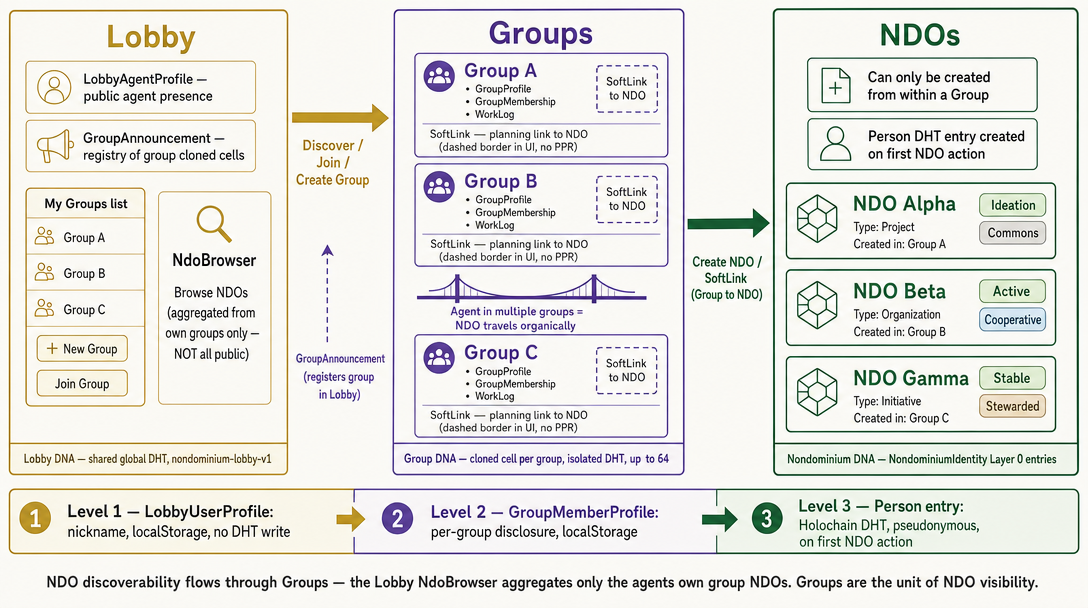
Lobby (global shared DHT) discovers Groups via GroupAnnouncement — not NDOs directly. Each Group is a cloned Group DNA cell with its own isolated DHT; Groups point at NDOs via NdoAnchor entries, and each NDO is itself a cloned ndo cell (ADR-010 model A). The Lobby's NdoBrowser aggregates only NDOs from the agent's own groups — there is no global public NDO registry. Identity deepens at each level: localStorage nickname (Level 1) → per-group profile (Level 2) → Person DHT entry on first NDO action (Level 3).
This hierarchy maps to the three concentric organizational scopes in ui_design.md:
- Lobby — the entry point: the NDOs aggregated from the agent's own groups, Groups listed in sidebar (no global public NDO registry).
- Group — organizational context: NDOs scoped to a group, where new NDOs are created.
- NDO — the resource identity detail view: Layer 0 metadata, lifecycle transitions, fork friction.
On top of this hierarchy, the next UI iteration adds a cross-cutting Perspective layer (Resource · Agent · Intelligence · Work) with a switcher and a navigation trail — see §16 and ui_design.md § Perspectives.
2. Technology Stack
| Layer | Technology |
|---|---|
| Framework | SvelteKit 2 + Svelte 5 runes ($state, $derived, $effect) |
| Language | TypeScript (strict mode) |
| Styling | UnoCSS (atomic CSS, preset-wind) |
| Headless components | Melt UI next-gen (melt) |
| Async / error handling | Effect-TS (effect package) — Context.Tag, Layer, E.gen |
| Holochain client | @holochain/client ^0.20.0 |
| Shared types | @nondominium/shared-types (workspace package) |
| Build | Vite 7 |
| Dev runtime | Browser (web) — Electron/hc-spin superseded by a per-agent Vite harness (§15) |
3. Layer Architecture
┌──────────────────────────────────────────────────────────────────┐
│ ROUTES                                                           │
│ /   (LobbyView)  /group/[id]  /ndo/[hash]  /ndo/new              │
└──────────────────────────────────────────────────────────────────┘
                                ↓
┌──────────────────────────────────────────────────────────────────┐
│ COMPONENTS                                                       │
│ lobby/: LobbyView, GroupSidebar, NdoBrowser, NdoCard,            │
│         UserProfileForm                                          │
│ group/: GroupView, NdoCreateModal, GroupProfileModal, MemberList │
│ ndo/:   NdoView, NdoIdentityLayer, LifecycleTransitionModal,     │
│         TransitionHistoryPanel, ForkNdoModal                     │
│ shell/: Sidebar (global nav)                                     │
└──────────────────────────────────────────────────────────────────┘
                                ↓
┌──────────────────────────────────────────────────────────────────┐
│ STORES (Svelte 5 $state + Effect-TS)                             │
│ app.context.svelte.ts   — cross-view app state                   │
│ lobby.store.svelte.ts   — Lobby-level NDOs, groups, filters      │
│ group.store.svelte.ts   — Group-scoped NDOs                      │
│ resource.store.svelte.ts — ResourceSpecification list            │
└──────────────────────────────────────────────────────────────────┘
                                ↓
┌──────────────────────────────────────────────────────────────────┐
│ SERVICES (Effect-TS Context.Tag / Layer)                         │
│ person.service.ts    — PersonServiceTag / PersonServiceLive      │
│ resource.service.ts  — ResourceServiceTag / ResourceServiceLive  │
│ governance.service.ts — GovernanceServiceTag / Live              │
│ ndo.service.ts       — NdoServiceTag / NdoServiceLive            │
│ lobby.service.ts     — LobbyServiceTag / LobbyServiceLive        │
│ group.service.ts     — GroupServiceTag / GroupServiceLive (stub) │
└──────────────────────────────────────────────────────────────────┘
                                ↓
┌──────────────────────────────────────────────────────────────────┐
│ HOLOCHAIN CLIENT                                                 │
│ holochain.service.svelte.ts — HolochainClientServiceTag          │
│ wrapZomeCallWithErrorFactory — wz<T>(fnName, payload, ctx)       │
└──────────────────────────────────────────────────────────────────┘
                                ↓
┌──────────────────────────────────────────────────────────────────┐
│ HOLOCHAIN CONDUCTOR (multi-DNA hApp)                             │
│ nondominium DNA: zome_person · zome_resource · zome_gouvernance  │
│ lobby DNA (provisioned) · group DNA (cloned per group)           │
│ ndo DNA (cloned per NDO, #112) · hrea DNA (vendored)             │
└──────────────────────────────────────────────────────────────────┘
4. Three-Level Identity Model (MVP)
The MVP UI introduces three distinct identity layers that do not require DHT writes for the outer two, enabling permissionless browsing and progressive disclosure.
Level 1 — Lobby (LobbyUserProfile, localStorage)
interface LobbyUserProfile {
  nickname: string;       // required
  realName?: string;
  bio?: string;
  email?: string;
  phone?: string;
  address?: string;
}
- Stored in
localStoragekeyndo_lobby_profile_v1. - Hydrated into
appContext.lobbyUserProfile($state) on first module load. - Created/edited via
UserProfileForm.svelte(modal on first launch, page-mode for edits). - No DHT entry. Exists before any
Personentry is created.
Level 2 — Group (GroupMemberProfile, localStorage)
interface GroupMemberProfile {
  isAnonymous: boolean;
  shownFields: (keyof Omit<LobbyUserProfile, 'nickname'>)[];
}
- Stored alongside
GroupDescriptorinlocalStoragekeyndo_groups_v1. - Prompted once per group via
GroupProfileModal.svelteon first group entry. - Agent controls which
LobbyUserProfilefields are visible to other group members.
Level 3 — NDO/Agent (Person entry, zome_person DHT)
- Written to the DHT when an agent performs their first DHT-active action (create NDO, accept commitment).
- Linked to
AgentPubKeyon-chain. - Required for governance participation, custodianship, specialised process access.
- Documented in
documentation/requirements/agent.md §2.1.
5. Group Architecture (DNA-backed)
Groups are the mandatory context for NDO creation. Each group is a cloned Group DNA cell (role_name: 'group', unique network_seed, clone_limit: 64 in workdir/happ.yaml).
interface GroupDescriptor {
  id: string;              // canonical key = network_seed
  networkSeed: string;
  name: string;
  description?: string;
  createdBy?: string;      // LobbyUserProfile.nickname at creation
  createdAt?: number;
  dnaHash?: string;        // clone cell DNA hash (base64)
  groupHash?: string;      // GroupProfile ActionHash (base64)
  memberProfile?: GroupMemberProfile; // Level 2 — localStorage only (ndo_group_profiles_v1)
}
Lifecycle: createGroup → createCloneCell → create_group → join_group → announce_group (Lobby DNA). Invite links encode { network_seed, group_dna_hash, group_name } as ?group=<base64>.
NDO association: each NDO is its own cloned ndo cell (ADR-010 model A). A group's NDO list = get_ndo_anchors(group_hash) on the group clone cell; cards render straight from the anchors' cached fields, so browsing never joins an ndo cell. Opening an NDO resolves its cell from the anchor coordinates (ensureNdoCloneCell, provisioning it for a peer who never joined) and reads the live entry. Pre-migration NDOs in the shared nondominium cell still resolve through a legacy fallback. Full rationale: documentation/specifications/adr/ADR-010-013-per-ndo-cells.md.
6. Component Reference
Lobby Level
| Component | File | Description |
|---|---|---|
LobbyView | lobby/LobbyView.svelte | Root lobby layout: profile bar, sidebar, NdoBrowser |
UserProfileForm | lobby/UserProfileForm.svelte | Lobby profile create/edit (modal or page mode) |
GroupSidebar | lobby/GroupSidebar.svelte | Groups list, Create Group form, Join Group form, My Profile link |
NdoBrowser | lobby/NdoBrowser.svelte | Filter chip bar (3 groups × multi-select) + NdoCard grid |
NdoCard | lobby/NdoCard.svelte | Compact NDO summary card with lifecycle/nature/regime badges |
Group Level
| Component | File | Description |
|---|---|---|
GroupView | group/GroupView.svelte | Group header, invite link, Create NDO, group-scoped NdoBrowser, MemberList (DHT) |
NdoCreateModal | group/NdoCreateModal.svelte | 5-field NDO creation form (name, regime, nature, stage, description) |
GroupProfileModal | group/GroupProfileModal.svelte | Per-group profile presentation choice (first entry only) |
NDO Level
| Component | File | Description |
|---|---|---|
NdoView | ndo/NdoView.svelte | NDO detail: header, tab navigation, Fork button |
NdoIdentityLayer | ndo/NdoIdentityLayer.svelte | Layer 0 identity panel: badges, initiator link, transition button, history |
LifecycleTransitionModal | ndo/LifecycleTransitionModal.svelte | State machine transitions with special Deprecated / Hibernating handling |
TransitionHistoryPanel | ndo/TransitionHistoryPanel.svelte | Collapsible history of lifecycle transitions |
ForkNdoModal | ndo/ForkNdoModal.svelte | Informational fork friction modal with copy-pubkey CTA |
Shell
| Component | File | Description |
|---|---|---|
Sidebar | shell/Sidebar.svelte | Global nav — "Browse NDOs", context-aware "New NDO" link |
Planned (Perspectives, §16):
shell/PerspectiveSwitcher.svelte,shell/NavigationTrail.svelte, and aperspectives/component folder.Sidebar's "Browse NDOs" link is expected to become the entry to the Resource Perspective.
7. State Management
app.context.svelte.ts
Cross-view singleton. All $state variables are module-level (Svelte 5 rune pattern):
| Field | Type | Persisted |
|---|---|---|
myAgentPubKey | `AgentPubKey | null` |
myPerson | `Person | null` |
currentView | `'lobby' | 'group' |
selectedGroupId | `string | null` |
selectedNdoId | `ActionHash | null` |
lobbyUserProfile | `LobbyUserProfile | null` |
Planned (§16):
currentPerspective('resource' | 'agent' | 'intelligence' | 'work') andnavigationTrail(stack ofPerspectiveLocation) will be added here;currentViewremains the Lobby/Group/NDO level within a Perspective.
lobby.store.svelte.ts
Effect-TS E.gen store instantiated once at module load via E.runSync.
| Reactive field | Derives from |
|---|---|
ndos | NdoServiceTag.getLobbyNdoDescriptors() |
filteredNdos | ndos + activeFilters (client-side OR-within/AND-across) |
groups | LobbyServiceTag.getMyGroups() |
activeFilters | Mutations via setFilters() / clearFilters() |
myPerson | PersonServiceTag.getMyPersonProfile() |
group.store.svelte.ts
Singleton per-session; loadGroupData(groupId) switches context:
| Field | Source |
|---|---|
group | LobbyServiceTag.getMyGroups() |
groupNdos | NdoServiceTag.getGroupNdoDescriptors(groupId) via SoftLinks |
members | GroupServiceTag.getMembers(cellId) |
loadGroupData(groupId, { silent? })— on a full (non-silent) load it first runslobbyService.ensureMembership(groupId)(idempotent self-heal so a joined agent always becomes a committed member), then fetches NDOs + members. A silent load (used by the pull layer) skips the membership reconcile, does not toggleisLoading, and keeps existing data on transient failure (no flicker/blanking).refreshCurrentGroup()— silent re-fetch of the currently-open group; driven byGroupView's pull-based reactivity (tab focus / visibility change + gentle ~8 s poll while visible).TODO(signals): replace the pull layer with Holochain remote signals (focus/poll kept only as an offline/missed-signal fallback).
8. Service Layer
Pattern
All services use the wz<T> factory:
const wz = <T>(fnName: string, payload: unknown, context: string) =>
  wrapZomeCallWithErrorFactory<T, DomainError>(
    holochainClient, 'zome_name', fnName, payload, context, DomainError.fromError
  );
ndo.service.ts — NdoServiceTag
| Method | Delegates to |
|---|---|
getLobbyNdoDescriptors() | Union of SoftLink targets across all group clone cells → resource.getNdo |
getNdoDescriptorForSpecActionHash(hash) | Direct resource.getNdo(hash) first; fallbacks to listings/cache |
createNdo(input, groupId) | resource.createNdo(input) + create_soft_link on group cell |
updateLifecycleStage(input) | resource.updateLifecycleStage(input) |
getNdoTransitionHistory(hash) | resource.getNdoTransitionHistory(hash) (zome fn not yet implemented; returns []) |
getGroupNdoDescriptors(groupId) | get_soft_links → resolve each target via resource.getNdo |
getAssociatedGroupIds(ndoHashB64) | SoftLink scan across agent's groups |
joinNdo / getNdoMembers | DHT-backed via zome_resource join_ndo / get_ndo_members on the per-NDO clone cell; joinNdo is idempotent |
lobby.service.ts — LobbyServiceTag (Group + Lobby DNA)
| Method | Behaviour |
|---|---|
getMyGroups() | Enumerate group clone cells from appInfo + get_my_group per cell |
createGroup(name, createdBy) | createCloneCell → create_group → join_group → announce_group (the join_group/announce_group post-steps are best-effort via E.catchAll, so transient contention never aborts creation) |
joinGroup(inviteCode) | Decode invite → createCloneCell(same seed) → fetchGroupProfileWithRetry (poll get_my_group, 6× / ~2.4 s for DHT gossip) → is_member guard → best-effort join_group → on profile miss, build a GroupDescriptor from the invite payload so the group still appears immediately. TODO(signals): replace the poll with a Holochain remote signal once available |
ensureMembership(groupId) | Idempotent membership self-heal: resolve group hash via get_my_group → is_member → best-effort join_group if missing. Covers joins that missed the membership commit (payload-fallback path / swallowed join_group). Called on every full loadGroupData so a joined agent always reconciles into the member list |
generateInviteLink(groupId) | { network_seed, group_dna_hash, group_name } → ?group=<base64> URL |
getGroupCell(groupId) | Resolve clone CellId by network_seed |
saveGroupMemberProfile(groupId, profile) | localStorage[ndo_group_profiles_v1] (Level 2 identity) |
group.service.ts — GroupServiceTag
| Method | Zome call |
|---|---|
getMembers(cellId) | get_group_members (each member = action author of a GroupMembership linked from the group hash) |
getSoftLinks / createSoftLink | get_soft_links / create_soft_link |
Shared-group reactivity & data freshness
Shared-group items (members, NDO SoftLinks, work logs) live on the group clone-cell DHT and reach other members via gossip. The UI keeps views fresh with a pull-only model today (no push):
- Per-open reconciliation —
loadGroupDatarunsensureMembership(self-heal) then re-reads members + NDOs whenever a group view mounts orgroupIdchanges. - Tab focus / visibility —
GroupViewcallsrefreshCurrentGroup()(silent) when the window regains focus or the tab becomes visible. - Gentle poll — a ~8 s interval silent refresh while the group is open and the tab is visible (paused when hidden).
- Join gossip-retry + fallback —
fetchGroupProfileWithRetryinjoinGroupabsorbs the gossip latency of a freshly-cloned cell.
Consequence: a change made by another member appears within the poll interval, on focus, or on reload — not instantly. The push upgrade (TODO(signals)) is to have zome_group remote_signal members on join_group / create_soft_link / log_work, with the UI refreshing on those signals and the pull layer kept only as an offline/missed-signal fallback (consolidated design note in dnas/group/zomes/coordinator/zome_group/src/lib.rs).
9. Routing
| Route | Component | Notes |
|---|---|---|
/ | LobbyView | Lobby entry point; shows all NDOs |
/group/[id] | GroupView | Group-scoped view; ?createNdo=1 auto-opens modal |
/ndo/[hashB64] | NdoView | NDO detail (hash is base64-encoded ActionHash) |
/ndo/new | Redirect page | Redirects to active group or shows explanation |
Planned Perspective routes (§16): /resource, /agent (+ /agent/[pubkey]), /intelligence, /work (+ /work/[projectHash]). / remains the Lobby entry until the Resource Perspective replaces it as the default landing view.
Navigation Logic
- "New NDO" link in Sidebar: if
appContext.selectedGroupIdis set →/group/{id}?createNdo=1; else →/ndo/new(explanation screen). - Group navigation:
GroupSidebar.sveltecallsgoto('/group/{id}')after create/join. - Post-NDO-creation:
NdoCreateModal.sveltecallsgoto('/ndo/{hashB64}')on success.
10. NDO Lifecycle State Machine (Frontend Mirror)
LifecycleTransitionModal.svelte encodes the same state machine as the Rust validation in zome_resource. Allowed transitions:
| From | Allowed next stages |
|---|---|
| Ideation | Specification, Deprecated, EndOfLife |
| Specification | Development, Deprecated, EndOfLife |
| Development | Prototype, Deprecated, EndOfLife |
| Prototype | Stable, Deprecated, EndOfLife |
| Stable | Distributed, Deprecated, EndOfLife |
| Distributed | Active, Deprecated, EndOfLife |
| Active | Hibernating, Deprecated, EndOfLife |
| Hibernating | hibernation_origin stage, Deprecated, EndOfLife |
| Deprecated | EndOfLife |
Special handling:
- Deprecated: requires successor NDO selection (autocomplete from
lobbyStore.ndos). - Hibernating: confirmation message shown;
hibernation_originpreserved in entry. - Transition button visible to initiator only (
descriptor.initiator === encodeHashToBase64(myAgentPubKey)). transition_event_hashis passed asnullin MVP (automatic EconomicEvent generation is a post-MVP backend task).
11. Filter Architecture (NdoBrowser)
Three independent chip groups with multi-select:
| Group | Options | Logic |
|---|---|---|
| LifecycleStage | 10 variants | OR within group |
| ResourceNature | 5 variants | OR within group |
| PropertyRegime | 7 variants | OR within group |
Cross-group logic: AND (an NDO must match at least one selection in every active group).
Default: all filters empty = show all NDOs.
Chip colors: match the badge colors in NdoIdentityLayer.svelte color maps.
12. Fork Friction Pattern
Fork requests are intentionally non-trivial by design (see ui_design.md Fork section). The MVP implements:
- Informational modal only (
ForkNdoModal.svelte): explains negotiation → consensus → Unyt stake (post-MVP) flow. - CTA: copy initiator's
AgentPubKey(base64) to clipboard for out-of-band contact. - Visibility: Fork button visible to any authenticated user (anyone with
myAgentPubKeyset). - Full fork submission (claim, vote, Unyt stake) is post-MVP.
13. Post-MVP UI Tracks
The following UI capabilities are documented but not yet implemented. Perspectives (§16) are not post-MVP: they are the next planned UI work (see ui_design.md § Perspectives ToDos); only the parallax/landscape visual layer on top of them remains post-MVP.
| Track | Trigger | Design reference |
|---|---|---|
NDO membership (join_ndo) | Backend stub in UI; implement NdoMembership in zome_resource | documentation/zomes/resource_zome.md § NDO membership |
get_ndo_transition_history | Lifecycle audit panel empty until zome fn lands | TransitionHistoryPanel.svelte |
| NDO cell cloning | Per-NDO DHT once Holochain cloning stabilises | ndo_prima_materia.md §4 |
| PPR / Reputation dashboard | After PPR zome functions are complete (#14–#21) | specifications/governance/private-participation-receipt.md |
| Economic Process workflows | After Phase 2.2 process infrastructure lands | requirements.md §4.2, implementation_plan.md §5 Phase 2.2 |
| Person management components | After enhanced private data sharing (#40) | requirements.md §4.1, issue #8 |
| Role management UI | After agent promotion workflow (#33, #34) | requirements.md §4.3 |
| Moss WeApplet | Post-MVP deployment target | implementation_plan.md §12.6 |
| Unyt / Flowsta integration UI | Phases 12.2–12.3 in implementation plan | post-mvp/unyt-integration.md, post-mvp/flowsta-integration.md |
| Push reactivity via Holochain signals | Replace the pull layer (focus + poll + per-open reconcile) with remote_signal from zome_group on member/SoftLink/work-log mutations | TODO(signals) in zome_group/src/lib.rs, GroupView.svelte, lobby.service.ts |
14. Effect-TS Patterns
Service injection
// Resolved layer for direct component use
export const NdoServiceResolved: Layer.Layer<NdoServiceTag> =
  NdoServiceLive.pipe(Layer.provide(ResourceServiceResolved));

// Usage in a Svelte $effect or onMount
const exit = await E.runPromiseExit(
  pipe(
    E.gen(function* () {
      const svc = yield* NdoServiceTag;
      return yield* svc.getLobbyNdoDescriptors();
    }),
    E.provide(NdoServiceResolved)
  )
);
Store instantiation (Svelte 5 rune + Effect pattern)
// Module-level $state variables (top-level only — Svelte 5 rune constraint)
let ndos = $state<NdoDescriptor[]>([]);

// Store created synchronously with E.runSync; Effect only provides dependencies
export const lobbyStore = pipe(
  createLobbyStore(),         // E.Effect<LobbyStore, never, Services>
  E.provide(LobbyStoreServicesResolved),
  E.runSync                   // services are pure/synchronous; no async at creation time
);
Error handling
All zome errors are domain-tagged (ResourceError, PersonError, etc.) with context strings for debugging. Effects that may fail are run with E.runPromiseExit, and Exit.isSuccess(exit) guards all state mutations.
15. Local Development & Multi-Agent Web Harness
The dev runtime is the browser, not Electron. The previous hc-spin flow streamed the full .happ (~8 MB) over the admin websocket and timed out, so local development is now orchestrated by scripts/launch-happ.mjs (invoked by bun run start / AGENTS=N bun run network).
15.1 Launcher responsibilities (scripts/launch-happ.mjs)
- Bootstrap + signaling: spawns
kitsune2-bootstrap-srvand parses its listening URLs. - Sandboxes:
hc sandbox --piped create -n N … webrtc <signal>thenhc sandbox --piped run(LAIR password piped on stdin). - Path-based install: connects an
AdminWebsocketper conductor and callsinstallApp({ source: { type: 'path', value: happPath } })+enableApp— avoids the websocket bundle-streaming timeout. - Connection manifest: writes
ui/static/hc-connection.json({ appId, agents: [{ agent, adminWsUrl, appWsUrl }], updatedAt }), updated incrementally as each conductor comes up. - One Vite server per agent:
startUiServers()spawnsbun run startfromui/for each agent withUI_PORT = basePort + (agent-1)andVITE_DEV_AGENT = agent. Agent n →http://localhost:{5173 + n - 1}. - Auto-open: when a Vite server prints its
Local:URL, the launcher opens a browser tab (open/start/xdg-open). SetNO_OPEN=1to disable (headless/CI). - Shutdown:
SIGINT/SIGTERMtears down all UI servers, the sandbox, and the bootstrap server.
15.2 Why a port per agent
Each agent gets a dedicated port = dedicated origin, which yields fully isolated browser localStorage per agent while keeping URLs clean (no ?agent= noise in permalinks). This replaced an earlier single-origin ?agent=N approach. The query param is retained only as a manual override for advanced cases.
15.3 Agent selection (ui/src/lib/utils/hc-connect.ts)
getDevAgentIndex() resolves which conductor a window binds to, in priority order:
?agent=Nquery param (manual override).VITE_DEV_AGENTenv var (the primary mechanism — injected per Vite server by the launcher).localStorage[ndo_dev_agent], else default1.
15.4 Connection modes (connectHolochainClient)
| Mode | Trigger | Notes |
|---|---|---|
launcher | window.__HC_LAUNCHER_ENV__ present | hc-spin Electron path (legacy/optional) |
manifest | /hc-connection.json has agents | Primary web path; picks the entry matching getDevAgentIndex(); polls up to 5 min while conductors install |
env | VITE_HC_ADMIN_WS_URL + VITE_HC_APP_WS_URL | manual override |
In manifest/env modes the result carries the adminWsUrl so the UI can authorize signing credentials for runtime-created group clone cells.
15.5 Signing-credential authorization & resilience
- On connect, the UI calls
authorizeSigningCredentialsfor everyprovisionedandclonedcell (clone cells lose in-memory signing credentials on reload, so their zome calls would otherwise fail). - Grants are serialized (each is a source-chain commit); concurrent grants raise "source chain head has moved", so
authorizeWithRetryretries with backoff (5 attempts). authorizeCellSigning(adminWsUrl, cellId)is exported so a group clone cell created after initial connect (create/join group) is authorized on demand.
15.6 Per-agent UI-state namespacing
Because two windows can share an origin (the ?agent= override), all UI-only localStorage keys are namespaced via devStorageKey(base) → ${base}__a{agentIndex}:
| Base key | Owner |
|---|---|
ndo_lobby_profile_v1 | app.context.svelte.ts (Level 1 profile) |
ndo_group_profiles_v1 | lobby.service.ts (Level 2 disclosure prefs) |
ndo_group_visited_v1 | GroupView.svelte (first-visit prompt) |
ndo_dev_agent | dev agent index (not namespaced — it is the namespace) |
Note: DHT-backed state (groups, NDOs, members) is isolated by the conductor itself; namespacing only protects the UI-only localStorage layer when origins are shared.
16. Perspectives Architecture (Next, planned)
Status: planned — next UI iteration after the MVP. Normative requirements: documentation/requirements/ui_design.md § Perspectives and § Perspectives ToDos. Nothing below is implemented yet.
A Perspective is a lens (filters, default tools, layout) over data already reachable through the Lobby → Group → NDO hierarchy. Perspectives are orthogonal to that hierarchy: currentView (lobby/group/ndo) says where the agent is; currentPerspective says how the data is being looked at.
16.1 Perspectives and data sources
Each Perspective has a base primitive and answers "what is the agent doing?" (see ui_design.md § Perspectives).
| Perspective | Route | Base primitive | Primary data | Backing services |
|---|---|---|---|---|
| Resource | /resource | Resource (NDO) | NDOs across own groups; linked Agents (custodian, repair, ...); Sources and the Source view | NdoServiceTag, LobbyServiceTag, PersonServiceTag |
| Agent | /agent, /agent/[pubkey] | Agent (incl. Groups) | Agent profiles, group members, skills, relationship graph, Group announcements | PersonServiceTag, GroupServiceTag, LobbyServiceTag |
| Intelligence | /intelligence | Projects / organizations beyond the current sphere | Groups and project-type NDOs, incl. outside the agent's own groups; role / skills / reputation (PPR) / interaction history; project-declared benefits; MCP assistant | LobbyServiceTag, NdoServiceTag, GovernanceServiceTag (PPR) |
| Work | /work, /work/[projectHash] | Process / work item, scoped to a resource, project or group | Project-type NDOs the agent subscribed to or contributed to; tasks, commitments, contributions, stigmergic signals | NdoServiceTag (joinNdo / getNdoMembers), GovernanceServiceTag, GroupServiceTag |
Progressive layering: within a Perspective, a view starts from its primitive and adds layers on demand (e.g. Resource: communities → local map → users → owner organization). Layers are modelled as an ordered list in each Perspective's view config, not as separate routes.
Known gaps to close first: (1) a way to identify project-type NDOs; (2) project-declared benefits must be added to the project-type NDO specification (requirements/post-mvp/project-type-ndo-specifications.md) before Intelligence can assess them; (3) cross-group / Lobby-level discovery — today the Lobby only aggregates the agent's own groups; (4) skills / reputation data (Person + PPR still in progress); (5) push signals for Work's stigmergic feed (pull-based polling as interim, see § 8); (6) an MCP server exposing the agent's profile and project data for the Intelligence assistant.
16.2 State
Added to app.context.svelte.ts (module-level $state, Svelte 5 pattern):
type Perspective = 'resource' | 'agent' | 'intelligence' | 'work';

interface PerspectiveLocation {
  perspective: Perspective;
  route: string;                 // e.g. '/agent/uhCAk…'
  entity?: { kind: 'ndo' | 'agent' | 'group' | 'project'; id: string; label: string };
  viewState?: unknown;           // filters, scroll, selection — restored on "back"
}

// appContext.currentPerspective: Perspective
// appContext.navigationTrail: PerspectiveLocation[]   (in-memory; not persisted)
A dedicated perspective.store.svelte.ts (Effect-TS pattern as in § 14) owns jumpTo(target), back(), switchTo(perspective) and trail truncation, so components never mutate the trail directly.
16.3 Navigation semantics
- Switch (
switchTo): user picks a Perspective in the switcher; trail is reset to that Perspective's root. Each Perspective remembers its lastviewState. - Jump (
jumpTo): a contextual link carrying an entity (e.g. linked Agent in an NDO expanded view → Agent Perspective; joined project → Work). The current location is pushed onnavigationTrailwith itsviewState. - Back (
back): pops the trail and restores route +viewState.NavigationTrail.svelterenders the stack as a breadcrumb (Resource: Drill press → Agent: Alice → Groups). - Hints:
PerspectiveSwitcher.sveltemay show a contextual badge when another Perspective is relevant (e.g. "Discover projects" in Work → Intelligence).
Jump table (authoritative list in ui_design.md § Cross-Perspective Navigation): Work → Intelligence; Intelligence → Work (on join); Resource → Agent (linked Agent); Agent → Resource; Agent/Intelligence → Work or Group (on join).
16.4 Tools (perspective-agnostic)
Tools are not Perspectives. A small tool registry (tools/registry.ts) lets any Perspective mount a tool over its current entity set via a typed contract:
interface PerspectiveTool<T> {
  id: string;                          // 'map', 'chat', 'simulation', 'kanban', ...
  accepts: (kind: EntityKind) => boolean;
  component: Component<{ entities: T[]; onSelect: (e: T) => void }>;
}
The Chat tool (direct contact with an Agent, possibly via the Capability Surface) is available from several Perspectives. The Geographic map is the first tool (it replaces the former Geographic Perspective): opened from Resource it maps NDOs, from Agent it maps Agents, from Intelligence it maps opportunities. Kanban is Work-scoped; simulations (time-allocation portfolio, benefit redistribution) are primarily hosted by Intelligence, next to the MCP-based assistant.
16.5 Component / file plan
| Component | File | Role |
|---|---|---|
PerspectiveSwitcher | shell/PerspectiveSwitcher.svelte | Persistent switcher + contextual hints |
NavigationTrail | shell/NavigationTrail.svelte | Breadcrumb + "Back to |
ResourcePerspective | perspectives/ResourcePerspective.svelte | Seeded from NdoBrowser; adds linked-Agent view |
AgentPerspective / AgentProfileView | perspectives/AgentPerspective.svelte | Agent search, profile, connections, Group discovery |
IntelligencePerspective | perspectives/IntelligencePerspective.svelte | Ranked discovery + tool slot |
WorkPerspective / ProjectWorkspace | perspectives/WorkPerspective.svelte | Project list, kanban, tasks, signals |
ToolHost | tools/ToolHost.svelte | Mounts registered tools in any Perspective |
Implementation order follows ui_design.md § Perspectives ToDos: switcher and trail first, then Resource (reusing NdoBrowser), Agent, Intelligence, Work.
16.5.1 Layer 0 cut (prototyped in the design system, not yet in the app)
For the Layer 0 release the Perspective switcher sits inside the Group page (Lobby → Group → Perspective); only Resource is live and every Perspective is group-scoped. The prototype lives in nondominium-design-system (/scenarios/resource-perspective), with components in @nondominium/ndo-ui. The port to this app is a ToDo (ui_design.md § Port to the nondominium app).
| Piece | Location (in packages/ndo-ui/src/) | Role |
|---|---|---|
| Coming-next registry | domain/coming-next.ts | Single source of copy for every "Soon" item (perspectives, tabs, access actions, processes, governed transitions, jump points; Unyt stake and Source view copy exist but are not wired yet), plus the PERSPECTIVES list and PerspectiveId |
ComingNextPopup, SoonBadge | components/primitives/ | Reusable popup (built on Modal; optional live shortcut, e.g. Offer → Create NDO) and badge |
PerspectiveSwitcher, Breadcrumb | components/patterns/perspectives/ | Tablist of four Perspectives (non-live ones open the popup and keep the current one); breadcrumb Lobby › Group › Resource › NDO |
ResourcePerspective | same | Search, ownership scope, sort, stage / nature / regime filters over NdoBrowser; logic in domain/resource-perspective.ts (searchNdos, scopeNdos, sortNdos) |
GroupPerspectivesView | same | Perspective host replacing the Group page body (header, switcher, Resource Perspective, member list) |
ResourceNdoView, NdoActionRow | same | NDO view with Overview + "Soon" tabs, access actions and processes row, join / associate / fork / copy link |
Additive changes to existing components (no breaking changes for current callers): NdoBrowser gains cardAction and emptyMessage; NdoIdentityPanel gains lockedTransition, onlockedtransitionclick, oninitiatorclick; MemberList gains onmemberclick.
State at this cut: currentPerspective only ('resource' live); navigationTrail and jumpTo / back stay in § 16.2 and arrive with the Agent Perspective. Jump points open the Coming-next popup instead of navigating.
Authorization is unchanged: the lifecycle transition remains initiator-only, enforced in the integrity zome (zome_resource); the UI only mirrors it by locking the button for non-initiators.
16.6 Community-specific implementations (later)
Community-specific UIs (terminology → workflows → visuals) sit on top of the four base Perspectives; ValueFlows stays the background vocabulary. Architecturally this implies a dictionary layer: a per-community mapping from display terms to the base vocabulary, consulted by components instead of hard-coded labels (so new base components should already route user-facing terms through a single t()-style lookup). How this relates to the Surface / Surface Attachment (capability slots) is to be specified; see ui_design.md § Community-Specific Implementations. Higher-level interoperability concerns are parked (ui_design.md § Future Reflection).