Private Participation Receipts (PPR)
Overview
Private Participation Receipts are cryptographically signed, cumulative records stored as private entries in an agent's source chain. They serve as proof of reliable participation in the nondominium network and form the foundation for a generative reputation system.
Core Principles
- Bi-directional Issuance: Receipts are issued between agents involved in each economic interaction
- Cryptographic Integrity: All receipts are cryptographically signed for authenticity
- Multi-role Support: Agents can accumulate receipts across multiple roles simultaneously
- Privacy Preservation: Receipt details remain private while enabling reputation derivation
- ValueFlows Compliance: Modeled as specialized Claims within the ValueFlows ontology
Fundamental Concepts
Commitments and Fulfillments
- Commitments: Actions (resource creation, transfer, maintenance) are formally committed by agents
- Validations: Fulfillments that confirm commitments have been properly executed
- Good Faith Usage: Users commit to honest usage practices (reporting damage, avoiding monopolization)
Receipt Generation Logic
- Two Receipts Per Action: Each economic interaction generates exactly 2 bi-directional receipts between participating agents
- Implicit Resource Validation: Resource validation is implicit through agent validation (except for creation events)
- Agent-Focused: Receipts track agent behavior and reliability, not resource state changes
TODO (G1, REQ-GOV-16 — post-MVP): The
counterpartyfield inPrivateParticipationClaimcurrently assumes an individual agent (AgentPubKey). Post-MVP, custody transfer to a collective agent (e.g., a project NDO) will requirecounterparty: AgentContext. Bot agents generate PPRs with their operator'sAgentPubKeyas the accountable counterparty.
PPR Issuance Categories
1. Genesis Role - Network Entry
Resource Creation Events
1.1 Resource Creation & Validation (Single Transaction)
- Trigger: A resource is registered on the network and validated by another agent
- Generated Receipts (2 total):
- Creator Agent: Receives "successful resource contribution" receipt
- Validator Agent: Receives "network validation performed" receipt
- Special Case: Resource creation is an event requiring explicit validation receipts, as it establishes the resource's entry into the network
2. Core Usage Role - Custodianship
Custody Transfer Events
2.1 Resource Custody Transfer
- Trigger: Resource custody is transferred between agents
- Generated Receipts (2 total):
- Outgoing Custodian: Receives "responsible custody transfer" receipt
- Incoming Custodian: Receives "custody acceptance" receipt
- Note: Resource validation is implicit through the custodian agents' reliability; no separate validation receipts needed
3. Intermediate Roles - Specialized Services
Specialized Service Receipts
Participant Structure: Involves 2 or 3 agents (original custodian, intermediate service provider, final recipient).Thus, the Resource is transferred from original custodian (User) to intermediate service provider, back to another or the same User.
3.1 Maintenance Service
- Commitment Phase: Service provider commits to maintenance duties
- Generated Receipts (2 total):
- Maintenance Agent: Receives "maintenance commitment accepted" receipt
- Custodian Agent: Receives "Good faith transfer" receipt
- Fulfillment Phase: Commitment is fulfilled through completed maintenance and resource available again
- Generated Receipts (2 total):
- Maintenance Agent: Receives "maintenance fulfillment completed" receipt
- Resource Recipient: Receives "custody acceptance" receipt
3.2 Storage Service
- Commitment Phase: Service provider commits to storage duties
- Generated Receipts (2 total):
- Storage Agent: Receives "storage commitment accepted" receipt
- Custodian Agent: Receives "Good faith transfer" receipt
- Fulfillment Phase: Commitment is fulfilled through resource custodian transfer
- Generated Receipts (2 total):
- Storage Agent: Receives "storage fulfillment completed" receipt
- Resource Recipient: Receives "custody acceptance" receipt
3.3 Transport Service
- Commitment Phase: Service provider commits to transport duties
- Generated Receipts (2 total):
- Transport Agent: Receives "transport commitment accepted" receipt
- Custodian Agent: Receives "Good faith transfer" receipt
- Fulfillment Phase: Commitment is fulfilled through completed transport and resource delivery
- Generated Receipts (2 total):
- Transport Agent: Receives "transport fulfillment completed" receipt
- Resource Recipient: Receives "custody acceptance" receipt
Role Chaining Mechanics
- Multi-role Agents: Agents can hold multiple intermediate roles simultaneously, ex. they can hold credencials for transport, maintenance and storage at the same time.
- Action Chaining: Service Agents can chain multiple actions (transport → repair → transport) within a single commitment
- Self-Managed Chains: Intermediate steps don't require external validation
- Atomic Transactions: Entire chain treated as single commitment/fulfillment cycle
Example Workflow: Transport + Repair Service
Initial State: Lynn (custodian) → Resource needs repair
Service Request: Lynn requests Bob (transport + repair credentials) to service resource

Commitment Phase:
1. Bob commits to: receive → transport → repair → transport → deliver
2. Mutual signatures create bi-directional receipts:
   - Lynn → Bob: "Service commitment accepted" receipt
   - Bob → Lynn: "Good faith transfer" receipt

Execution Phase:
3. Bob executes action chain without intermediate validation
4. Internal status changes (transport → repair → transport) for the resource are self-managed, pending validation.

Completion Phase:
5. Resource delivered to final recipient (Lynn or another recipient agent)
6. Final bi-directional receipts:
   - Bob → Recipient: "custody acceptance" receipt
   - Recipient → Bob: "Transport + Repair fulfillment completed" receipt
Additional PPR Contexts
4. Network Governance
- Dispute Resolution Participation: Receipts for constructive participation in conflict resolution
- Validation Activities: Receipts for performing validation duties beyond specific transactions
- Rule Compliance: Receipts for consistent adherence to governance protocols
5. Quality Assurance
- Economic Event Completion: Receipts for successfully completing any EconomicEvent
- Commitment Fulfillment: Receipts when claims properly link commitments to their fulfillment
- Performance Standards: Receipts for meeting or exceeding quality thresholds
ValueFlows Integration
PPRs are implemented as specialized PrivateParticipationClaim entries that extend the standard ValueFlows Claim structure:
#![allow(unused)]
fn main() {
pub struct PrivateParticipationClaim {
    // Standard ValueFlows fields
    pub fulfills: ActionHash,           // References the commitment fulfilled
    pub fulfilled_by: ActionHash,       // References the economic event
    pub claimed_at: Timestamp,

    // PPR-specific extensions
    pub claim_type: ParticipationClaimType,
    pub performance_metrics: PerformanceMetrics,
    pub bilateral_signature: CryptographicSignature,
}
}
This design maintains ValueFlows compliance while enabling the cumulative reputation system essential for nondominium governance.
Resource End-of-Life Management
6. Resource Decommissioning
Critical Lifecycle Completion
Resources require formal end-of-life processing to prevent abuse vectors and maintain network integrity.
6.1 Resource End-of-Life Declaration
- Trigger: Resource becomes permanently unusable, damaged beyond repair, or deliberately retired
- Security Concern: This event is a potential attack vector where agents might claim resources are "destroyed" to steal or monopolize them
- Generated Receipts (2 total):
- Declaring Agent: Receives "end-of-life declaration submitted" receipt
- Validator Agent: Receives "end-of-life validation performed" receipt
Strict Validation Requirements
To prevent end-of-life abuse:
- Multiple Validators Required: Minimum 2-3 validators must confirm end-of-life status
- The number of validators required can be adjusted based on the resource's value and sensitivity
- The declarator agent can't be a validator and even less than the disposal agent
- The validators must be experts (maintainers) that can validate the resource's condition and authenticity
- Evidence Documentation: Physical evidence (photos, inspection reports) required
- Validator Accountability: Validators become liable for false end-of-life approvals
- Historical Review: Past custodians notified and can challenge the declaration
- Time-Delayed Finalization: 7-14 day challenge period before final decommissioning
- Reputation Impact: False end-of-life declarations severely impact declaring agent's reputation
- Resource final transfer: Resource can not stay with the declaring agent. Validators can transfer the resource to a storage for broken resource in waiting for reparation attempt or definitively decommission it.
Complete Resource Lifecycle
Genesis → Active Use → Service Cycles → End-of-Life → Decommissioned
   ↓         ↓             ↓              ↓             ↓
Creation  Transfers   Maintenance    Declaration   Validation
Receipt   Receipts    Receipts       Receipt       Receipt
This comprehensive lifecycle ensures complete accountability from resource creation through final decommissioning, with enhanced security measures protecting against end-of-life abuse vectors.
PPR System Overview
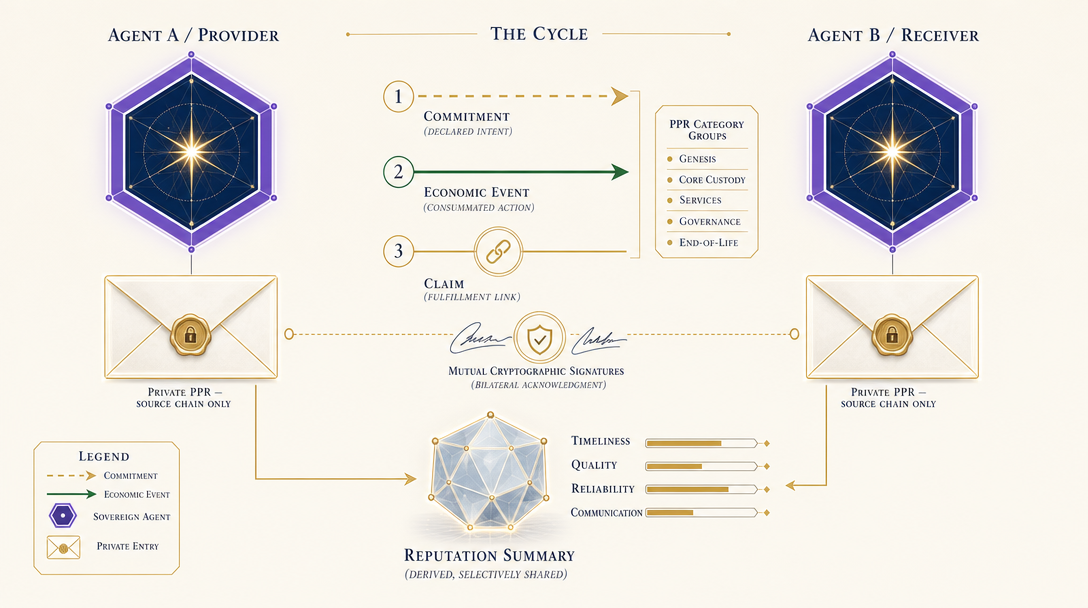
Two sovereign agents (Agent A / Provider and Agent B / Receiver) exchange a Commitment, an Economic Event, and a Claim. Each agent stores a sealed Private PPR on their own source chain only. Both receipts feed into a derived Reputation Summary.
PPR Process Flow Diagram
flowchart TB
    subgraph Genesis["Genesis Phase"]
        RC["Resource Creation"]
        Creator["Creator Agent"]
        Validator1["Validator Agent"]
        CreatorReceipt["Receipt: Resource Contribution"]
        ValidatorReceipt["Receipt: Network Validation"]

        RC --> Creator
        RC --> Validator1
        Creator --> CreatorReceipt
        Validator1 --> ValidatorReceipt
    end

    subgraph ActiveUse["Active Use Phase"]
        Transfer["Custody Transfer"]
        CustodianOut["Outgoing Custodian"]
        CustodianIn["Incoming Custodian"]
        OutReceipt["Receipt: Responsible Transfer"]
        InReceipt["Receipt: Custody Acceptance"]

        Transfer --> CustodianOut
        Transfer --> CustodianIn
        CustodianOut --> OutReceipt
        CustodianIn --> InReceipt
    end

    subgraph ServicePhase["Service Phase"]
        ServiceCommitment["Service Commitment"]
        ServiceFulfillment["Service Fulfillment"]
        ServiceAgent["Service Provider"]
        CustodianAgent["Custodian Agent"]
        ResourceRecipient["Resource Recipient"]

        CommitmentReceipt1["Receipt: Commitment Accepted"]
        CommitmentReceipt2["Receipt: Good Faith Transfer"]
        FulfillmentReceipt1["Receipt: Fulfillment Completed"]
        FulfillmentReceipt2["Receipt: Custody Acceptance"]

        ServiceCommitment --> ServiceAgent
        ServiceCommitment --> CustodianAgent
        ServiceAgent --> CommitmentReceipt1
        CustodianAgent --> CommitmentReceipt2

        ServiceFulfillment --> ServiceAgent
        ServiceFulfillment --> ResourceRecipient
        ServiceAgent --> FulfillmentReceipt1
        ResourceRecipient --> FulfillmentReceipt2
    end

    subgraph EndOfLife["End-of-Life Phase"]
        EOLDeclaration["End-of-Life Declaration"]
        DeclaringAgent["Declaring Agent"]
        ExpertValidator["Expert Validator<br/>(2-3 Required)"]
        PastCustodians["Past Custodians<br/>Notification"]
        ChallengePeriod["7-14 Day<br/>Challenge Period"]
        FinalDisposal["Final Disposal/Storage"]
        ValidationReview["Validation Review"]
        EOLReceipt["Receipt: EOL Declaration"]
        ValidationReceipt["Receipt: EOL Validation"]

        EOLDeclaration --> DeclaringAgent
        EOLDeclaration --> ExpertValidator
        EOLDeclaration --> PastCustodians

        ExpertValidator --> ChallengePeriod
        ChallengePeriod -->|No Challenges| FinalDisposal
        ChallengePeriod -->|Challenge Raised| ValidationReview

        DeclaringAgent --> EOLReceipt
        ExpertValidator --> ValidationReceipt
    end

    RC -->|Validated| Transfer
    Transfer -->|May Need Service| ServiceCommitment
    ServiceCommitment --> ServiceFulfillment
    ServiceFulfillment -->|Return to Use| Transfer
    Transfer -->|End of Lifecycle| EOLDeclaration
Key Process Features
- Bi-directional Receipts: Each economic interaction generates exactly 2 receipts between agents
- Security Constraints: Multi-validator requirement (2-3 experts) and challenge period for end-of-life restrictions
- Validation Requirements: Shows expert validators needed and time-based challenge periods
- Lifecycle Loops: Service phase can cycle multiple times during active resource utilization
- Complete Accountability: Every phase tracked with appropriate cryptographic receipts
Security Highlights
- Multi-Validator System: 2-3 expert validators required for end-of-life declarations
- Challenge Period: 7-14 day window for contesting end-of-life claims
- Past Custodian Notification: Historical custodians informed of end-of-life events
- Evidence Documentation: Physical evidence requirements for validation
- Reputation Impact: False declarations severely impact agent reputation
Post-MVP: Governance Ceremony PPRs
TODO (G6, REQ-GOV-15 — post-MVP): The
AffiliationRecordsigning ceremony generates a new PPR category. When an agent signs anAffiliationRecord(Terms of Participation, Nondominium & Custodian agreement, Benefit Redistribution Algorithm), theCommitment/EconomicEvent/Claimcycle inzome_governanceproduces anAffiliationRecordSignedPPR.
AffiliationRecordSigned PPR Properties
- Bilateral: The witness
AgentPubKeycountersigns if present at the ceremony - Non-transferable and private: Stored as a private entry; cannot be reassigned to another agent
- Affiliation trigger: The presence of this PPR is the evidence that
AffiliationStatederivation returnsActiveAffiliatefor the signing agent - New
ParticipationClaimTypevariant:AffiliationRecordSigned(seegovernance_zome.mdParticipationClaimTypefor the full TODO)
Governance Ceremony Flow (Post-MVP)
- Agent calls
create_affiliation_record()inzome_governance - A
Commitmentis created: agent commits to Terms of Participation - An
EconomicEventrecords the signing as a completed governance action - A
Claimfulfils the Commitment, producing theAffiliationRecordSignedPPR AffiliationStatederivation inzome_personreads DHT forAffiliationRecordentry → returnsActiveAffiliatefor this agent- Agent can now participate in governance processes gated by
min_affiliation: ActiveAffiliate(seeREQ-GOV-14andgovernance.md §3.6.2)