Agent: Ontology, Implementation, and Forward Map
Type: Archive / Knowledge Base Document
Created: 2026-03-11
Relates to: governance.md, resources.md, ndo_prima_materia.md, unyt-integration.md, flowsta-integration.md
Sources: MVP code (zome_person, zome_gouvernance PPR/validation), post-MVP design, OVN wiki — Agent, Identity, Individual profile, Organizational structure
Purpose
This document maps the three states of Agent understanding in the Nondominium / NDO project:
- Implemented — what exists today in the MVP
zome_personand governance-related agent handling - Planned — what is designed in post-MVP documents for agent evolution
- Remaining — what the OVN wiki's 15 years of commons-based peer production practice contains that NDO does not yet plan for
The goal is to ensure the generic NDO agent model is as complete and principled as the OVN ontology, enabling diverse applications (resource-sharing, digital commons, open science, cooperative production) to configure agent behaviour through data, not custom code.
1. Conceptual Foundation: What is an Agent in P2P Complexity Economics?
1.1 Agent vs User — A Critical Distinction
The OVN wiki is unequivocal: "In a p2p context it is not advised to reduce agents or affiliates to users." The word user is appropriate for centralised platforms (Facebook, Uber) where participants have no control over the platform, interact on terms set by the owner, and provide data in exchange for access. An agent, by contrast, is an entity with agency — the capacity to plan and take actions, to own its own data, and to participate in defining the rules of the system it operates within.
This is not merely semantic. The data model follows the ontology: a "user" has an account on a server that another party controls. An agent has a cryptographic key pair that they control, a source chain of their own actions that only they can append to, and relationships with other agents that are maintained on a shared DHT — not a shared database controlled by an operator. Holochain is the first infrastructure natively designed for agent-centric data models. The NDO must take this seriously from the ground up.
1.2 The Agent Type Spectrum
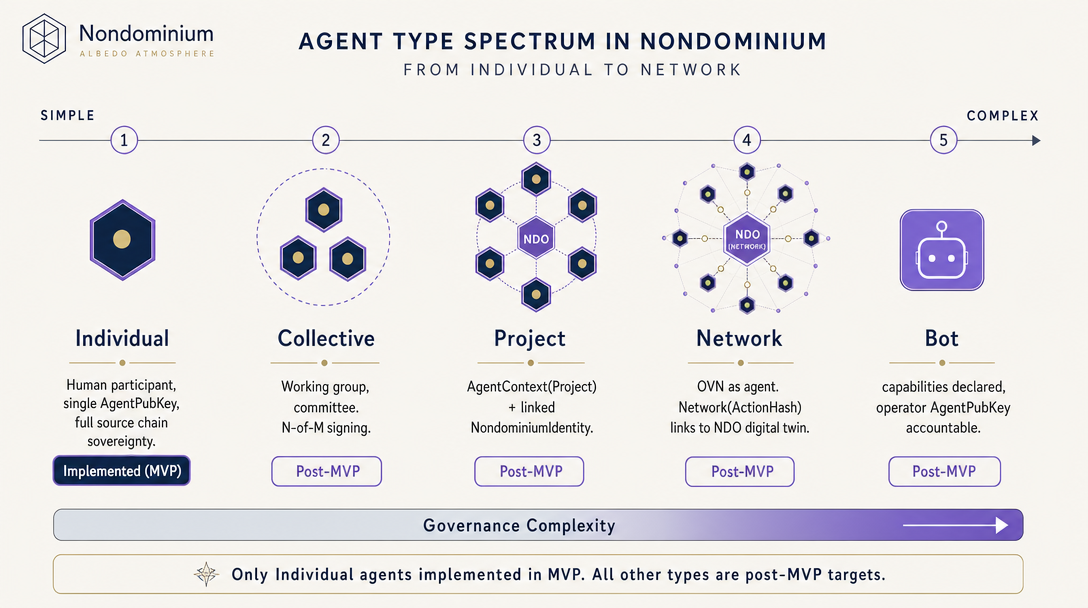
MVP implements Individual only. Post-MVP targets: Collective (working groups, N-of-M signing), Project (AgentContext + linked NondominiumIdentity digital twin), Network (OVN as agent), Bot (capabilities declared, operator accountable). Governance complexity increases rightward.
The OVN wiki defines agents as: "anything that can perform an action. Has agency, i.e. can also plan to take actions. Agents can be individuals, groups, projects, networks. Agents can also be bots, machines (IoT)."
This spectrum is essential. In a P2P complexity economics framework, the system must model:
- Individual agents: human participants, each with a source chain
- Collective agents: groups, working groups, communities — entities with collective agency
- Project/venture agents: temporary organised efforts with their own goals and resources
- Network agents: larger-scale communities (an OVN as a whole is also an agent in its ecosystem)
- Artificial agents: bots, AI models, IoT devices — increasingly significant actors in the commons
The current NDO models only individual agents. This is a significant constraint for the generic NDO project, which aims to support Sensorica-style open value networks where ventures, networks, and partner organisations are themselves agents in economic processes.
1.3 Individual vs Person — The Two Layers of Agent Identity
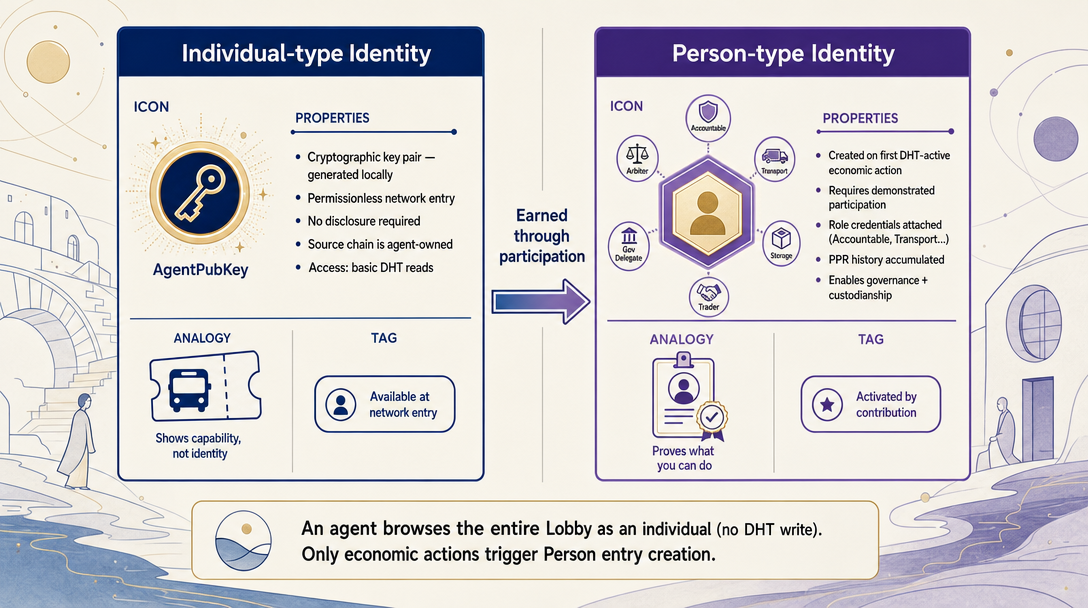
Individual-type identity: cryptographic key pair, permissionless entry, no disclosure required — like a bus ticket. Person-type identity: created on first DHT-active action, role credentials, PPR history, enables governance and custodianship — like a medical credential. The progression is earned through participation, not granted.
The OVN wiki makes a distinction of deep philosophical and technical importance:
"An individual is the physical you. You exist and therefore you have access to certain things. A person is a representation of the physical you, it is an agent in a socio/economic context."
In practical terms:
- Individual-type identity: exists by virtue of holding a cryptographic key pair. Permissionless access. No disclosure required. Like Bitcoin: you only need keys to transact. This is the foundation of the NDO's permissionless entry model.
- Person-type identity: requires reputation, credentials, or demonstrated capabilities earned through participation. Required for sensitive processes: governance participation, custodianship, specialised service provision.
This two-layer model is not bureaucratic gatekeeping — it is a precise answer to the information-theoretic question: "what does this process require to function well?" Taking the bus requires a ticket, not identification. Performing surgery requires credentials. The NDO must distinguish which processes are ticket-level (individual-type) and which require person-type identity, and build the appropriate mechanisms for each.
In complexity economics terms: forcing all interactions through person-type identity is a high information-overhead solution applied to low-information-need situations. It reduces participation, increases friction, and creates centralisation risks (who issues the credentials?). The OVN model, and therefore the NDO model, reserves person-type identity for the specific processes that genuinely need it.
1.4 Identity ≠ Credentials
The OVN wiki offers a clarifying thought experiment: "When you take the bus you don't need to tell the driver all about yourself before boarding, you just show your ticket, which is the credential required to access the transportation service."
Credentials are context-specific access tokens derived from past actions or present conditions. They are not identity. You can prove you can safely use a 3D printer (credential) without revealing who you are (identity). This distinction, made precise through zero-knowledge proof technology, is the foundation for privacy-preserving participation in P2P systems.
The implications for NDO agent design: the system should be designed so that agents prove what they can do through minimally-revealing credentials, not by revealing who they are through full identity disclosure. This is currently only partially implemented: the PPR system generates verifiable contribution records (a form of capability credential), but there is no ZKP layer to share them without revealing the underlying data.
1.5 Agent as Network Node: Social Capital and Interconnection
The OVN wiki's individual profile description captures a dimension of agents often overlooked in technical implementations: an agent's profile includes "social relations (connections with other agents), which can be seen as social capital, may be shared in context / processes, part of the wealth structure of a network" and "network affiliations."
Social capital — the value embedded in relationships and network position — is an intangible resource that the NDO system should make legible, not obscure. In complexity economics, information flows through social networks, and an agent's connectivity is a measure of their access to collective intelligence. The individual profile should capture relational wealth, not just transactional history.
1.6 The Long Tail of Agent Engagement
From the governance archive, the OVN operates with a 1-9-90 engagement distribution: 1% core (entrepreneurial, high commitment), 9% active contributors, 90% occasional participants. This is not a design flaw — it is universal in open networks. The agent model must be designed for this reality.
An agent system designed only for the 1% (assuming high engagement, rich profiles, continuous participation) will exclude the 99% who should still be able to participate meaningfully at their actual engagement level. The affiliation model (unaffiliated → close → active → core) is the OVN's answer to this: design for the full spectrum, not just the core.
2. Current Implementation (MVP)
2.0 Three-Level Identity Model (UI)
The MVP UI introduces three distinct identity layers that reflect the Lobby → Group → NDO hierarchy defined in ui_design.md. These layers are intentionally separate: they allow progressive disclosure of personal information and defer DHT costs until the agent acts.
Level 1 — Lobby (UI-only, localStorage)
LobbyUserProfile is the outermost, lightest identity layer. It is never written to the DHT.
| Field | Required | Notes |
|---|---|---|
nickname | Yes | Displayed in the Lobby profile bar and Group profile |
realName | No | Optional; user controls whether it is shared in groups |
bio | No | Optional |
email | No | Optional |
phone | No | Optional |
address | No | Optional |
- Stored in
localStorageunder the keyndo_lobby_profile_v1. - Written to
app.context.lobbyUserProfile(Svelte$state) on every page load. - Created via
UserProfileForm.svelte(modal on first launch; page-mode for editing). - Exists before any
PersonDHT entry is created. An agent can browse the Lobby anonymously (no profile) or under a pseudonym (nickname only).
Level 2 — Group (GroupMemberProfile, localStorage presentation + Group DNA membership)
Groups are DNA-backed: each group is a cloned Group cell (clone_cell with unique network_seed). GroupProfile and membership live on the group DHT via zome_group (create_group, join_group, get_group_members). The Lobby DNA announces groups for discovery (announce_group).
GroupMemberProfile is a per-group presentation choice derived from LobbyUserProfile. It controls how much of the Lobby profile the agent consents to show other group members. It is not the same as DHT membership — it is a UI-only disclosure layer.
| Field | Type | Notes |
|---|---|---|
isAnonymous | boolean | If true, the agent appears only by pseudonym |
shownFields | (keyof LobbyUserProfile)[] | Fields from LobbyUserProfile the agent explicitly consents to share |
- Stored in
localStorageunderndo_group_profiles_v1, keyed by groupnetwork_seed(not inGroupProfileentry). - Prompted via
GroupProfileModal.svelteon first entry to each group. - NDO-level pseudonymity: an agent may browse the Lobby with no profile, join groups under a nickname-only presentation (Level 2 anonymous), and defer creating a
Personentry until a DHT-active economic action (Level 3).
Level 3 — NDO / Agent (DHT, zome_person)
Person is the public, on-chain agent profile. It is created when the agent performs their first DHT-active action — creating an NDO, joining an NDO, or accepting a commitment. This layer corresponds to the "person-type identity" described in §1.3.
- Written to the NDO's DHT via
create_personinzome_person. - Linked to the agent's
AgentPubKeythrough Holochain's source chain. - Required for governance participation, custodianship, and specialised service provision.
- Discoverable by other agents via the
all_personsanchor.
This three-level model enables permissionless browsing (Level 1 not required), group participation under a pseudonym (Level 2), and full economic participation (Level 3), without conflating disclosure requirements across contexts.
Cross-reference:
ui_design.mdMVP section describes the intended UI flow. Implementation lives inapp.context.svelte.ts(lobbyUserProfile),lobby.service.ts(Group DNA +saveGroupMemberProfile),group.service.ts(getMembers, SoftLinks),UserProfileForm.svelte,GroupProfileModal.svelte, andSidebar.svelte.
2.1 The Two-Layer Identity Model in Code
The NDO MVP implements the individual/person distinction at the data model level:
Individual layer — the Holochain AgentPubKey:
- Cryptographic key pair generated locally by the agent
- Source chain is agent-owned and agent-controlled
- Permissionless network entry (
validate_agent_joiningreturnsValidateCallbackResult::Validunconditionally) - No disclosure required for basic read access to the DHT
Person layer — the Person entry (public) + PrivatePersonData entry (private):
#![allow(unused)]
fn main() {
pub struct Person {
    pub name: String,
    pub avatar_url: Option<String>,
    pub bio: Option<String>,
}

pub struct PrivatePersonData {
    pub legal_name: String,
    pub email: String,
    pub phone: Option<String>,
    pub address: Option<String>,
    pub emergency_contact: Option<String>,
    pub time_zone: Option<String>,
    pub location: Option<String>,
}
}
Person entries are the public identity anchor — discoverable via the AllPersons anchor, versioned (via PersonUpdates links), and permanently immutable once created (validate_delete_person returns Invalid). They cannot be deleted: consistent with the OVN principle that contribution records and identity anchors must be permanent.
PrivatePersonData is a Holochain private entry stored only on the agent's source chain, accessible to others only through explicit capability grants.
2.2 The Capability-Based Private Data System
The MVP implements a sophisticated field-level capability sharing system for private data:
PrivateDataCapabilityMetadata: tracks each capability grant issued by an agent:
granted_to,granted_by,fields_allowed(subset of: email, phone, location, time_zone, emergency_contact, address)context: why the access was grantedexpires_atwith a hard-coded 30-day maximum durationcap_secret: stored locally for revocation
RevokedGrantMarker: explicit revocation record (important because Holochain native capability revocation is silent — this creates an auditable revocation trail)
FilteredPrivateData: the view of private data after capability filtering — what the other agent actually sees given their access level
This system implements the OVN principle of "absolute privacy by default" with agent-controlled selective disclosure. The legal_name field is notably never shared (not in allowed_fields), preserving the individual/person separation at the field level.
2.3 The Role System — Four Capability Levels
The MVP implements a six-role system across two dimensions:
Governance tiers (progressive trust levels):
SimpleAgent(member) — permissionless entry; basic participationAccountableAgent(coordination) — validated private identity; can validate others; can initiate process commitmentsPrimaryAccountableAgent(governance) — highest trust; can promote agents; can approve governance decisions
Functional service roles (validated competencies):
Transport,Repair,Storage(stewardship level)
Capability level hierarchy: member < stewardship < coordination < governance
The promotion workflow is a cross-zome interaction:
SimpleAgent → Accountable:
  1. Agent calls request_role_promotion("Accountable Agent")
  2. System validates private data exists (legal_name, email required)
  3. Cross-zome call: governance.validate_agent_for_promotion()
  4. Accountable/Primary agent approves: approve_role_promotion()
  5. Cross-zome call: governance.validate_agent_identity() (with first_resource_hash)
  6. Role entry created and linked to Person

Accountable → Primary:
  1. Requires PPR milestones (governance_claims in ReputationSummary)
  2. Specialized role validation for functional roles
  3. Governance-level approver required
The promotion workflow correctly implements the OVN's "access to governance is earned through contribution" principle. Simple agents exist (permissionless) but cannot act as validators or custodians without establishing person-type identity.
2.4 Multi-Device Agent Architecture
The MVP's most technically sophisticated agent-layer contribution: a clean many-to-many Agent ↔ Person relationship model.
AgentPersonRelationship: explicitly models the link between a cryptographic key (AgentPubKey) and a persistent identity (Person hash):
relationship_type:Primary(initial device),Secondary(additional devices),Device(dedicated device agents)
Device entry: tracked per physical device with device_id, device_name, device_type (mobile/desktop/tablet/web/server), registration, last-active timestamps, and revocable DeviceStatus.
Bidirectional links: AgentToPerson (key to identity) and PersonToAgents (identity to all associated keys) enable multi-device coordination without leaking any of the devices' keys.
This is a forward-looking implementation: one person may use Nondominium from a phone, a desktop, and a shared lab computer. Each device has its own key. All keys are controlled by the same person. The Person is the persistent socio-economic identity; AgentPubKeys are the session-level cryptographic instruments.
2.5 What the MVP Does Well
- The individual/person dual layer correctly implements OVN's identity model: permissionless individual access + earned person-type credentials
- Permanent identity anchors (Person entries cannot be deleted): enforces the OVN principle that contribution history cannot be retroactively erased
- Field-level capability grants with 30-day expiry and explicit revocation are privacy-first by design, consistent with the OVN's "absolute privacy by default" principle
- Multi-device architecture is pragmatic and technically sound — most systems ignore this, resulting in brittle single-key identities
- The cross-zome promotion workflow is correctly designed: role assignment requires governance validation, not just peer-to-peer agreement
- Functional roles as validated competencies (not just trust levels) introduce the credential concept correctly, even if without portability
2.6 Known Gaps in the MVP
| Gap | OVN relevance | Impact |
|---|---|---|
| Only individual agents | OVN: groups, projects, networks, bots are also agents | Cannot model collective agency, AI participants, or network-level actors |
| Person profile is minimal (name/avatar/bio) | OVN: profile contains contributions, roles, artifacts, social relations, affiliations | Cannot produce a rich agent profile for governance or contribution accounting |
| No contribution aggregation in profile | OVN: profile is "window into the past" and "predictive tool" | ReputationSummary is separate; not discoverable as part of agent profile |
| No credential portability | OVN: profile must be portable across networks | Roles and PPRs are local to this DNA instance |
| Roles are closed (6 predefined) | OVN: roles emerge from community needs | Communities cannot define their own role taxonomies |
| No zero-knowledge proofs | OVN: "prove capability without providing access to data" | Agents must reveal private data to prove eligibility |
| No affiliation types | OVN: unaffiliated / close / active / core / inactive spectrum | Cannot model the long tail of engagement; all non-members look the same |
| No social graph | OVN: social relations are part of profile / social capital | Cannot surface network wealth or organisational reach |
| No agent type taxonomy | OVN: individual, group, project, network, bot | Everything is modeled as an individual human |
| Promotion is partially stubbed | request_role_promotion returns a placeholder hash | Promotion requests cannot be queried or tracked |
| Legal_name is never shared | Appropriate for most use cases but inflexible | Cannot support cases where legal identity sharing is required (e.g., insurance, legal agreements) |
| No cross-app identity or DID | OVN: portable profile across networks; agents as bridge nodes between OVNs | Agents cannot prove they are the same person on another Holochain app; reputation and roles stay local to this DNA. Planned: FlowstaIdentity CapabilitySlot on Person hash, W3C DID via Flowsta agent linking (ndo_prima_materia.md Section 6.7) |
| No deterministic key recovery | Permanent Person and PPR model assume long-lived signing keys | Device loss can strand the agent from their source chain and private entries. Planned: Flowsta Vault BIP39 recovery, auto-backup, CAL-compliant export (ndo_prima_materia.md Section 6.7) |
3. Post-MVP Roadmap
3.1 Collective Agents and Their Digital Twins
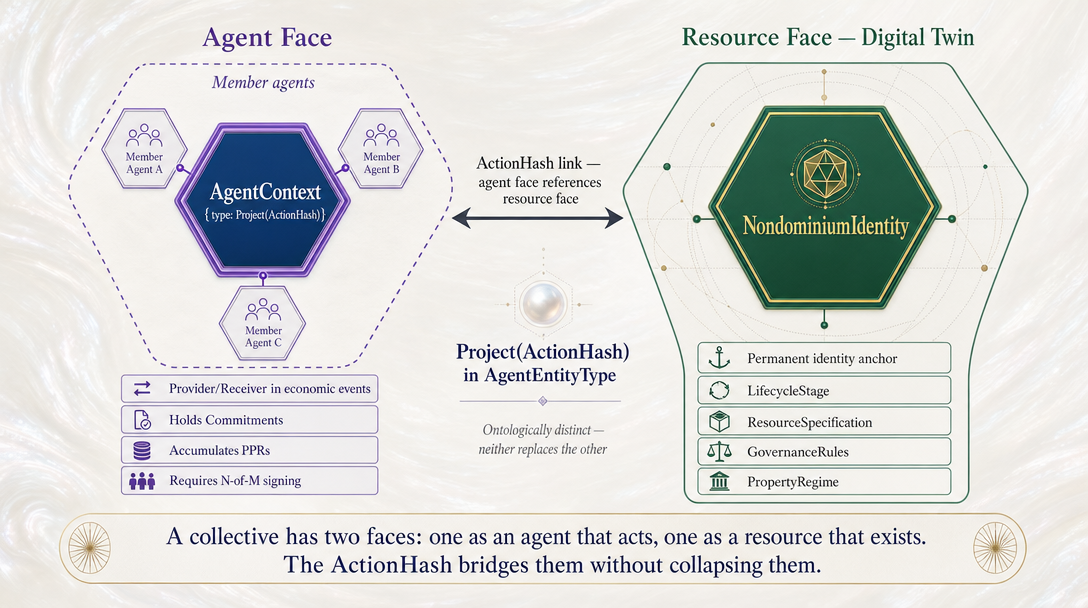
Agent face: AgentContext with member agents, acts as provider/receiver in economic events, accumulates PPRs. Resource face: NondominiumIdentity — permanent anchor, lifecycle, specification, governance rules. The Project(ActionHash) in AgentEntityType bridges them. Neither face replaces the other — they are ontologically distinct.
A collective entity — a project-as-organisation, a cooperative, an open value network — has two distinct ontological faces in the Nondominium model. These faces are different roles the same real-world entity plays, and they must not be collapsed into one.
The agent face is the AgentContext carrying the relevant AgentEntityType variant (Collective, Project, Network). Through this face the collective participates in economic events as provider or receiver, holds commitments, accumulates reputation, and may be the primary_accountable on shared resources. Collective agents of this kind are composed agents or group agents: their actions may require N-of-M authorisation from individual member agents (multi-signature pattern — forward design, post-MVP). This is how REA-ontology-compliant collective economic agency works — it is distinct from the physical thing the collective creates or represents.
The resource face is the NondominiumIdentity — the collective's digital twin as a Nondominium Object. NDOs are Resources, and the resource face of a collective carries its permanent identity anchor, property regime, lifecycle stage, specification (what the collective IS — its mission, assets, rules of participation), and governance rules (how agents interact with it). The resource face does not have agency; it records which agents are associated and under what terms.
The ActionHash inside AgentEntityType::Project(ActionHash) and AgentEntityType::Network(ActionHash) links the agent face to the resource face: it points to the NondominiumIdentity that is the collective's digital twin. The two faces are thus connected by this hash reference.
| Agent face | Resource face | |
|---|---|---|
| Entry type | AgentContext | NondominiumIdentity |
| Role in economic events | Provider / receiver | — (no agency) |
| Accumulates | Reputation (PPRs, EconomicEvents) | Contribution records (individual agents who contributed) |
| Can hold custody | Yes — via AgentContext as primary_accountable | No |
| Has lifecycle/spec/governance | — | Yes — LifecycleStage, ResourceSpecification, GovernanceRules |
| Permanent / immutable | No | Yes — NondominiumIdentity is permanent |
An individual agent can hold a PersonRole in both their own profile and in a collective's governance. Cross-agent capability grants enable a collective's AgentContext to act on behalf of its members (with appropriate authorisation).
A Collective(String) agent (e.g. a working group or committee) may not yet have an associated NDO — its agent face exists independently of any resource face. Attaching a resource face (creating an associated NondominiumIdentity) is optional and done when the collective's digital representation as a Resource becomes useful.
When a collective does have an associated NDO, the NDO's three-layer structure (Identity + Specification + Process) applies to the collective's resource face — not to the collective as an agent:
- NDO Identity layer = the collective's permanent identity anchor (name, regime, nature, creation record)
- NDO Specification layer = the collective's documented form (mission, assets, governance rules for how agents interact with it)
- NDO Process layer = the economic activity around the collective as a resource (contributions, agreements, events involving the collective-as-resource)
The LifecycleStage at registration can be any non-suspend, non-terminal stage (Ideation through Active) so the resource face can anchor an already mature or in-use NDO (e.g. a stable shared tool), not only an emerging project. Profiles or wizards may suggest a narrower subset for specific organisation types — for example a short-lived working group often stays in emergence — but that is UX guidance, not an ontology constraint on NondominiumIdentity. Hibernating, Deprecated, and EndOfLife remain transition-only after creation. The PropertyRegime and ResourceNature fields on NondominiumIdentity remain applicable to the collective's resource face: a working group's shared knowledge base is a Commons/Digital NDO; a collectively owned workshop maps to a Collective or Pool physical NDO in the UI's seven-regime model.
3.2 CapabilitySlot on Agent Identity
The NDO CapabilitySlot surface (from ndo_prima_materia.md) can be extended to agent identities: an agent's Person entry hash becomes a stigmergic attachment point for external applications — credential wallets, reputation oracles, DID documents, professional networks — without modifying the core Person entry. This is the agent-level equivalent of the resource-level CapabilitySlot.
Flowsta Auth (ndo_prima_materia.md Section 6.7) is the first specified implementation: a FlowstaIdentity CapabilitySlot from the Person entry hash to an IsSamePersonEntry (dual-signed attestation: NDO agent key + Flowsta Vault key), yielding a W3C DID (did:flowsta:uhCAk...) without changing the Person schema. Full architecture, two-tier identity authority, and integration phases are summarised in Section 3.5 below.
3.3 Composable Profile Aggregator
A post-MVP AgentProfile view that composes:
Person(public identity)ReputationSummary(derived from PPRs)PersonRolelist- Participation statistics (economic event counts by category)
- Capability slot attachments (external credentials, DIDs)
This view is not stored as a new entry type — it is computed from existing DHT data. But exposing it as a queryable composite is the key step toward the OVN individual profile model.
3.4 Credential Portability via Holochain Membrane Proofs
Post-MVP: a mechanism to export cryptographically signed summaries of an agent's role assignments and ReputationSummary that can be verified by other Holochain networks. This implements the OVN requirement for portable identity: a person's contribution track record in one community should be recognisable in another.
Flowsta agent linking provides a cross-app identity anchor (DID) so ReputationSummary and participation history can be attributed across Flowsta-linked apps; full PortableCredential structures (this document, Section 6.5) remain the NDO-native export path — the two are complementary (ndo_prima_materia.md Section 6.7, PPR cross-app attribution).
3.5 Flowsta Integration (flowsta-integration.md)
Decentralized identity and authentication for Holochain apps: agent linking commits IsSamePersonEntry on this DNA via flowsta-agent-linking zomes; FlowstaIdentity CapabilitySlot on the agent's Person entry hash points to that attestation. Tier 1 (Flowsta Phase 1): permissionless self-attestation (trust signal; REQ-NDO-CS-12/CS-13). Tier 2 (Flowsta Phase 3): governance can require a valid Flowsta link for sensitive transitions (e.g. PrimaryAccountableAgent promotion, high-value custody) via IdentityVerification-style rules (REQ-NDO-CS-14/CS-15). Flowsta Vault: BIP39 recovery, encrypted auto-backups, CAL-aligned export — addressing the gap between permanent Person/PPR anchors and real-world key loss. OAuth-only path (@flowsta/auth): consistent DID across web apps while the app keeps its own Holochain keys (Flowsta docs "Option 1"); Vault path ("Option 2") is the one that produces IsSamePersonEntry on the NDO DHT. See ndo_prima_materia.md Section 6.7 and Section 11.6; see also resources.md Section 3.8 for resource-ontology cross-links.
4. OVN Agent Ontology: 15 Years of Practice
4.1 Agent Type Taxonomy
The OVN wiki classifies agents into four primary types:
| Agent type | Examples | NDO support |
|---|---|---|
| Individual | Human participants, affiliates | ✅ Implemented (Person + AgentPubKey) |
| Group/Collective | Working groups, committees | ❌ Gap: no collective agent type |
| Project/Venture | An open hardware project, a design sprint | ❌ Gap: ventures are implicit in resources, not agents |
| Network | An OVN as an entity in the ecosystem | ❌ Gap: no network-level agent |
| Artificial | Bots, AI models, IoT devices | ❌ Gap: no bot/machine agent type |
In the REA model used by Sensorica, economic agents can represent:
- An individual
- A project/venture (another network or autonomous open business unit)
- Another network (cross-OVN interactions)
- A traditional organisation (partner, supplier, funder)
The NDO currently only models the individual case. For the generic NDO to support Sensorica-style operations, at minimum group/collective and project/venture agent types are needed.
Complexity economics note: The omission of collective agents is not just an inconvenience — it makes it impossible to model the actual economic events in many commons-based peer production contexts. When Sensorica licenses a sensor to a university, the economic agents are Sensorica (a network) and the university (a traditional organisation), not individual humans. Without collective agent types, the economic model is systematically misrepresented.
4.2 The Affiliation Spectrum
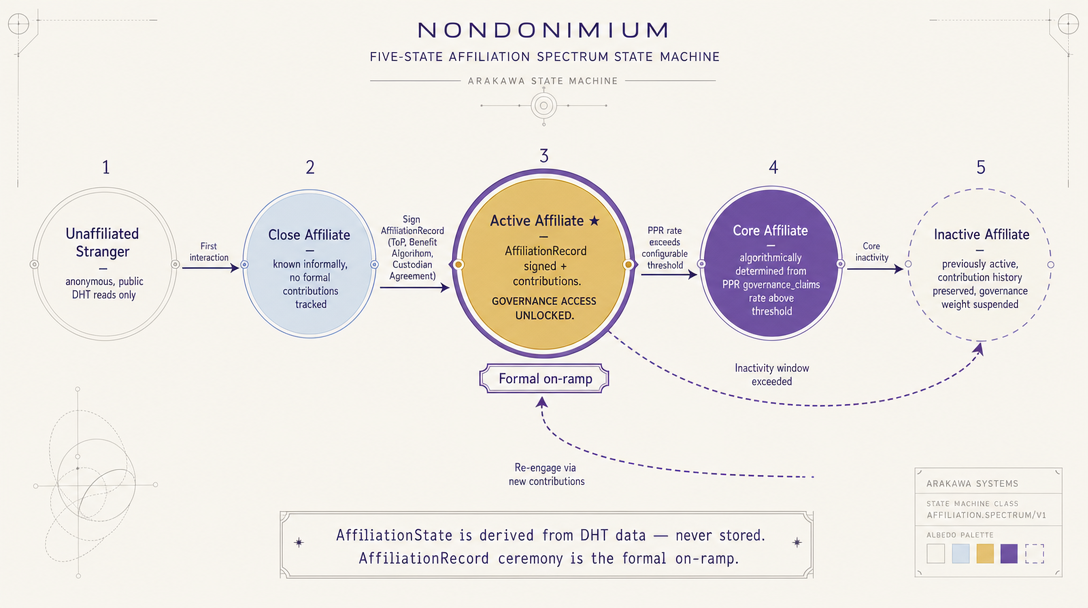
Five states: UnaffiliatedStranger → CloseAffiliate → ActiveAffiliate (governance gate, requires AffiliationRecord signing) → CoreAffiliate (algorithmically determined from PPR rate) → InactiveAffiliate (contribution history preserved). Re-engagement via new contributions. AffiliationState is derived from DHT data — never stored.
The OVN wiki defines five affiliation states that capture the long tail of participation:
Unaffiliated: anonymous; accesses public information only; no obligations; not known by affiliates.
Close affiliate: not yet contributed in a trackable way; known by some affiliates; can access database and some activities; no formal obligations but respects OVN's assets.
Active affiliate: has logged contributions in the NRP-CAS AND is recognised by the community; has access to OVN infrastructure, governance, and production assets; must adhere to the Benefit Redistribution Algorithm and affiliation conditions.
Core affiliate: algorithmically selected from active affiliates based on contribution + reputation; special privileges within specific projects or ventures; status is dynamic (in/out based on contribution; can expire through inactivity).
Inactive affiliate: previously contributed, currently inactive; access to some activities; can re-engage by contributing again.
Formal affiliation: becoming an active affiliate formally consists of:
- Acknowledging the Affiliate Handbook
- Acknowledging the Nondominium & Custodian agreement
- Signing the "Acknowledgement of Knowledge Commons" agreement
- Signing the Benefit Redistribution Algorithm agreement
The NDO currently has only two states: joined (has a Person entry) and not joined. There is no modelling of engagement depth, affiliation conditions, formal affiliation agreements, or the core/active/close/inactive spectrum. This means the system cannot algorithmically determine who should participate in a governance decision (active affiliates only? core affiliates? anyone with a Person entry?), cannot manage the onboarding process, and cannot track affiliation lifecycle.
4.3 The Individual Profile as Composable Aggregate
The OVN wiki defines the individual profile as "a digital environment that aggregates information and data about Agents." Key properties:
Composable: can contain roles, reputation, contributions, artifacts, social relations, network affiliations, credentials, available assets, needs/wants.
Standard format: portable across contexts.
Non-transferable: cannot be reassigned from one individual to another (analogous to soul-bound tokens). The link to the physical self must be unique.
Portable: "An individual can participate in more than one OVN simultaneously... enables the individual to transport his/her reputation and credentials from one cluster of economic activities to another."
Owner-controlled: the agent controls what is shared, with whom, for what purpose, and for how long. But crucially: some parts are write-protected — "applications can write data about contributions, roles, and reputation, which cannot be deleted by the affiliate in question." This is exactly what the NDO implements with immutable Person entries and private-but-signed PPRs. The profile owner cannot delete their contribution history, but controls what they reveal.
Predictive: "can be used as a predictive tool, to judge if a future action or relation would be beneficial."
Agency-extended: "The individual profile can even have agency in the digital world. It can be AI-enhanced to act on behalf of the real agent in some circumstances, sign contracts based on predefined rules."
The NDO currently splits what should be the individual profile across at least four separate concepts: Person, PrivatePersonData, ReputationSummary, and PersonRole. These are correct building blocks but lack the composable aggregation layer that would make the profile a genuine OVN individual profile.
4.4 Identity Architecture: SSI, DIDs, VCs, ZKP
The OVN wiki synthesises the state of the art in decentralised identity:
Self-Sovereign Identity (SSI): The individual controls their own identity data; no third party can revoke or modify it without the individual's consent. Roles in the SSI ecosystem: issuer (issues credentials), wallet (stores and provides), validator (requests and obtains), revoker.
Decentralised Identifiers (DIDs): W3C-standardised unique identifiers for individuals and organisations that are independent of any centralised registry, resolved through decentralised systems. DIDs enable "a direct, encrypted channel for p2p communication" and portability from one transport or security context to another.
Verifiable Credentials (VCs): "Sets of claims about an agent of which the provenance and immutability can be proved." ZKP-compatible: an agent can prove "I have a credential that satisfies condition X" without revealing the credential's full contents.
Soul-bound tokens: non-transferable, non-sellable reputation tokens. The OVN wiki references these as one potential mechanism for non-transferable credentials. The NDO's Person entries (non-deletable) and PPRs (bilaterally signed, private) are soul-bound-like, but not interoperable with external VC/DID ecosystems.
Portability challenge: "I can gain some credentials based on activities in one organization/context and have that, or only a part of it, being recognized in another context." This is the core portability requirement. The technical path: ZKP-based proofs from Holochain source chains that can be verified by other Holochain networks or other distributed systems.
Near-term bridge — Flowsta: Flowsta supplies W3C DIDs and dual-signed agent linking (IsSamePersonEntry on the NDO DHT, ndo_prima_materia.md Section 6.7) so the same human can be recognised across Holochain conductors without shared DNA. PrivateParticipationClaim entries remain non-transferable and bound to the local AgentPubKey; reputation summaries can nevertheless be attributed to a DID for cross-app trust — the same distinction as resources.md Section 4.6 (attribution portability is not claim transferability). REQ-NDO-AGENT-08 positions the Flowsta DID as the cross-network identity anchor for portable credentials. ZKP/VC layers remain the longer-term path for minimally revealing proofs at scale.
The identity insurance alternative: the OVN wiki cites Vinay Gupta's proposal that what P2P systems need is not reputation but restorative justice — insurance that compensates you if an agent acts in bad faith. "If I present you with proof that I am insured against bad conduct, and you trust my insurer will pay, REPUTATION is suddenly a whole bunch less important." This is a provocative alternative to the PPR approach: rather than tracking reputation to prevent bad actors, use economic backstops to make bad acting unprofitable. The NDO's Unyt Smart Agreement integration could potentially implement this pattern.
4.5 Privacy vs Network Efficiency
The OVN wiki frames this as a genuine tension with no universal solution: an agent's contribution history can improve network efficiency (matching to tasks, governance access, trust in new interactions) but also creates a privacy risk (triangulation of physical identity, de-platforming vulnerability).
The OVN wiki's resolution: "the agent must be given the choice, allow an individual profile to be formed from past activity or not, weighing the pros and cons, the benefits and the potential harm." The NDO's private-but-derivable PPR system partially implements this: agents sign PPRs (opting into accountability) but control how their ReputationSummary is shared. The gap is that there is currently no mechanism for an agent to participate partially — all PPRs follow the same model.
A more complete implementation would allow agents to choose their privacy level per interaction:
- Full anonymity: no PPRs, no reputation accumulation, no access to governance
- Pseudonymous: PPRs linked to a persistent pseudonym, not to physical identity
- Named: PPRs linked to public Person entry
This spectrum maps to the OVN's individual/person identity model: individual-level participation (anonymous), person-level participation (reputation-accumulating), and fully identified participation (legal accountability for high-trust processes).
4.6 Agent Profile and Network Wealth
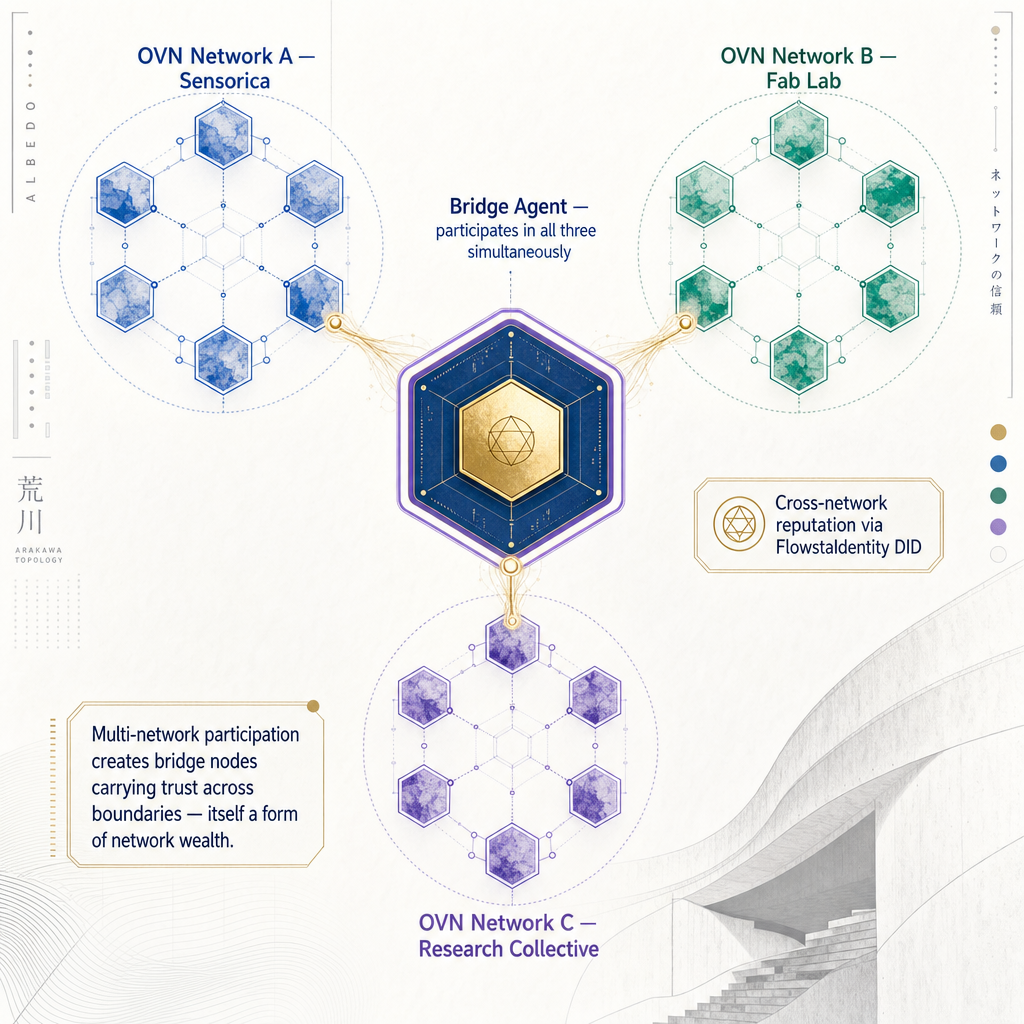
An agent participating in Sensorica, a Fab Lab, and a Research Collective simultaneously is a bridge node — carrying trust, information, and potential collaboration across network boundaries. Multi-membership and cross-network reputation (via FlowstaIdentity DID) are themselves a form of network wealth.
The OVN wiki's individual profile description includes something not present in most technical systems: network affiliations as a form of organisational wealth. "The information about affiliations can be used... to assess the organic reach into other organisational contexts, beyond the immediate zone of influence of the context. This allows surfacing of a new form of network wealth, its influence or degree of connectivity with other networks within the ecosystem, provided by the number of relations extending from the context network to other networks, through agents."
An agent who participates in multiple OVNs is a bridge node — a carrier of information, trust, and potential collaboration across network boundaries. This agent's profile is not just a personal record; it is a piece of the network's connective tissue. Making this visible makes the network's resilience and reach legible.
The NDO currently has no social graph and no multi-network affiliation model. An agent is either in this network or not. The generic NDO should model the OVN's insight that agents are simultaneously nodes in multiple overlapping networks, and that this multi-membership is itself a form of value.
5. Gap Analysis
5.1 Mapped — OVN concepts implemented or planned in NDO
| OVN concept | NDO implementation | Status |
|---|---|---|
| Individual/person identity distinction | AgentPubKey (individual) + Person entry (person-type) | ✅ Implemented |
| Permissionless individual-level access | validate_agent_joining unconditional pass | ✅ Implemented |
| Owner-controlled private data with selective disclosure | PrivatePersonData + field-level capability grants | ✅ Implemented |
| Non-transferable, non-deletable identity anchor | Person entries are permanent (delete validation returns Invalid) | ✅ Implemented |
| Earned access to sensitive processes | Role promotion requiring private data validation | ✅ Implemented |
| Contribution history write-protected from owner | Bilaterally signed PPRs cannot be unilaterally deleted | ✅ Implemented |
| Multi-device support | Agent-Person many-to-many relationship model | ✅ Implemented |
| Capability expiry and explicit revocation | 30-day max grants + RevokedGrantMarker | ✅ Implemented |
| Composable profile building blocks | Person + PrivatePersonData + PersonRole + ReputationSummary | ✅ Partial (separate, not aggregated) |
| Functional role credentials | Transport / Repair / Storage validated competency roles | ✅ Implemented |
| Cross-app identity / DID (agent) | FlowstaIdentity CapabilitySlot + Flowsta agent linking (ndo_prima_materia.md Section 6.7) | 🔄 Planned (post-MVP) |
| Agent key recovery (Vault) | Flowsta Vault BIP39, auto-backup, CAL export (ndo_prima_materia.md Section 6.7) | 🔄 Planned (post-MVP) |
5.2 Partial — concepts present in OVN and partially covered in NDO
| OVN concept | NDO partial coverage | Gap |
|---|---|---|
| Affiliation spectrum | Joined (has Person) vs not joined | No close/active/core/inactive states; no affiliation conditions |
| Active affiliate = contribution + recognition | SimpleAgent → Accountable promotion is contribution-gated | Recognition is informal; no algorithmic determination of active affiliate status |
| Core affiliate = algorithmically selected | PPR-based ReputationSummary provides the data | No algorithm using PPR data to compute core affiliate status |
| Portability | Roles and PPRs are local | No export mechanism; no VC/DID interoperability yet. Planned: cross-app attribution via Flowsta DID + FlowstaIdentity slot (ndo_prima_materia.md Section 6.7); NDO-native PortableCredential export (this document, Section 6.5) remains complementary |
| Privacy vs efficiency trade-off | Agents can share ReputationSummary selectively | No per-interaction privacy level choice; no pseudonymous participation mode |
| Agent-controlled profile sections | Private data share controlled | No mechanism to protect some sections while exposing others; no correction mechanism for contributions |
5.3 Missing — OVN concepts not yet planned in NDO
| OVN concept | Gap description | Proposed resolution |
|---|---|---|
| Agent type taxonomy (individual, group, project, network, bot) | Only individual agents exist | Model collective agents as NDOs with their own governance; add AgentType to person context |
| Composable individual profile | Profile is split across unconnected entries | Build AgentProfile as a composable view aggregating Person, PPR summary, roles, capability slots, affiliations |
| Social graph (social capital, network relations) | No peer relationships modeled | Add AgentRelationship link type: bidirectional, typed (colleague, collaborator, trusted, etc.), private |
| Network affiliations | Only single-network membership | Model cross-network affiliations as links from Person to other NDO instances |
| Affiliation conditions (formal ToP agreements) | No affiliation ceremony | Add AffiliationRecord: a hash-referenced acknowledgement of Terms of Participation + benefit redistribution agreement |
| Affiliation lifecycle (active/core/close/inactive) | Binary in/out membership | Derive affiliation state algorithmically from PPR activity + recency; expose as queryable status |
| Zero-knowledge capability proofs | Must reveal raw data to prove eligibility | Integrate ZKP library or ZKP-compatible VC layer; allow prove_capability(condition) without data disclosure |
| Credential portability (across networks) | Roles and PPRs are local | Flowsta W3C DID + FlowstaIdentity CapabilitySlot on Person hash as cross-network identity anchor (REQ-NDO-AGENT-08, ndo_prima_materia.md Section 6.7); and define a PortableCredential structure: signed summary of roles + PPR statistics, verifiable by other Holochain networks |
| Sybil resistance mechanism | No proof-of-personhood | Optional Tier 2 governance requirement for verified Flowsta identity (REQ-NDO-CS-14) for high-trust roles; complements social vouching (existing agents vouch for new agents), biometric opt-in, or Proof-of-Personhood integration as optional membrane proof |
| Pseudonymous participation mode | Contribution always linked to AgentPubKey | Allow ephemeral agents (agent contributes under a temporary key without linking to Person); contribution is recorded but unlinkable to physical identity |
| Agent AI/bot delegation | Agents must act manually | Define a DelegatedAgent relationship: a Person can authorise an AI agent to act on their behalf within defined scope |
| Needs and wants in profile | Not modeled | Add AgentNeedsWants as an optional profile extension: what resources the agent needs and what they can offer; enables matching |
6. Forward Map: Generic NDO Agent Architecture
6.1 Agent Type as Configuration, Not Hard-Code
Rather than adding parallel code paths for each agent type, the generic NDO should treat agent type as a configuration property:
#![allow(unused)]
fn main() {
pub enum AgentEntityType {
    Individual,                    // Human participant
    Collective(String),            // Group/working group (name/description)
    Project(ActionHash),           // Project NDO this agent represents
    Network(ActionHash),           // Network NDO this agent represents
    Bot { capabilities: Vec<String>, operator: AgentPubKey }, // AI/bot with declared capabilities
    ExternalOrganisation(String),  // Traditional org (name, for partner modelling)
}

pub struct AgentContext {
    pub agent_type: AgentEntityType,
    pub person_hash: Option<ActionHash>,   // None for bots/external orgs
    pub created_at: Timestamp,
    pub network_seed: String,              // Which NDO network this context belongs to
}
}
Individual agents have AgentEntityType::Individual with a linked Person. Collective agents (working groups, projects) reference an NDO hash. Bots have no Person but have declared capabilities and a responsible operator.
6.2 Affiliation State as a Derived Property
Rather than storing affiliation state (which would need maintenance and could become inconsistent), derive it algorithmically from existing DHT data:
affiliation_state(agent) = f(
    person_exists(agent),                   // Boolean
    contributions_count(agent),             // From economic events
    last_contribution_timestamp(agent),     // Recency from economic events
    reputation_summary.total_claims,        // From PPRs
    affiliation_record_exists(agent),       // Has the agent signed the ToP?
    governance_claims_count(agent)          // From PPRs
)

→ UnaffiliatedStranger | CloseAffiliate | ActiveAffiliate |
  CoreAffiliate | InactiveAffiliate
CoreAffiliate is algorithmically determined: an active affiliate whose PPR contribution rate in the past N days exceeds a configurable threshold becomes a core affiliate. This implements the OVN governance equation: governance access as benefit derived from contribution activity.
6.3 Composable AgentProfile View
The aggregated individual profile, computed on demand:
#![allow(unused)]
fn main() {
pub struct AgentProfile {
    // Identity layer
    pub agent_pub_key: AgentPubKey,
    pub person: Option<Person>,
    pub affiliation_state: AffiliationState,

    // Capability layer
    pub roles: Vec<PersonRole>,
    pub capability_level: String,           // member/stewardship/coordination/governance
    pub capability_slots: Vec<CapabilitySlotInfo>,  // External credential attachments; includes FlowstaIdentity → IsSamePersonEntry; optional resolved flowsta_did for UI (`ndo_prima_materia.md` Section 6.7)

    // Reputation layer (derived, selectively shared)
    pub reputation_summary: Option<ReputationSummary>,
    pub economic_reliability_score: Option<f64>,    // For Unyt credit limit

    // Participation layer
    pub active_commitments_count: u32,
    pub economic_events_count: u32,
    pub resource_custodianships_count: u32,

    // Social layer (optional, agent-controlled)
    pub network_affiliations: Vec<NetworkAffiliation>,
    pub peer_vouches: Option<u32>,          // Number of vouches from trusted peers

    // Temporal
    pub joined_at: Option<Timestamp>,
    pub last_active_at: Option<Timestamp>,
}
}
This profile is not an entry type — it is a query result, composed from existing entries. The agent controls which sections are exposed by granting access to the constituent entries.
6.4 Affiliation Record — The Terms of Participation Bridge
A lightweight mechanism to record formal affiliation:
#![allow(unused)]
fn main() {
pub struct AffiliationRecord {
    pub agent: AgentPubKey,
    pub network_id: String,                    // Which NDO network
    pub documents_acknowledged: Vec<DocumentAck>,  // Hash + title of each ToP document
    pub signed_at: Timestamp,
    pub signature: Signature,                  // Agent signs the affiliation record
    pub witness: Option<AgentPubKey>,          // Optional vouching agent
}

pub struct DocumentAck {
    pub document_hash: String,         // Hash of the document text
    pub document_title: String,
    pub document_version: String,
}
}
When an agent creates their first Person entry, the UI prompts them to acknowledge the network's Terms of Participation. The acknowledgement is cryptographically signed and stored as an AffiliationRecord. This bridges the OVN's formal affiliation ceremony with the NDO's digital infrastructure.
6.5 Portable Credential Summary
A structure that can be shared with other Holochain networks as proof of contribution and capability:
#![allow(unused)]
fn main() {
pub struct PortableCredential {
    pub issuing_network: String,               // DNA hash of the issuing network
    pub agent: AgentPubKey,
    pub credential_type: PortableCredentialType,
    pub claims: PortableCredentialClaims,
    pub issued_at: Timestamp,
    pub valid_until: Option<Timestamp>,
    pub issuer_signature: Signature,           // Signed by a Primary Accountable Agent
    pub agent_signature: Signature,            // Countersigned by the agent
}

pub enum PortableCredentialType {
    RoleCredential(String),                    // "Accountable Agent in network X"
    ReputationCredential,                      // Aggregated reputation score
    CompetencyCredential(String),              // "Certified 3D printer operator"
    AffiliationCredential,                     // "Active affiliate of network X since date"
}
}
A receiving network can verify the issuer_signature against the issuing network's DNA hash, establishing a cryptographic chain of trust without requiring centralized credential issuers.
Receiving networks may correlate credentials with a Flowsta DID when the issuer also records a FlowstaIdentity link on the agent's Person hash — improving interoperability without making PPR entries themselves transferable.
7. Complexity Economics Justification: Why Each Agent Concept Matters
Agent type taxonomy matters because economic models must faithfully represent economic actors. In Sensorica's actual operations, the entities performing actions are networks, ventures, and partner organisations — not just individuals. Flattening these to individual-human agents produces systematically inaccurate economic accounting. Benkler's P2P advantage — that P2P systems can process more information and model more finely-grained reality — is lost when the agent model is coarser than the actual social structure.
The affiliation spectrum matters because governance decisions made by binary "in/out" membership are weaker than those made by graded participation-aware membership. The governance equation (contribution history → governance access) requires a nuanced engagement model as input. If everyone is either "in" or "out," the governance equation reduces to "everyone who joined gets an equal vote," which ignores the 1-9-90 engagement reality. The result is either oligarchy (the 1% who do all the work decide everything while the 90% technically could override them) or paralysis (decisions require the majority of a population that mostly isn't paying attention).
ZKP capability proofs matter because the current privacy-accountability model forces a false binary: either share raw data (low privacy, high accountability) or share nothing (high privacy, no accountability). Zero-knowledge proofs break this binary. An agent can prove "I have at least 10 completed maintenance commitments" without revealing who the counterparties were, what the resources were, or what the exact performance scores were. This is the technical foundation for privacy-preserving meritocracy — governance access based on contribution without requiring surveillance.
Credential portability matters because the value of contribution data is severely limited if it only functions within a single application instance. An experienced Sensorica contributor who joins a new OVN should be able to leverage their track record. Without portability, every new commons requires starting from zero, creating massive friction to growth of the P2P ecosystem. Benkler's model of the peer production advantage assumes information flows across organisational boundaries — credential portability is the mechanism that makes this flow possible.
Cross-app identity (Flowsta) matters for the same reason credential portability matters: agents who participate in multiple OVNs or hApps are bridge nodes (Section 4.6). Without a verifiable same-person link across conductors, every network treats them as a stranger; sybil pressure and cold-start friction repeat. Flowsta's permissionless Tier 1 keeps overhead low for casual participants; Tier 2 lets communities demand verified identity only where Bar-Yam-style complexity matching says it is worth the coordination cost (high-trust governance, high-value custody).
The composable individual profile matters because an agent's full profile — their roles, contributions, social relations, affiliations, capabilities — is the information substrate for most governance and economic decisions in the commons. If this information is scattered across disconnected entries with no composable view, the information cost of making well-informed decisions is high. Bar-Yam's complexity matching principle: the governance system's access to information about participants must match the complexity of the participation patterns it is trying to govern.
Collective agent types matter because commons-based peer production is fundamentally about collectives. Modelling it as a collection of individual agents without collective agency misses the emergent properties of collaboration. A working group is not just the sum of its members — it has its own identity, its own resource access, its own reputation, and its own governance. Without collective agent types, the NDO cannot model the holonic structure of OVNs: the fact that every entity is simultaneously a whole and a part of a larger whole.
This is a living document. Section 5.3 should be converted into formal requirements as the generic NDO project begins. Section 6 describes design directions, not final specifications. The OVN wiki pages at Agent, Identity, Individual profile, and Organizational structure remain authoritative references for agent design in peer production systems.